Individual Details
Russell Fred "Russ" HELSTERN
(28 Nov 1903 - 25 Aug 1973)

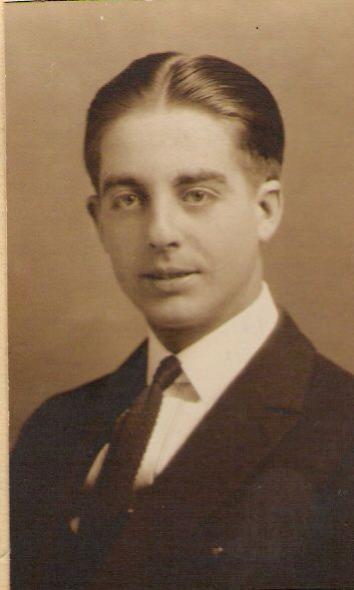
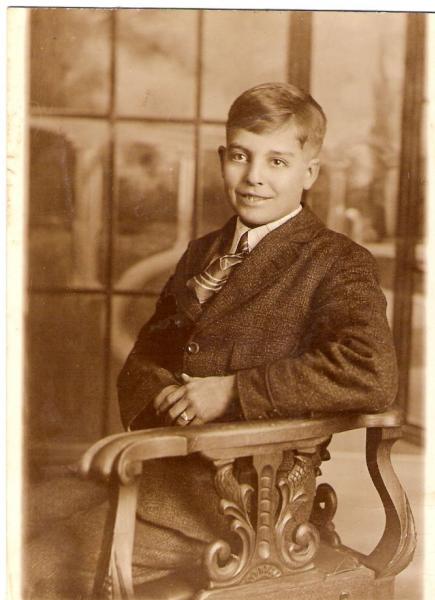
Events
| Birth | 28 Nov 1903 | Dayton OH |  |  | |
| Illness | 1911 | amputation of fingers - Montgomery Co OH | | | |
| Marriage | 16 Apr 1927 | St. Joseph Co. IN - Vinna BOWERS | | | |
| Illness | 1933 | hemolytic spherocytosis requiring surgery - Montgomery Co OH | | | |
| Residence (family) | 1933/34 | in Residence Park with Harold & Teenie - Dayton OH - Vinna BOWERS | | | |
| Ordination | Abt 1940 | Ft. McKinley Church of the Brethren | | | |
| Death | 25 Aug 1973 | Congress, OH | |||
| Burial | Jul 1974 | Ohio State University Medical Center | |||
| Cremation | Jul 1994 | Ohio State University Medical Center | |||
| Occupation | From Abt 1924 to 1963 | public school teacher and guidance counselor - Montgomery Co OH | | | |
| Miscellaneous | From 1911 to 1973 | was involved in Boy Scouts, church camping - Montgomery Co OH | | | |
| Mission | Abt 1910 - 1973 | in peace-making all his life - Montgomery Co OH | | |
Families
| Spouse | Vinna BOWERS (1906 - 1995) |
| Child | Carol Jean HELSTERN (1928 - 2003) |
| Child | Joy Ann HELSTERN (1933 - 2011) |
| Child | Betty Lee HELSTERN (1935 - 1978) |
| Child | Mary Sue HELSTERN (1940 - ) |
| Father | George HELSTERN (1872 - 1937) |
| Mother | Bessie ERBAUGH ( - 1961) |
| Sibling | Harold Emery "Bi" HELSTERN (1899 - 1980) |
| Sibling | Wilbur "Bink" HELSTERN (1901 - 1983) |
| Sibling | Unnamed girl HELSTERN (1902 - 1902) |
Notes
Birth
His birth was not officially recorded in the Montgomery County until sometime after 1945. Instead of a birth certificate, two documents are preserved:I. "IN THE PROBATE COURT OF MONTGOMERY COUNTY, OHIO: In the matter of the Registration of the Birth of Russell Fred Helstern, Certified Copy of Finding and Order, Case No. 103955 Doc. 7"
This document indicates that the court had taken
*1) "the sworn testimony of Bessie Bower [sic], mother of applicant and Samuel Bower [sic], step-father of applicant...
*2) supportive "...documentary evidence as follows: a) The Prudential Insurance Company of America, Policy No. 3038776, issued September 20, 1919... b) Employment Record from Board of Education, Dayton Ohio, dated year 1930....c) School record from Manchester College, North Manchester, Indiana, dated September 18, 1902..."
II. The letter of certification from the Board of Education of the Dayton Schools *2)b) above.
Illness
Remembrances of Vinna (Bowers) Helstern, tape-recorded 1989 by Bob Gross#3B Russ "He was only 8 when those fingers were cut off on New Year's Day. He adjusted to it and didn't have too much trouble with anything he wanted to do. When he graduated from high school, he followed his brothers, applying for a job with the PA RailRoad. He got interviews over and over again, [but] every time he got ready to sign the application and they saw those missing fingers, there was no job. He came home so discouraged day after day. And then, as it came toward fall, his father said, 'Russ hasn't had any luck getting a job. I think when Sept. comes and [Emmert] Bowman, a high school buddy, leaves for college, Russ better go with him.' His father gave him the money for his expenses every quarter for two years. Never kept a record of it [but] always asked when he was home, 'Russ, got enough money?'
I just want the family to really appreciate the kind of person he was - but he really didn't sell himself well...."
#2A "He was 8 years old when [his] 2 fingers were crushed. The whole Erbaugh family was at Grandpa Erbaugh's on New Year's Day. They were shredding corn fodder. [Russ] was wearing a new pair of gloves; they were nice and fuzzy, and he wasn't a very big person. He leaned over so he could see better and, in leaning over, he laid his hand on the belt. The gloves stuck to the canvas belt and pulled his fingers into the cobs, and those two fingers were just crushed....The doctor heroically tried to save the fingers but when blood poisoning set in he knew he couldn't , so they removed them."
Marriage
Remembrances of Vinna (Bowers) Helstern, tape-recorded 1989 by Bob Gross#2A Helstern family life memories “After we were married we were in Dayton. We [lived] in part of the house where Grandpa & Grandma Helstern lived for about four years [after we were married]. Carol was about three when we moved to a bungalow in Ft. McKinley within walking distance from the school. We were in that general area for about ten years until we moved out to the country in 1941...."
Illness
Remembrances of Vinna (Bowers) Helstern, tape-recorded 1989 by Bob GrossRuss' hospitalizations "All of this is against the background of abnormally high hospital and doctor bills. In 1933 when [Russ] had his spleen surgery it really was a 50-50 chance of survival. There was no hospitalization [insurance]at the time. Costs were way down [compared to today] but it was stress, a terrible amount of stress. He recovered. Even the nurses didn't think he would; they thought that it was a temporary procedure. Through the years it was learned that this [hs] was hereditary, and he's the only one that had follow-up problems. But he lived with the problems longer than his daughters did. Somebody at [my dining room] table was talking about how happy she was about collecting CDs. We know each other pretty well, so I said, 'That's all right. While you were collecting CDs, we were collecting hospital and doctor receipts.' Because with one income we were paying monthly hospital and doctor bills for 25 years. By the time one [surgery] was over, here came another one. Joy, Carol was married so they paid [for hers]. [They were] all splenectomies. [Russ] had other [medical] problems; he should never have been a farmer. He had hernias, both sides, were repaired twice each... I don't think that doctors even today could be specific about how much the spleen surgery and the pancreatitis were related..... The removal of the spleen tends to the formation of [gall] stones... We recall that [Russ] was having trouble with [the gall stone that caused his pancreatitis] before Betty graduated from college....We came through [it]. He died younger than most of his contemporaries but the years he had he made the most of. When he was near death, Uncle Wilbur said, 'He did many of the things he wanted to' and he did."
Residence (family)
Charlotte HELSTERN Paugh: "For part of the year when Russ had his splenectomy the two couples [Russ and Vinna and Harold and Teenie] and their 5 children lived together to share expenses and rent. Then Russ and Vinna moved to Grant Ave. and then to Ft. McKinley [Gettysburg Ave?]"Mary Sue HELSTERN Rosenberger: In 1941 they and their 4 girls moved to a small farm they had purchased northeast of Brookville, Ohio on Crawford Rd.
Ordination
He had requested licensure to the ministry "apparently out of a hospital experience" and was later ordained.He served the Gratis Church of the Brethren as pastor for 9 months in 1944.
1965 Russ preached for the last time due to his peace activism and advancing age
Remembrances of Vinna (Bowers) Helstern, tape-recorded 1989 by Bob Gross
#2B Russ’ licensing to ministry "[Russ] was licensed [to the ministry] and ordained when we were in the Ft. McKinley Church the first 10 years after we were married. He asked to be licensed. I believe it was a conviction that developed during his spleen surgery in 1933...He did some supply preaching. During the war, 1944 and 45, he accepted the invitation of the Gratis Church, a little church south of West Alex, to preach. Unfortunately, they had evening services, too, and gas was rationed. But he wanted to try it, and so we did. So, for 9 months we went to Gratis in the morning, SS, church, he preached twice every Sunday, morning and evening. I made the church bulletins, typed the stencils and, because there wasn’t enough gas for two trips, we had dinner with people in the church on a rotating basis, and stayed till after [evening] church and then went home. Believe me, that was no picnic. Mary Sue was 4 years old; Carol was 16. None of the girls ever complained about it. But we’d get home after evening church service and while I helped the girls get to bed, he went to the barn and milked the cow. We did that thru the winter. I think he helped the church a great deal. I certain that he was far better than anybody else they could have found in those days, and he enjoyed doing it. He performed a wedding there; had a funeral for some of the active people. There were some good people there. Then, when school was out and camp season began, that ended that, so it was 9 months rather than a year.
That was the summer that he got an especially urgent call to go on one of the livestock boats. They were having trouble getting enough people [to serve as sea-going cowboys], so that’s what he did.
He did supply preaching a number of times and did very well. After his severe illness, he was asked to speak at one of the southern Ohio churches. I have the outline of the sermon he used. He came home that Sunday – I stayed in Brookville – he came home quite deiscouraged. He said, ‘That’s the last time.’ As I look back, I think there were two factors. One, he had some pretty strong peace issues lifted up... and this was a good church but more inclined to disturb them. The other thing, I think he realized that, young as he was, that his recall of ideas was slowing down. And that is the last time he ever preached...
He did more of his speaking in support of the camp program. He gave lots of talks in terms of Christian Education that were very well received. But straight preaching, that one year was all. But he performed several weddings in different places, held funerals at Brookville when the pastor was absent or was ill; as a back-up person, primarily....
Not too many years before Pleasant Hill CoB [in Northern Indiana] closed, we were invited out there for a Harvest Day meeting. He preached in the morning service and I spoke in the afternoon. ".
Occupation
Russ taught at Westwood School 4 years (1924-28?); at Ft. McKinley 28 years (1928-56) and at Stivers High School 7 years (1956-63).Remembrances of Vinna (Bowers) Helstern, tape-recorded 1989 by Bob Gross
[Russ’] teaching "had started in the Westwood School of Harrison Twp. At the end of his 4th year, he came home one night pretty despondent; his contract had not been renewed. He was the 8th grade teacher. Neither had the principal’s contract been renewed. It seems that the trustee of that area had the only school with a woman principal and he had a cousin he wanted to put in that job. Well, he had to let the woman principal go. Then, what about [Russ] then? Well, you didn’t promote somebody from outside over a capable man so he had to get [Russ] out of there in order to bring a stranger in, cause [Russ] should have had [the job]. So that was the year that [Russ] was immediately hired at Ft. McKinley.
He stayed at Ft. McKinley for 28 years. There were times when he was interested in the principalship there but the principal stayed on a good many years. By the time he retired and [Russ] applied for it they were not hiring people that far into their 50's. So he never got the principalship . He did have the principalship offered to him in a small school on the east side of town which he didn’t care to take.
He started in working on his Master’s degree working out of Wittenberg University (College it was then) with summer and night school and driving back and forth to Richmond [Springfield?] every day one summer for residency credit, he got his Master’s in History in 1939, and he wrote his thesis on “The History and Development of the Northwest Territory Ordinance.” .. We traveled together, for him to do research, to Columbus in the State Library ... We had a wonderful Grandma and a couple of aunts, Grandma Helstern, Aunt Teenie and Aunt Elizabeth would keep [the children] when needed. We were luckier than we knew.
After 28 years at Ft. McKinley he went to Stivers High School. That was a new experience for him and for the school. Stivers was a four-year high school [but] because of overcrowding in other schools, 8th graders were moved in there, along with some teachers. That principal didn’t know what to do with them. After considerable struggle, I understand, [Russ] went to the principal one day and said ‘Would you mind if those of us with the 8th grade students would form a committee and look at some of the ways to work out these problems?’ ‘Mr. Helstern, do anything you can to get them out of my hair!’ Of course, he ended up as chairman of the committee. Out of what they did evolved a guidance counselor and he was the first one Stivers ever had. It was that period of time we went to Univ. Of Wisconsin for a month special workshop on high school counseling. So his last 7 years he really enjoyed the shift in teaching and I think did a pretty good job. By the time he finished, he had no classes to teach – he did at first – but he was full-time counselor for the whole school. I think he would have continued several years longer if we hadn’t gone to Austria."
Miscellaneous
Vinna (Bowers) Helstern tape-recorded memories, 1989"His two older brother seem to have been more sedate, and one of them is reported to have gone home and said. “Mom, I wish you’d make Russ behave at school. I’m ashamed of him.” Harold, the oldest, [was] very proper and precise, and that’s probably where it came from. After grade school, high school at Trotwood. During that period of time his parents moved from where they had been on the farm to closer to Dayton where Grandpa operated the gravel pit and the contracting for gravel for sidewalks and things. [Russ] didn’t want to change schools so he rode the train to school. He could get on the train out west Third Street and ride to Trotwood....
Some of the stories I have heard over and over; he seems to have been a very good student. Emmert Bowman said one time that whenever the teacher had to leave the room he had Russ take over and he did a better job than the teacher lots of times. I’ve talked with a number of people who said they sang in special quartets with him; mixed quartets and men’s quartets. So he did a lot of singing in high school. And there are several pieces of his handiwork in manual training here in the room, such as the picture frame that was made to fit his high school diploma, and the footstool down here which he tells me was made without a screw and [is] still holding together. We talked about his not being able to find a job so he went to Manchester for two years. At the time, with 2 years of college and a county exam, you could teach. I think he had to take those county exams for years. Anyway, immediately he started night classes at the University off Dayton nights and Saturdays; Miami Univ. would have extension classes in the Dayton area. So he continued working toward that A.B. degree. Two summers, 1930 and 1931, we went to Manchester for summer school. So, by 1931, he had his 4 years finished and got his degree. Wasn’t too long after he had his degree that he decided he’d go on for his Master’s.
#2A Boy Scouts "[Russ] organized the Boy Scout troop in the Ft. McKinley area... As the scouting began to take off there, several guys whose families had no church started coming to SS at Ft. McKinley church. One I remember particularly, Willie Buck started coming to SS and pretty soon his sisters were coming and the whole family became very active in the Church of the Brethren.
#2A Russell’s legacy "An interesting comment was made here [at BRC]. A woman he had sung with in quartets said, ‘You know, I don’t think folks remember Russ so much for what he said or did, but for what he was.’
Camping "Way back in the summer of 1927, the year we were married, he was asked to serve as a leader in the Intermediate Boys’ Camp at Sugar Grove, and he did. After that he was up for at least a week for the next few summers. Gradually, over the years... I guess there were times when I wasn’t as gracious as I should have been. Here were some of his fellow teachers who were getting summer jobs. I’m afraid I resented it at times, but that wasn’t his thinking. So, he went to camp, and it was volunteer clear up until about the time we went to Austria. I think for 40 years he was at camp every summer for any place from 1 to 6 or 8 weeks. He loved it, and got along beautifully in almost every situation. It was his contribution [to the church?]. Before we got back from Austria, the Camp Board had written asking him to serve as a part-time Director for Camp, and he did until he took ill. He spent lonts of hours developing Woodland Altars and helping to get things going there. Directed the first camp that was ever held down there. But it was very difficult for him to accept pay. This was work for the church ... I think that $1 out of every $3 they paid him was returned to camp as a contribution. That’s the only way he could live with himself.... There were just certain things he wanted to do for the Lord and for the church without taking any pay for it. So, I suppose we could have put a good bit more in savings, but we didn’t! Gtreat-Grandpa Helstern shows through; ‘I have all I need; other people don’t.’ [Russ’] camping was very meaningful and I think he made a tremendous contribution in that."
Remembrances of Vinna (Bowers) Helstern, tape-recorded 1989 by Bob Gross
Russ’ summer work: “While we were living in Ft. McKinley, during the depression, the schools didn’t completely close but they had 3/5 of a day and paid the teachers 3/5 of their contract salary. Against this, I must say; never in all the years we were married was he without a job... There was always something to look forward to. But that year we were facing the summer with nothing after the last paycheck. Different summers he would go out to Uncle Johnnie’s on the farm. He’d work for a farmer the family knew who went to market with sweet corn. [Russ] did a lot of day work. He helped in the harvest fields with the neighbors right around us there. This hourly work by the day was very helpful when you remember that we were growing most of our food. So we managed.
This incident [summer without paycheck during depression was when he said] ‘I’ve got to get a job this year. So, on Monday morning after school had closed, he went down to Dayton Rubber. It was closest to our side of Dayton. It was the middle of the forenoon, he was back. I just looked at him and waited. ‘No, I didn’t get a job. I didn’t even get in to the employment office. I stood there in line and I heard the men talking. There were men there that haven’t had a job for a year; some of them haven’t had a steady job for 2 years.’ Remember, this was about 1933 or 34. He said, ‘I couldn’t do it. No way could I go in there and compete for a job with a man who has nothing ahead. I have a job when Labor Day comes. The contract is signed. We’ll manage somehow.’ In the eyes of a lot of people, he was very impractical. And I’m a very practical person, in most ways. So then I just had to make the dollar go a little farther than it had before. We just go in debt. We had a good neighborhood grocer, and when fall came we might have a pretty good sized grocery bill. Paid it off by the month. We had a lot of things going for us, but not financial!...
One week, when he went to camp, he rode with someone else. In those years they had Visitor’s Night on Thursday nights. He went to camp – maybe it was the summer he didn’t get the job. A few days after he got to camp, here came a letter, and there were about $2 bills in it. He knew there wasn’t much money at the house. He said, ‘Take this and get gasoline in the car and come up Thursday night. I’m lonesome for my girls.’ That was before Betty was born [in 1935]. He had collected for his expenses and sent it home so we could come up and see him. Those are things that money can’t buy...
These stories will disappear with me. The girls are too young to remember. They each have their own memories. "
Mission
Remembrances of Vinna (Bowers) Helstern, tape-recorded 1989 by Bob Gross#2B Russ' Peace work "During his years in Dayton, there were refugees coming into Dayton from the Japanese concentration camps in the West. Some of the professors at Bonebrake Seminary, United Seminary now, sponsored certain young people. I can’t remember the name of the lady who was sponsored by a church in Dayton and [Russ] invited her to come out and give a talk to his 8th grade social sciences class one day. She must have been delightful; she answered questions and the children thoroughly enjoyed it. The next day somebody said, ‘Couldn’t we write her a letter and thank her?’ That was a good project, but one student went home and told his parents that they wrote a letter to a Japanese woman who talked at their school. The principal got a call forthwith, and it wasn’t very many days until the F.B.I. was out [to the school]. [Russ] only knew about it by hearsay. The principal, Ralph Etter, talked to the F.B.I. man and cooled him down. Told him the background of what happened and the F.B.I. man never saw [Russ]. Ralph told him later what had happened. [Russ] was ahead of his time in a lot of ways.
Ralph Etter got between [Russ] and trouble [on war bonds, too.] There was a certain amount [of war bonds] each school was supposed to buy every pay period. We were not buying war bonds but were putting the equivalent into the ‘peace bonds’, which of course, the government didn’t recognize. The ‘peace bonds’ were sponsored by the Church of the Brethren General Board. We would put what we could afford into the ‘peace bonds’ which was a contribution, no interest bearing or anything... Ralph Etter, who was a lifelong Brethren but not with some of the intensity that [Russ] had but just as genuine in his own way, had money. He had his principal’s salary and he owned a farm. So he simply bought the difference [between what the school contributed and] what was expected. There was never any question raised. It was just a blessing because [Russ] could have lost him job [for this refusal to buy war bonds] otherwise. Other teachers never knew it; I’m very certain nobody ever knew it. Ralph Etter was that kind of a person. He was a blunt kind of a person, criticized by many strait-laced Brethren because he liked his pipe, but who’s the Christian? The person who says ‘Lord, Lord’ or the person who does good things? Ralph did lots of good background things. He did not share [Russ’s] stand on a lot of these things but he understood it and respected it. What more can you ask for?
“During the years of intense activity against the VietNam war and for peace...This is an incident I’ve never talked about [before] ... During the war [WW II] he worked as secretary for the [Tri?]-Hi-Y. Remember, he was teaching downtown and with gas rationed, he went by bus; left the car parked in Brookville and went to Dayton by bus... The nights he went to the Hi-Y, he didn’t get home until about 9 pm. He came in one night absolutely silent. Not one word. ‘Are you sick?’ ‘No.’ I didn’t know what was wrong but I knew something was terribly wrong, and yet - ‘No.’ The next morning, he and I usually ate breakfast while the girls were dressing. He used the bathroom and finished and then we turned it over to them. Whuile we were eating, he said, ‘Maybe I can tell you what’s wrong.’ The night before, the bus had to stop at the 3rd street crossing. During the war, the trains ran all over the country. Train traffic was heavy. The bus had to stop at the 3rd Street crossing, down by the Dayton Alabline? Works while a train crossed. As usual, [Russ] barely made the bus and he was standing. While the bus waited there, he suddenly could see that was a hospital train going east. The windows were all lighted; you could see patients in beds. The sight just overwhelmed him. The enormity of a country using its young men in that way to be crippled for life. It just overwhelmed him, and by the time he got home he was speechless. He never completely got away from that [sight].
These are some of the things that would have sounded defensive if I had said them to some of his critics. But this is a part of his background. And, again, I can see his father’s makeup in the reaction [Russ] had to injustice and unfairness. Sin! It was wrong, and what could he do about it?...
He didn’t make too much of an issue [about withholding war taxes] until monies were specifically designated for the war. There wasn’t too much tax [for us] to pay. Yes, he wrote a note ... always sent the portion of his income taxes that went for civilian use. The rest of it [the military portion of his taxes] went to UNICEF. [I.R.S.] always collected it from our checking account, so we paid double, but at least we contributed to UNICEF... Once he was called in by I.R.S. and the person who talked to him simply said, ‘I don’t think you realize how much some of us agree with you. But this is our job.’ He was never treated harshly or unkindly when he went [to appear before I.R.S.]. Always with respect...”
Endnotes
1. Russell Fred Helstern birth record, Montgomery County, Ohio Case #103955 Doc 7, Montgomery County Birthe Records and State Department of Health, Dayton Ohio and Columbus Ohio, Certified Copy of Finding and Order ... in the matter of the Registration of the Birth of Russell Fred Helstern.
2. Memories of Vinna BOWERS Helstern as shared with family, tape #3.
3. Memories of Vinna BOWERS Helstern as shared with family, tape #3.
4. Memories of Vinna BOWERS Helstern as shared with family, tape #3.
5. Interview with Charlotte HELSTERN Paugh (), by Mary Sue HELSTERN Rosenberger, 21 Apr & 5 May 2006. Transcript held by mshr (). questionnaire & mini-tape, questionnaire & mini-tape.
6. Tape-recorded memories, Vinna Helstern memories, Tape #1.
7. Tape-recorded memories, Vinna Helstern mermories, Tape #1.
8. Memories of Vinna BOWERS Helstern as shared with family, tape #3.
9. Memories of Vinna BOWERS Helstern as shared with family, tape #2B.