Individual Details
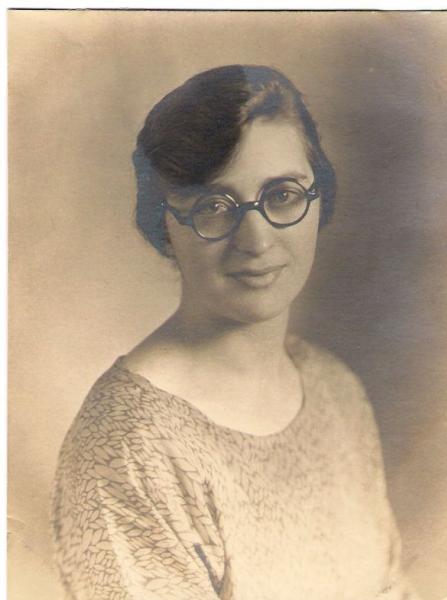
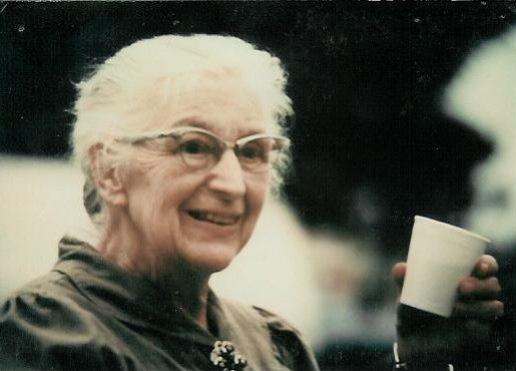
Vinna BOWERS
(29 May 1906 - 31 Oct 1995)
#2A Personal history I was born in St. Joe County while my parents were living out west of Wakarusa, south of South Bend. I was about 5 when the folks moved into the only home I ever knew with them. Went to grade school ½ mile from home. I was the only beginner when school began.... The teacher, a dear Mennonite young man was kinda pushed with all 8 grades, having a grade with only 1 person in it. So it wasn’t very long until I was meeting with the second grade, and stayed with them the rest of the way through school.
So, after 7 years in that school, we went to high school, 3 ½ miles [away]... For historical interest, I went to school in the days when we had to find our own transportation. You hoped a neighbor had a horse and buggy so you could hitch a ride, and that’s how we got to high school....[Joel’s disbelief, ‘Did Grandma really mean she went to school in a horse and buggy?’] There were times I walked hom if I were late for some reason, and we didn’t think much about it.
High school was a pretty good experience. I can remember our principal who saw that I was never busy enough so she would bring me her grade book and sheets of grades to copy. I also remember an English teacher who saw me reading a Horatio Alger book one day. ‘What are you reading that trash for?’ I said, ‘There’s nothing wrong with it.’ She said, ‘No, but there are so many good books in the world and you’ll never have time to read them all. Why waste your time on this?’...There were 2 teachers especially who contributed ideas [to me] and I think to my sisters, and gave us an appreciation of good literature. They required us to read things we didn’t understand, but they helped us to appreciate it....
High school was a pretty good experience. One day we were to have a quotation contest...Two of us who were pretty close to the top of the class were to have a contest reciting literary quotations. The other girl just let it be known that she was going to win. I started in writing down my quotations, and Mother, bless her, would listen to me while we washed dishes. I had mine in order; [the other girl] didn’t. I kept going after she got stumped. [It was] exactly like a spelling bee but there were only the two of us. She’d start with a quotation; I’d answer with one of mine. And I can still quote some from “Hiawatha”; [the quotations] were from literature and we picked our own. We got an in depth study of literature... We were required to memorize passages from Shakespeare as well as American poets...I think my technique paid off; I put [my quotations] in order and memorized them in order. So I won the contest...
I graduated from high school. At the end of the year the principal said that I was the first person that [had] ever graduated from Wakarusa High School with an all straight A record. I didn’t get any foreign language in high school other than Latin. I went to high school in the years right after the First World War and German had been thrown out of most high schools and few of them had French.
I went to Manchester 1 year. In Indiana you could teach with one year [of college] if you continued your training. That [year at Manchester] is when I met [Russ]. After that year, I taught in a country school south of Goshen, upper 4 grades. At the end of the year I was prepared to go back, but school politics are not new! The person who had hired me was the trustee, but he was also a licensed teacher, and he wanted a job. He couldn’t hire himself in the town of Millersburg but he could have the job I was promised if he gave me one. It was to my betterment because it put me in the town of Millersburg and I had a 4th and 5th grade. That was another good experience in town. I managed to pay off what I had borrowed for my first year [at Manchester] and save enough to go back. So the next year I went back to Manchester. Then we were married in 1927....
Remembrances of Vinna (Bowers) Helstern, tape-recorded 1989 by Bob Gross
I’m sure I could find some unpleasant memories, but I can remember, up at the Pleasant Hill Church [in northern Indiana] one year, [Russ] and I were asked to come for a Harvest meeting day. [He] preached in the morning; I spoke in the afternoon. Harvest Day is a Thanksgiving time, and I had made up my mind ... [to focus my remarks on] Thanksgiving needed to be something more than the possession of things...I was looking for things to give thanks for that you don’t see or handle. One of those things was the appreciation of beauty, and the other was the fact that we seem to be created so that the good times we’ve experienced get clearer with time, and the really rocky times don’t seem so bad anymore. I think that’s just a part of our make-up. I think that’s why I remember these things that I want to remember and forget a lot of things that I’m sure were not quite so pleasant.
Events
| Birth | 29 May 1906 | St. Joseph Co. IN |  |  | |
| Illness | 1920 | rheumatic fever - Elkhart Co IN | | | |
| Marriage | 16 Apr 1927 | St. Joseph Co. IN - Russell Fred "Russ" HELSTERN | | | |
| Residence (family) | 1933/34 | in Residence Park with Harold & Teenie - Dayton OH - Russell Fred "Russ" HELSTERN | | | |
| Death | 31 Oct 1995 | Brethren Retirement Community, Greenville OH | | ||
| Cremation | Dec 1995 | Wright State Univ. School of Medicine | | ||
| Burial | 1996 | Wright State Univ. School of Medicine, Rockafield Cemetery, Dayton OH | | ||
| Occupation | 1925-27, 1946-48, and 1953 | Public Schoolteacher - northern INdiana, Preble Co OH, Montgomery Co OH | | | |
| Residence | From 1911 to 1927 | on a small farm - Elkhart Co IN | | | |
| Religion | From 1906 to 1995 | lifelong member of the Church of the Brethren, - Elkhart Co IN and Montgomery Co OH | | |
Families
| Spouse | Russell Fred "Russ" HELSTERN (1903 - 1973) |
| Child | Carol Jean HELSTERN (1928 - 2003) |
| Child | Joy Ann HELSTERN (1933 - 2011) |
| Child | Betty Lee HELSTERN (1935 - 1978) |
| Child | Mary Sue HELSTERN (1940 - ) |
| Father | Harvey Sylvester BOWERS (1879 - 1966) |
| Mother | Rhoda WINELAND (1882 - 1910) |
| Sibling | Floy BOWERS (1908 - 2003) |
| Sibling | Viola Ruth BOWERS SHAW Witham Stump (1910 - 1989) |
Notes
Birth
No location of the birth is indicated on the Birth Certificate.Illness
Remembrances of Vinna (Bowers) Helstern, tape-recorded 1989 by Bob GrossDoctoring “[Did not go to the doctor] for that [pig bite]. We had a liniment that my Grandpa Bowers made. Part of it was iodine, and I don’t know what all. It was in the cupboard with the horse medicine. It must have been potent stuff. I remember very, very few infections, and I’m sure Mother must have dabbed that on the open spots... I don’t remember too much experience with doctors....The time of the typhoid epidemic at Annual Conference at Winona Lake back in the early 20's. Floy seems to have contracted a bit of typhoid and I can remember the doctor was called. He insisted on shots for the rest of us, and the shot made me sick.... We did not have a great deal of experience with doctors....I must have had a bout with rheumatic fever (they called it inflammatory rheumatism back in 1920). I was keeping Jimmy, the baby of the family, while the folks were gone and I suddenly realized I couldn’t walk or get up. My knees, my hips, my back; everything hurt, and I thought What do I do if this baby cries? So, in the rocking chair, I got to the telephone and called the next door neighbor and she stayed till the folks got home. That did start an episode with the doctor because as I recall., I didn’t get back to school for about 6 weeks. I got upstairs that night by sitting on each step, but the joints all swelled....my hands swelled till I couldn’t feed myself, and I couldn’t bend my knees, my ankles was where the pain was... It came that quick, but it didn’t go quick! That was one of the miserable times. There wasn’t too much [that could be done.] We didn’t really have many aspirins in those days. You just [had to] wear it out....The doctor thought that part of it could [have been] infection from a badly decayed tooth so he brought the dentist to the house and they pulled the tooth....We had very little need for doctors in those days. When you consider the primitive state of medical services then it’s rather strange that we all survived as well as we did".
Marriage
Remembrances of Vinna (Bowers) Helstern, tape-recorded 1989 by Bob Gross#2A Helstern family life memories “After we were married we were in Dayton. We [lived] in part of the house where Grandpa & Grandma Helstern lived for about four years [after we were married]. Carol was about three when we moved to a bungalow in Ft. McKinley within walking distance from the school. We were in that general area for about ten years until we moved out to the country in 1941...."
Residence (family)
Charlotte HELSTERN Paugh: "For part of the year when Russ had his splenectomy the two couples [Russ and Vinna and Harold and Teenie] and their 5 children lived together to share expenses and rent. Then Russ and Vinna moved to Grant Ave. and then to Ft. McKinley [Gettysburg Ave?]"Mary Sue HELSTERN Rosenberger: In 1941 they and their 4 girls moved to a small farm they had purchased northeast of Brookville, Ohio on Crawford Rd.
Occupation
Remembrances of Vinna (Bowers) Helstern, tape-recorded 1989 by Bob Gross“It was not customary for married women to teach. In the days very shortly after we were married, any woman who married was dismissed instantly.... I [would] not have kept teaching in the climate of those days. I know that for [Russ’s] father it would have been a disgrace if I had taught. I think for [Russ] it would have been difficult. With the little handicap he had, he had to prove that he was just as good as his brothers. It never came up into open conversation but I had the sense that it was a matter of essential pride for him to prove that he could support a family on his own... There was another side to it; we loved those little girls and wanted to take care of them the best we could and I have never had the physical stamina to do day and night work. A couple of years I did teach. During the war I had a wonderful situation ... Verona High School, 8 or 10 miles away, needed a half-time teacher. By that time Mary Sue was in the first grade. ... I taught 3 7th and 8th grade classes and supervised a study hall. They gave me my choice of morning or afternoon, and that was beautiful. The next year teachers were still scarce and I went to Trotwood with a mixed 5th and 6th grade. I enjoyed it and I think I did a pretty good job as a teacher because I enjoyed it. It was full-time. Mary Sue and Betty went with us to Trotwood so they wouldn’t be home alone [because] I had to leave with [Russ] when he left for Ft. McKinley. It made very long days, especially for Mary Sue in second grade. Carol could be very sharp and to the point when she wanted to be. She came home [from college] for Christmas vacation that year and said, “I’ve just got this to say. If this is the only way to keep me in college I’m dropping out right now! When I came home from school I could talk about what happened that day. Nobody listens to Mary Sue.’ I had to admit; by the time I had taught school all day [when I got home I was so tired] I didn’t even feel like fixing supper. So [my decision not to teach] was not only Grandpa’s feeling about it but it was my own physical limitations. The only way I could have taught school was to hire help.
Over the years I am quite sure that we lived better on his income and what I did with it than we would have lived on 2 incomes and the help we would have had to hire. [Carol] never bought a ready-made dress until after she graduated from high school. I made them. We did subsistence living in a way that was delightful. Economically, it maybe wasn’t the smartest thing to do but in terms of the overall pattern of life, I don’t regret it. I don’t think [my daughters] do either. But times have changed. If I were back [in working age] now I know I’d have some kind of a job. I didn’t have an automatic washing machine. In those days it took all day to heat the water and do the laundry. It took all day to do the ironing. It was a whole different economic pattern. But we were doing it the economical way... Had I been teaching I wouldn’t be in the financial straights I’m in now... But, a day at a time, I’m going to make it somehow.
A number of my contemporaries went back into the job market after their children were in school. One of them said to me, ‘You are a good teacher. Why aren’t you teaching school?’ I said, ‘Simply because I pay too high a price for the salary. I can’t do two things.’ Our family was central for us. I did do substituting for a good many years and I spent one year as full-time secretary at the high school, after the girls were all in school. It worked much better then. And by that time there were some laundromats and we could go in the evening. We made a couple of trips to [Annual] Conference because of my work at the school and extra income...
We did see to it that all 4 girls had a chance at college."
Residence
Remembrances of Vinna (Bowers) Helstern, tape-recorded 1989 by Bob Gross#2B memories of farm It was 15 acres and there was rotation of crops; apparently a traditional rotation. I can distinctly remember when the thrashing machine would come to our place. Because Dad’s amount was small, they usually stuck it in between a couple of the big farmers... That was something when those great big machines would pull in, because there was the steam engine, the thrashing machine and the water tank. [The steam engine was under its own power] but the others would be pulled in by horses... and the time came when the water tank was pulled behind the steam engine. Land, you could hear the thing coming down the road.
Among the Christmas cards that I had sent out was the picture of a horse drawn sled... There were people from Baugo Church who lived on north of us. On a nice winter night, if there was something at church, they’d hitch the team to the sled... it didn’t look like [a sleigh]. It was the grain wagon from the barn with bales of straw in it and old blankets to keep warm and sleigh bells on the horse’s harness. When you’d hear those, you’d grab your hat and get your coat on and run out the front door and catch a ride, and they’d have everybody along the way riding up to the church.... The sleigh, or cutter, was not the bobsled; it was a small vehicle on iron runners. Two people would fill the seat. We had a sleigh. One morning – it must have been when I was a 1st grader – when my Dad started for school I must have been ready to ride with him. He had to go farther than I did. So, I got in the sleigh with him. At [our] house you came out the driveway and turned right into the road and there was a drainage ditch there that made the ground a little bit lower. We started around that and just rolled over sideways. The horse stopped the minute the shaves bumped it. Dad laughed. The only calamity I can recall: I must have had a new bottle of ink and the snow was all blue, [but] not on clothes.”
Our parents’ farm had been purchased by a Mennonite teacher who was remodeling it. [My sister] Grace insisted that we gather there so we could take a tour of it. I talked with the sweet young lady who was cleaning the church. Her grandparents had gone to SS with me....
My sister Grace spearheaded [getting the family back to the home place after it had been sold and was being remodeled]... The person who bought it (a Mennonite teacher) had done research [and discovered] that it was an ancestor of his that built [the house].... Grace and Martha set a day and contacted Floy and me and we would all go together to see the house. That has helped a lot to bring back some memories, because all of us dug into our pictures and pulled out some that we had forgotten....
The threshing machine “[It] wouldn’t have been an annual occurrence because Dad didn’t have wheat every year. In the matter of rotation [of crops, there was] wheat, alfafa and corn. So, it was a yearly occurrence up and down the road, but not at our house. In those days, feeding the threshers was a job. Ours was a small job so they always steered around meal-time. But I can remember my mother, going across the road and helping over there when Mrs. Hunsberger had threshers to cook for... So they balanced out in a neighborly fashion....
Putting in drainage tile: "The field south of the house must have had a wet streak in it. Dad, who was always up on the developments going on in the world, sensed that what it needed was tile. I can still remember that he dug the ditch, laid the tile, and he and Mother must have planned long before to be gone someplace, and it had to be with horse and buggy....They would be gone overnight.. When they left, he told Bernice, Floy and me, ‘You close up as much of that ditch as you can.’He had laid the tile. ‘You get the shovel and the hoes and you cover that tile and get it leveled off, just as much of it as you can, and I’ll give you each a dime.’ That dime was pretty big right then. They took off in the horse and buggy with the little children. I can still remember that Elmer Eby, one of the men at church, was absolutely horrified when the 3 of us came to church alone the next morning. We had stayed alone overnight. We didn’t think a thing about it, but he couldn’t understand it....We were about... 8, 9, and 10....
Livestock" Always at least one milk cow; sometimes two. And, for a number of years, Dad would keep one horse for power and borrow from the neighbors when he needed a second one. Always farmers in those days fattened out hogs for their winter’s meat. So we always had hogs around... One hot summer day, my Dad was down in the field and I could hear his voice, saying: ‘Take a bucket of water out to the shed for that old sow.’ So I did. I got a bucket of cold water and went out and reached over the fence and as I put that bucket down [that old sow] grabbed my wrist and left her teethprints in it. I had the marks for a good many years. Well, Dad said, ‘Don’t be too hard on her. As your hand came down over the fence, she grabbed your arm just like she would an ear of corn.’ Yes, we kept livestock and I hated those pigs!.... "
Religion
Remembrances of Vinna (Bowers) Helstern, tape-recorded 1989 by Bob GrossChurch congregation and meetings "If you want a picture of some of the church meetings [of the Baugo Church of the Brethren], read Kermit Eby’s books ... He’s done a pretty good job of laying the foundation of country churches in those days..
The community involvement of the members of the church in getting ready for a District meeting or a communion. It was a big event; it was not casual.... [Communion] at Baugo was never a 2-day affair. It would be evening and breakfast the next morning. At a good many churches it would have been more than that. It wasn’t there. It was always on a Thursday evening. In the afternoon the pews would be moved off the floor and the men would come with buckets of soap water and scrub the floor and then get buckets of clear water and rag mops and wipe it up. And then put the tables back. We had the kind of tables where you pull the back [of the pew] up and it makes the top of the table. The next morning there would be breakfast at the church. There would be beef left from the night before, and all the women would bring canned red beets, and home made apple butter and homemade bread....and pickles. Then after the breakfast, everything was put back in order for Sunday morning....
We had Sunday night services most of my years growing up. But for a period of time, Baugo and Wakarusa were sort of linked together as a single congregation....I can remember as a youngster going to SS in town on a Sunday evening. Most of the time we [had SS] right there at Baugo. But apparently there were times when we had the morning service and then we went into town for the evening service. But there were personalities that got into it then – just as they do now. There were resident ministers in both congregations. I don’t know the background of it but I remember hearing that they really fell out with each other once upon a time. As one lived in town and the other in the country, the two churches drew farther and farther apart....
I can remember how often, after church, a few persons would drive in the driveway at our house and never even stop at the door but head straight for the cow stable. They knew when Dad would be out milking and that’s when they came....I remember one evening when Dad came in with the milk, he said to mother, ‘If that cow stable could talk, it really would have some stories to tell.’... The church was a significant thing in the lives of people.
[Midweek service] periodically; not regularly. Every fall, early fall, we would have School of Missions, books to read on early missionaries and got together to discuss on Sun nights for several months...
[Sunday morning] was music, singing hymns, scripture reading, prayer (never stood, we were on our knees), a certain set number of hymns and a sermon. [No musical instruments] in the early days. I don’t believe Baugo church had a piano ‘till after I was gone... We always had hymnals and had two sets of songbooks; the hymnal for church and the “Kingdom Songs” for SS. They were lighter in theology and in music types....
I don’t recall a specific time when [we hosted District meeting at Baugo]....The big meetings that I remember there were our own Sept. Harvest Meetings. Those would be really big affairs. In those days, when you couldn’t go distances, people visited back and forth at each other’s Communion services in a way that’s really been unknown in my adult life. It was a social thing as well as spiritual. There were lots of visitors and, with my Dad, I went to lots of other churches. I don’t remember that we had very many visitors who stayed overnight....
About 1915, the revival meetings – I have bad memories of them – the kind of thing that happened in revival meetings ruined the word ‘evangelism’ for me for many years. I’ve had to make a conscious effort to return some respect to the word ‘evangelism’ because of bad experiences then. The worst one was a more or less professional evangelist. You talk about the TV preachers of today; well, there were a few evangelists in those days that could have outdone Jimmy Bakker. But this one, Garber, he was well known and highly recommended. I suppose they had to speak [for him] years ahead. He turned a couple of us completely off. He just didn’t want to stay in somebody’s home. So he asked that the church fix one of the SS rooms... so they put in a little heating stove and put a bed in and brought food to him. Kermit [Eby] makes a nasty comment, ‘This was done so he could have more time for meditation – and sleep!’ He didn’t want to be disturbed in the early morning hours that the men worked. I have horrible memories of that man because he was going to chase the devil right out of the church. And he would preach hellfire and brimstone from the pulpit and then chase the devil halfway down one of the side aisles. I’m giving you the impressions of a 9 year old but that’s how I felt. It was a 4-week meeting and I can remember nights when the pews were pushed in from the wall and there were people standing clear around the walls. I never saw that church so full. Where could you get a cheaper side show! Every night for 4 weeks....I know there must have been between 40 and 50 people who came to join the church [that year]. But 15 or 20 years later, I bet you wouldn’t find one out of 10 of them... They joined under the emotionalism of the moment but it was not a studied decision... I guess that [experience] colors my negativism toward any of the religious programs on TV. Dad never said one word about this evangelist...He never discussed it...
The next year the church had D.R. McFadden.... He was just such a down-to-earth likable person. And he stayed at the Eby’s home and Kermit almost idolized the man. If it was getting late, he could pull on a pair of overalls and go out and milk a cow. But there weren’t the crowds of people as there had been the year before.
There always are saints in every church. That church had a couple...[Moyer couple]; they had no children of their own. She taught the jr-hi or high school girls SS class and was just a mother to everybody. Once a year, they would have all the young people in the church for a Sunday dinner: 2 kinds of meat, 3 kinds of pie... About time I was getting ready to be married, she came and gave me a brand new comforter and I’m sure I wasn’t the only person that got one.... In the back of my mind I have a strange impression of the lady ... who must have been the first SS teacher I had at Baugo church. I can remember the little Bible picture cards we got for memorizing Bible verses. I don’t know whatever happened to her. Her husband was killed in a terrible tree-cutting accident. I just have the memory of a red-haired, Mama-type of person....
[Being the elder’s daughter] wasn’t like it is today’s being the preacher’s kid. There were no paid ministers and everybody was on common ground... "
Endnotes
1. Vinna Mary Bowers, birth certificate no. (May 29, 1906), St. Joseph County Book No. 7, Page 318, South Bend, Indiana, Book #7, page #318.
2. Memories of Vinna BOWERS Helstern as shared with family, tape #1.
3. Memories of Vinna BOWERS Helstern as shared with family, tape #3.
4. Interview with Charlotte HELSTERN Paugh (), by Mary Sue HELSTERN Rosenberger, 21 Apr & 5 May 2006. Transcript held by mshr (). questionnaire & mini-tape, questionnaire & mini-tape.
5. Memories of family stories, personal knowledge.
6. Letter from Wright State University School of Medicine staff (Dayton OH) to Joy (HELSTERN) Dull, 1996; held by Mary Sue (HELSTERN) Rosenberger (Livingston TX)..
7. Letter from Wright State University School of Medicine staff (Dayton OH) to Joy (HELSTERN) Dull, 1996; held by Mary Sue (HELSTERN) Rosenberger (Livingston TX)..
8. Tape-recorded memories, Vinna Helstern memories, Tape #1.
9. Memories of Vinna BOWERS Helstern as shared with family, tape #1 and 2.
10. Memories of Vinna BOWERS Helstern as shared with family, tape #1 or 2.