Individual Details
Harvey Sylvester BOWERS
(11 Jun 1879 - 21 Feb 1966)

Events
| Birth | 11 Jun 1879 | Hancock County, Ohio |  | ||
| Residence | 1880 | Hancock County, Ohio, United States | | ||
| Marriage | 24 Dec 1904 | Montgomery Co OH - Rhoda WINELAND |  | | |
| Marriage | 25 Dec 1910 | Northern Indiana - Leta Cook WALTER | | ||
| Residence (family) | 1920 | Olive, Elkhart IN - Leta Cook WALTER | | ||
| Death | 21 Feb 1966 | Wakarusa IN | | | |
| Occupation | Aft 1900 | was a teacher, builder, farmer and free minister - Elkhart Co IN | | | |
| Burial | 1966, Feb | Olive Cemetery, Elkhart County IN | | |
Families
| Spouse | Rhoda WINELAND (1882 - 1910) |
| Child | Vinna BOWERS (1906 - 1995) |
| Child | Floy BOWERS (1908 - 2003) |
| Child | Viola Ruth BOWERS SHAW Witham Stump (1910 - 1989) |
| Spouse | Leta Cook WALTER (1884 - 1976) |
| Child | Grace BOWERS (1911 - 2008) |
| Child | Walter Enos BOWERS (1913 - 1996) |
| Child | Martha Elizabeth BOWERS (1915 - ) |
| Child | Elma Lucile BOWERS (1918 - 1993) |
| Child | James Lamar BOWERS (1921 - 1983) |
| Father | Enos Woods BOWERS (1855 - 1931) |
| Mother | Mary Jane BUSHONG (1860 - 1896) |
| Sibling | Jacob Wesley BOWERS (1881 - 1962) |
| Sibling | Mary MALINDA BOWERS (1883 - 1944) |
| Sibling | Lydia Ann BOWERS (1886 - 1964) |
| Sibling | Estella Florence BOWERS (1889 - 1947) |
| Sibling | Jesse Virden BOWERS (1891 - 1973) |
| Sibling | John Irvin BOWERS (1893 - 1965) |
| Sibling | Carrie Elizabeth BOWERS (1896 - 1896) |
Notes
Marriage
They were married at the Bear Creek Church of the Brethren southwest of Dayton Ohio on State Route 35.Death
In the nursing home.Occupation
Remembrances of Vinna (Bowers) Helstern, tape-recorded 1989 by Bob Gross#3B Harvey Bowers - “My father was born in Hancock Co OH in a little town by the name of Williamstown. The family was very active in the Eagle Ck Church, now on Route 30. My father, at a rather early age, was chosen SS Supt. And I heard him say one time that the person who helped him most was a little old widow lady who never said a word. Every Sunday morning on the say to church he would pass her, and he knew there would be at least one person there.
He finished the 8th grade twice. Then he was 16 or 17, so he could teach in a grade school. So he got a place to teach .... some miles from home and he had to drive a horse and buggy. That’s the school I believe that he had, as a student, that real large, overage Indian girl that just about had him buffaloed.
My father [Harvey] taught school [in Hancock Co] at 17 and there were still Indians in the area. I’ve heard [him] comment about an Indian girl that he was really almost afraid of. She was big and mean....
After teaching for a couple of years he went to Manchester, he must have saved enough money to go. Sometime prior to that he had gone to Ohio Northern at Ada OH for some summer [courses] in teacher training. Then he went to Manchester in 1902-03 and 1903-04. That’s when he met my mother [Rhoda Wineland]. She was there as a student part of the time; then she became (remember, she was an orphan. There was nothing back of her) assistant to the cook in the boarding house. There is a picture of her room when she was cooking at the boarding house and in the corner of the picture is a trunk – the one ‘Nita has - was her trunk to go to college. After a couple of years [at MC] she came to S. OH to relatives who needed help with the family and lived there until she and Dad were married.
Part of the time when he was teaching he stayed with his Uncle Simon Rodabaugh [and wife]. After 2 years at Manchester, he went back to OH and he and my mother were married the day before Christmas 1904 in West Dayton. The next fall they moved to IN...into St. Joe Co., partly because that’s where Aunt Hannah Parrot was; that was a family connection there. He got a school N of S. Bend and attended a church no longer in existence, St. Joseph Prairie.
When he changed from OH to IN, he had to take an IN State Teacher’s examination; he passed with flying colors in everything but arithmetic so he had to take it over. So he really boned up on arithmetic. He passed arithmetic the next time, and failed a couple of others. But eventually, by means of state exam he got his IN State Teacher’s license and started teaching in St. Joe Co out in the area SE of S.Bend. Taught there until 1911 when my mother died. Shortly after that he moved farther south into Elkhart Co.
The place remembered as ‘Grandpa’s home’ was purchased in the winter of 1911 and they lived there until 1966, in the same house. It changed during the years. During that time he taught in all of the 5 schools of Eric?? Twp. Each school had its own trustee and the feeling was ‘you don’t keep a teacher longer than 2 years’ so my Dad did a lot of rotating, 2 years at this one, 2 years at that one, and when he got around he’d start his 2 years again. [He taught] all 8 grades. During those years of teaching he was going to Goshen College for several weeks of summer school. Finally as states began requiring degrees, one summer he went to Manchester because I was there, summer of 1925. There were two other teachers from the Wakarusa area that were in the same bind that Dad [Hrvey] was. I had a room in ]an off campus] house where [Carol (Helstern) and Al Gross] lived [in later years]. There was a kitchen in the basement. I ended up fixing meals for Grandpa and those two teachers and myself while we all went to summer school. My father got his degree 25 years from the time he started, 1927, from Manchester.
After Dad got his degree, it wasn’t long until he started teaching in the Wakarusa High School. He had been elected to the ministry when he was in St. Joe Co, at either Oak Grove or Pine Ck Church, so then he took his turns preaching. They moved into Baugo territory in 1911. There were 2 resident ministers at the time, farmers, so Dad was an extra. As the years went on, he did half or more of the preaching. It was all the free ministry, of course.
We [Russ & Vinna] were in Ft. McKinley when a couple of our girls were born. They [Harvey & Leta] came down to see the new grandchild, and the pastor at Ft. McKinley asked G’pa to preach that Sun. He did, and at the end of the service, he was a most surprised person; he had been given a $5 bill. That was the first time he had ever received any money for preaching.
His was not extemporaneous preaching. It was planned and organized. For instance, one time Grace said, ‘Every time I took friends home from college with me, I was so glad if it was Dad’s turn to preach. I knew there wouldn’t be grammatical errors. I knew it would be worthwhile.’
The other thing, after he died, somehow ... his notebook came into my hands. It had to be outlines of some sermons. I could have taken those outlines and built a talk on them ... his thought patterns were methodical, like I thought. It was free ministry but it was approached as carefully and as seriously as [if it were professional ministry].
He continued, and then I can remember that he was th person who pushed that church toward the paid pastoral ministry .... Then, if they were going to have a paid pastor, one of the steps was a parsonage. So, a member donated a couple of lots across from the church and my father, as he had done in the family, drew up the plans. (The house thatWalt and Wylan Bowers lived in and the house that Walt and Elma Harroff are both built from plans that my father drew. One day, Walt Harroff said, ‘Does anybody want a set of house plans cheap? ... They’re what Dad drew on the back of a Coca-Cola tablet.’) So he did draw up plans for a parsonage for Baugo church.... Arthur Schwalm said that my father drew up the plans and said [to the church members] ‘If you want to organize yourselves we can do much of this work ourselves and save a lot of money.’ They purchased a lot of the lumber directly from the lumber company. There was no contractor in this at all. A. Schwalm said, ‘Vinna, your father is up there at the parsonage at 7 o’clock every morning. It’s as though he’s going to see that parsonage ready for the church before he’s unable to work or before he’s gone.’ So, the church had a parsonage at the cost of materials, with one mistake. Not ‘till after it was finished did Dad realize that the bathroom door was in line with the front door and they had to be sure to keep the door shut.
He and a couple of other folks really influenced the community through their volunteer work for the church....Young folks went out from there into all corners of the world. Then after he reached the age of retirement, – teachers were plentiful for awhile and he had to retire; I don’t think time ever got heavy on his hands because he enjoyed his garden and the little farming that he did. Then, a committee of several Amish men from S of Nappanee visited and they wanted a teacher for their school. They didn’t want their children to go to high school so they maintained their own parochial school through the 8th grade. And one of the Amish girls who was especially capable could take the first 4 grades as an assistant if they had a licensed for the upper 4 grades.... My father went – he was 80 when he started there – and he kept it up for about 5 years. Talking at a family dinner one time, he was getting a little discouraged. It bothered him to see these youngsters count the days ‘till their 16th birthday. Some of them were repeating the 8th grade 2 or 3 times. And Dad went out and bought supplementary books out of his own pocket so that if they did have to take 8th grade history 2 or 3 times they could do it from a different book. And most of them didn’t care. Noble Frederick put it this way, ‘I don’t think it’s the work that’s getting an 84 year old down. I think your father is incapable of comprehending a young person who doesn’t want to learn something new.’... He kept on there until physically he wasn’t able to continue any more. Grandma [Leta] stayed on there [on the little farm] for about 6 months and then had to give up the farm....
They moved [to the farm within the territory of Baugo congregation] in 1911 and he was a minister when they moved there and he died in 1966. That was a second marriage for them and they celebrated 50 years together, which doesn’t happen very often.
[Harvey] was a cabin father at Camp Mack when he was 80.... He had a very special hobby; taking groups of campers around the auditorium and giving the background of the [Medford Neher] murals....
When he urged the congregation toward the pastoral ministry, somebody else came in [as pastor]. He never accepted pay from that congregation. That was his church. After the paid minister came, he served [Baugo] as elder; served as elder of the Crest Manor Church for a period of time; he served as elder of a number of neighboring churches. He did supply preaching but not anything regular. He served several terms on the District Board of Christian Education; served a term as Trustee of Manchester College. Glenn Kinsel was [at Baugo] for awhile; Ralph Rarick was semi-retired and they paid him part-time. I think he was the first person to live in the new parsonage.
[Reasons for encouraging the congregation toward the paid ministry?] I think he knew that it was unlikely they’d ever continue as a congregation if they depended on the free ministry. That was going out with the times. I think he knew that the future of that church was tied in with the professional ministry, and he wanted that to happen....Most of the time he was [at Baugo in the free ministry] there were [several ministers]. But by the time he saw the finish coming for him, he was the only one there....I don’t know of very many churches where the transition from free ministry to paid ministry was planned quite so carefully. With his District contacts, he knew the trend [toward professional ministry]. I also remember hearing somebody ask him one day why he stayed in teaching instead of the pastoral ministry. Some of his generation were among the pioneers in the paid ministry in the CoB and Dad was a pretty good speaker. He said, ‘Well, I looked at it this way. I took stock of my abilities and I felt that I was equipped to preach in the schoolroom rather than in the pulpit.’... The free ministry was successful only as long as you had capable, self-supporting – especially farm populations – to draw from. If you were in an area where that became scarce, the free ministry was in jeopardy. I was long gone when this was happening but I see no place on the horizon where it could have continued....
It’s almost stupendous to my mind sometimes to look at the changes I have lived through. Even local congregations were becoming more demanding. Instead of 4th and 5th grade education, states were requiring high school graduation and you had a congregation that understood proper grammar usage and could deal with ideas.... Old Order Churches are still functioning with free ministry but for the most part, Old Order folks are staying with their homes and the land. Brethren, and to a lesser extent the Mennonites, are going into the service professions....None of the folks from Baugo who went to college went back [to their home congregation].... The whole social pattern was changing. The opportunity for service in the free ministry was rapidly going and I think my father was one who recognized that and prepared for it. And that church has continued to grow....
Kermit Eby wrote for the National Parent Teacher an article, “Among my Teachers” [in which] he says that Harvey Bowers was one of the greatest teachers he ever had. He was getting too mischievous when Mr. Bowers laid the book down on his desk in front of him so he’d have something to read. It wasn’t finished when the school day was over, so Dad told him to take it home. He came back the next morning with the book; he had read it. Dad quizzed him, then said, ‘Well, you liked the book. I’ll give it to you.’ Kermit says it was the first book he ever owned.
Along about 1914, Cliff Kindy’s grandfather’s[Merle Kindy] brother [Glenn] who married the sister of my step-mother’s first husband. We were invited to the wedding at Middlebury at G’ma Weaver’s house – it had to be 1914 because we got the first car in 1914 and I know we didn’t go by horse and buggy. Everybody was in the living room waiting and nobody knew what we were waiting for. Everybody was there. Finally, I saw Uncle Glenn come down the stairs, tap my Dad on the shoulder and up the stairs they both went. Wasn’t very long until Dad, with his minister’s manual in hand, came down the stairs with Glenn and Elma behind him, and we had a wedding. Refreshments afterward.... On the way home, Dad turned toward Mother and said, ‘Somehow, something told me to put that manual in my inside coat pocket when I left home tonight.’ A day or two later we learned that the ceremony was supposed to be performed by Glenn Kindy’s father. They had spent most of the winter in CA, and the letter telling them about this had apparently reached CA after they had started back home.... They didn’t even know about the wedding until they got back several days later....
#2B memories of Harvey One of the things I remember was cutting and husking corn by moonlight. My father farmed about 15 acres but he also taught school and in the fall it was a little hard to get the work done. So, when it was a period of the full moon, after the moon came out, we would bundle up – and I can remember the chill – and cut corn. And I think I must have gotten fairly proficient at it. My brothers were younger; I was the oldest... More fun was husking it, and we’d go down when the moon got bright, yank down a shock or two, freeze our hands, and husk the corn. Those are some pretty tremendous memories because, alone out there in the dark, Dad and I discussed some things that would never have come up in other situations. So I have some pretty good memories about that experience that could have been considered a hardship. [What kinds of things did you talk about?] What you would do with your life? What was most important? And I still remember the time when I sorta envied one of the older girls who had finished high school and had gotten what I thought sounded like a real good job as assistant cashier in the bank. I said, ‘Hey, that’s a good job.’ My father’s reply was, ‘Well, I guess it all depends on whether you want to work with things or with people.’....
I guess I’m remembering the things that I hope I’ve passed on. Dad was considered a good teacher but not a particularly strict one. He didn’t need to be. One day, a couple of 4th or 5th graders got to fighting on the school yard. They must have really been going at it. Somebody dashed into the school to tell Mr. Bowers. He came out. I can still see: he walked that slow long stride of his to the corner where the boys were pummeling each other. With his great big hands, he took them by the nap of the neck and just led them slowly to the schoolhouse porch. I’ll bet he didn’t know what he was going to do, but when he got there, with a boy in each hand, he turned to one of the bigger boys and said, ‘Go to my desk and bring my chair out.’ So they brought the teacher’s chair and put it on the porch. Dad took those 2 little guys and put them both in the teacher’s chair. I remember what happened. It got so funny. There they were; they couldn’t even get away from each other. Both of them crowded into that teacher’s chair. They’d look at each other and pretty soon they were both laughing. Better than paddling...
He didn’t paddle. Physical punishment was not for him...I seem to remember hearing him say one time that in more than 50 years of teaching, he had paddled one child. And that was a boy who giggled or made a noise or disturbance on Monday morning when they were having assembly with The Lord’s Prayer... He never used physical punishment at home. His favorite punishment was ‘Go, sit on a chair.’ A couple of us older [children] have laughed more than once. On Sunday afternoon, after dinner, Dad was likely to sit down to read and go to sleep. I don’t know what Walter and Martha got into one day, but they got into one of these scraps. And Dad said, ‘You sit over there and you sit here. You sit there until I tell you you can get up.’ Well, we had little children’s rocking chairs ... [so] they each took a rocking chair and sat down. Dad promptly went to sleep. Those young’uns never made a move to get up until he told them they could get up. ... Well, it got pretty long. And the next thing we knew, two little rocking chairs were scooting all over the living room. You can walk [rocking chairs] pretty well and they were all over the living room. Finally, Dad woke up, and he had the grace to laugh! They had outwitted him while he slept. There was no further punishment and he appreciated the fun of the situation....
Burial
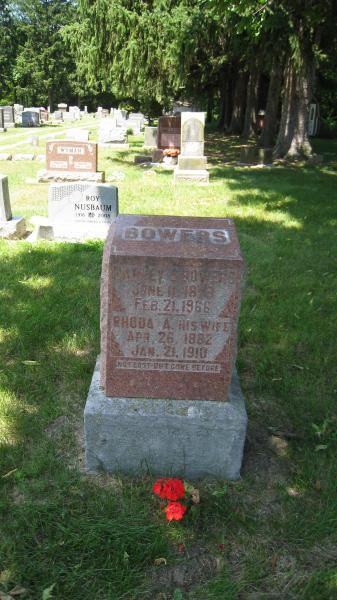
His gravestone includes his birth and death dates. It also includes Rhoda WINELAND Bowers' birth and death dates and the phrase "Gone before but not forgotten." His personal journal indicates that Rhoda was buried in Pleasant Hill Cemetery in Macoupin County, Illinois. However, there is no gravestone for her there. Did he include her life dates on his stone to serve as the memorial he was unable to buy at the time of her death?Endnotes
1. Floy Bowers, The Bauer -- Bower -- Bowers family.
2. Cynthia HARROFF Karn, "1880 census data re Harvey S. Bowers," e-mail from (, Elkhart IN), to MarySue HELSTERN Rosenberger, 2011.
3. Tape-recorded memories, Vinna Helstern memories, Tape #3.
4. Floy Bowers, "The Bauer -- Bower -- Bowers family".
5. Cynthia HARROFF Karn, "1920 Federal census re Harvey S. Bowers," info re residence from (, Elkhart IN), to MarySue HELSTERN Rosenberger, 2011.
6. Floy Bowers, The Bauer -- Bower -- Bowers family.
7. Memories of Vinna BOWERS Helstern as shared with family, tape #2 and #3.
8. Harvey S. Bowers burial; from personal knowledge of Mary Bowers (), personal visit/research of cemetery and/or records; provided 12 June 2009, HSBowers gravestone photo.