Individual Details
Edward J. SWANSON
(Bet 1769 and 1774 - 11 May 1829)
1790 Laurens Co., SC, Edward Swanson, head:
1 m 16 yr and up (Bef 1774)
1 free white female
Could be the same man. The other Edward was in Tennessee then, I believe.
Edward Swanson is on printed page 36 of the 1820 census for Brownsville Twp., Fayette Co., IN. Photocopy of entire page in the possession of the author. On the same page are two Wright families and 4 Thomas families, including an Ephraim. On page 34 is John Mires. On page 12 is Joseph Frazier and Peter Frazier.
1820 census for Brownsville Twp., Fayette Co., IN
1 m 45 and over (Bef 1775) [Edward]
1 f 26-45 (1775-1794) [Mary]
1 f 10-16 (1804-1810) [Mahala Conn?]
2 m under 10 (1810-1820) [John and Edward]
2 f under 10 [Narcissa and Mary]
Place of birth for Edward is from a bio of Amanda Swanson in Guinn's history of Tulare County, CA.
1796 History of Ross and Highland Counties, Ohio" lists the original voters in Highland Township, Highland Co., OH, in 1807. Edward's name was not on that list, although he did buy a lot there in 1808.
Book E pg 259, Highland Co., OH deed dated 10 Nov 1808 to Edward J.Swanson, of the County of Highland, State of Ohio, for Lot 23, Town of Hillsborough, from the Director of the Town of Hillsborough. Copy in the possession of the author.
Book E pg 258, Highland Co., OH deed dated 12 Dec 1808, to Edward J.Swanson, of the County of Highland, State of Ohio, for $25.00, for Lot 17, Town of Hillsborough, from Adam Brouse and wife Sarah. Copy in the possession of the author.
Book G pg 258, Highland Co., OH, deed dated 1 Oct 1809, Edward J. Swanson and wife Mary sold for $65 to James D. Scott, Lot 23, Town of Hillsborough. Edward signed the deed. Deed doesn't specify Mary signed by her mark, but there is an "X" to the left of her name. Copy in the possession of the author.
Book F page 160, Highland Co., OH, deed dated 24 June 1809, Edward J. Swanson and wife Mary sold for $25 to Benjamin Golliday, Lot 17, Town of Hillsborough. Edward signed the deed, Mary signed by her mark. Copy in the possession of the author.
"Indiana Land Entries, Vol. 1, Cincinnati District, 1801-1840" by Margaret R. Waters, 1948; Indianapolis. Pg. 67 lists Edward J. Swanson and Michael Culver acquiring title to the NE 1/4 of S35 T12 N R2W of 1st PM, in Union Co. IN, on 28 Dec 1813. Copy in possession of the author. It also shows John Myers acquiring title to the NW 1/4 of S24 same township and range, as of 13 Jan 1808; SW 1/4 S23 same township and range as of 9 May 1809; NE 1/4 S7 same township and range, as of 25 Oct 1811 and NE 1/4 of S32 same township and range also as of 25 Oct 1811. It is not proven that any or all of those are Mary Myers Swanson's brother.
No. 7550 issued at Land Office at Cincinnati 31 Dec 1818: It is hereby certified, That, pursuant to an act of Congress, passed on the tenth day of May, 1800, entitled "An act to amend the act entitled "An act providing for the sale of the Lands of the United States in the Territory northwest of the Ohio, and above the mouth of Kentucky river," Edward J (or I) Swanson & Mich'l Cullver of Wayne County on the 23rd day of Dec'r 1813 purchased of the Register of the Land Office at Cincinnati, the lot or North East quarter of section numbered thirty five in Township No. twelve in the Second Range of the Cincinnati district, lying West of the Meridian line drawn from the mouth of the Great Miami River containing One hundred & fifth Six 22/100 acres at the rate of two dollars ?cents per acres; for which said quarter section the said Edward J. Swanson & Michael Cullver has made full payment ? his account therefore being finally settled and closed in the books of this office, as will appear by the following statement thereof, viz: -
DEBIT
1813 Dec 28 To amt of purchase money $312.44
1818 Dec 21 To interest 46.85
359.29
CREDIT
1813 Dec 28 By Cash $78.00
1815 Dec 26 Ditto 78.00
1818 Dec 21 Ditto 203.07
359.29
Now therefore be it known, that on presentation of this Certificate to the Secretary of the Treasury William Whiteman. ? ? Edward J.Swanson & Mich?l Cullver shall be entitled to receive a patent for the land above described. Signed ? ?, Register of the Land Office.
Copy of the above document is in the possession of the author.
"History of Rush County, Indiana", no author, 1888 Chicago: Brant & Fuller; Reprinted 1966 by Eastern Indiana Publishing Co., Knightstown, IN. Pg. 337 states that no land could be entered before the first Monday in October, 1820. Pg. 338 states "In what is now Union Township, Ben Davis' Creek, or as it was called by the Delaware Indians, Mahoning Creek, seemed to be the center of attention." The earliest settlers are listed and include Edward Swanson.
On page 332/222, the history talks about shooting matches as a popular contest of skill. The matches were made by a number of persons uniting to buy a fat steer or heifer for beef. The animal was divided into five shares, the four quarters and the hide and tallow. The best shot had the first choice, the next the second, and so on . At other times there would be only one prize, perhaps a rifle an axe or a cow or calf. These contests were always interesting, not only on account of the value of the prize, but also the glory of the victory. Shooting at a mark even when there was nothing to be won was a constant source of amusement and was greatly appreciated by the frontierman and indulged in on all public gatherings, such as musters, elections, etc.. The skill of many with the rifle was indeed wonderful. Snuffing the candle with their ball was a feat that required the greatest tact and coolness. After night a candle was lighted and placed against a tree,say forty or fifty yards distant, and then the object was to cut the lighted wick off, without striking the candle itself. Edward Swanson, afterward famous as the murderer of Elisha Clark, and as being the only man in this county who has ever expiated his crime on the gallows, was the champion in this feat. His skill with the rifle was something wonderful, his sagacity as a hunter and woodsman could not be excelled. He was a typical frontiersman and Indian fighter, cool, crafty and courageous.
The same history, on page 403, says: "At the April term, 1829, Edward J. Swanson was indicted and tried for the murder of Elishi Clark; the prosecution was conducted by William W. Wick and James Whitcomb and the defense by Charles H. Test. The indictment embodied the essentials of the common law. It was drawn by James Whitcomb, and from it and the crushing prosecution escape was hopeless. The jury returned a verdict of guilty, which stands alone in the severity of punishment in the judicial history of the county. The defendants filed a motion for anew trial, assigning as one of the reasons that the Judge had charged the jury "that they were the judges of the facts and the court the judge of the law." The Judge, Hon. B. F. Morris, over-ruled all the motions and sentenced Swanson to be hanged on the following May 11, one month after the trial. Swanson disheartened, yielded to the inevitable and refused to appeal his case to the Supreme Court where there is scarcely any doubt that it would have been reversed. The execution occurred at the time fixed, and Swanson was the only man whoever paid the extreme penalty of the law in Rush County by an ignominius death upon the scaffold." A copy of the minutes of the April Term, 1829, obtained from the Rush County court confirms the above information.
On page 290 is a description of the early Rush County jail. It was a two-story building 14 x 18 feet, eight feet between floors,constructed of substantial timbers, hewed one foot square. The lower room was lined with two-inch plank; the entrance to that room was a door in one end, to be closed with iron shutters made of bars one-half an inch thick. The upper room was divided into two areas, one for females and one for debtors. Edward was most probably incarcerated in the downstairs room while awaiting execution.
On page 350 is part of some Reminiscenses of Dr. John Arnold, an early settler, who was also a witness to the Clark murder, speaks of one day being sent on an errand to his uncle Isaac Arnold and was accompanied by a Jane Richardson, a young woman from England who was living with the family. On the way they saw a gigantic wolf watching them from a distance of only 20 or 35 yards away. Jane screamed and ran for home. Dr. Arnold says "I felt disposed to follow her example, but remembered that I had heard Swanson, a famous hunter, a few days before say that the wolf would not attack even a woman or child if they boldly faced him, but that if they turned and fled it would be sure to kill them."He then picked up a handspike lying nearby and faced the wolf, and started backing away. Then the wolf howled and turned and left.
Darrol Pierson, Indianapolis, IN, sent newspaper articles as follows: "Reminiscenses of an Old Settler" by Dr. John Arnold. Mr. Pierson believes that these were originally published in the Rushville Republican, but is not positive. The source of the copies was Rush County Historical Society, Bicentennial Microfilm Project, 1976, Sec. 192 (Reel 4) pp. 30-33.
Paper IV, dateline Arnold's Home, Feb. 20th, 1875.
Friend Delbert: There are few of your readers who do not know that Edward Swanson was executed in Rushville for the murder of Elisha Clark, but beyond his crime and its punishment, but little or nothing is known of this man, and I propose in this paper to record all those matters relating to him, which I know and which I deem would be interesting. He was a man of mystery, for though known as pre-eminent in all woodscraft, successful as a hunter, and famous for his hostility to the Indian race, and the cunning and savage ferocity with which he pursued them, yet no one knew from whence he came or what were his antecedents; but enough was known to prove that his early years had not been passed in the wild woods of the West. He had a considerable acquaintance with literature and a great fondness for reading, two things never found in the native born back-woodsman. These traits led to my first acquaintance with him sometime in the year 1822.
My father, who was of literary tastes, brought with him to this country, a well selected library of several hundred volumes of standard works on history, philosophy, natural history, poetry and general belles-lettres. Swanson, as soon as he learned this fact, sedulously cultivated the acquaintance of my father so as to obtain the loan of his books. My father cheerfully loaned him his books, and took much interest in his tales of hunter's life and the recital of conflicts with the Indians. He was a blood-thirsty man and hated the whole race with a perfect hatred, and boasted that he had killed many a one in time of peace as well as war, whenever an opportunity presented for doing it in safety. He used to boast that he could show plenty of bones, in this country, of Indians who had fallen by his hands. It appears that he had come to the west early in the present century, and had had his share of adventures. As a woodsman he could scarcely be excelled; it seemed more like instinct than reason, the certainty with which he would traverse the pathless forest, by day or by night; the desired direction was all he required. In the year 1823,my father being entirely unacquainted with the process of sugar making, proposed that they should join together and make in partnership. They accordingly opened a camp on the school section,where there was a great abundance of fine sugar trees. This was about three miles from my father's and still further from Swanson's. They took provisions with them sufficient to last for several days, so that they would not have to return home during the run. Whenever they would get all the water boiled down they would start, frequently late at night and very dark, and at that time the woods were dense with spice brush, rendering it still more difficult to keep a straight course, but it made no difference with Swanson, he always struck the north-east corner of my father's clearing. If there were no stars visible, he kept his course by feeling the moss on the trees; you are no doubt aware that it grows most luxuriantly on the north side.
I will mention here a little incident that occurred illustrating a particular trait in his character, showing that though he feared nothing human he was superstitious and troubled at the super-natural. One night they were boiling very late, their fire beside a large log giving a bright light, when they heard the rustling of the leaves and saw what at first they supposed to be a dog approaching along a well worn Indian path passing within a few rods of and in the full light of their fire, but which they presently saw was a large panther. It passed by slowly, deliberately, not even turning its head to look at them, giving no signs of either fear or anger. My father expressed his astonishment at its boldness in coming so near them in the strong glare of the fire, as such animals usually fear it. Swanson replied that it was not a real panther, but the spirit of some Indian whom he had slain, and had taken this form to manifest itself to him, but for what purpose he knew not. He was then and ever afterwards unwilling to discuss the subject.
He was once taken prisoner by Ben Davis' band and held in captivity for some time in their village, a short distance from where I now live, but his cunning and knowledge of Indian character enabled him to escape. He was personally unknown to his captors, who had no idea that they held one of their most dangerous foes. The Indians would frequently invite him to shoot at a mark, which he invariably missed; when they took him with them on their hunts he never could kill anything; he also took pains to carry wood and water for the squaws; all these things excited their contempt and convinced them that he was no warrior, and they had no fears that so poor a hunter would try to escape. Finally the warriors had all gone away on some expedition, leaving none but the old men, the women and the children, when Swanson equipping himself with rifle, tomahawk and knife, struck a bee line for the nearest settlement, where he arrived in safety, having traveled night and day. I will here merely note the fact, that he was one of the best marksmen on the frontiers, and his awkwardness in the use of the rifle was a cunning ruse to deceive the Indians.
To illustrate his innate ferocity, I will relate some incidents that I have heard him frequently relate: At one time, when there was peace between the whites and the Indians, and irrepressible desire to kill one of the hated race seized him, and he determined at all hazards to gratify his inclinations in this particular. Accordingly, with his deadly rifle on his shoulder, his tomahawk and long hunting knife at his side and carrying a small sack of dried venison and parched corn,he set out for one of the White river towns. Arriving after night, he secreted himself behind a large log in a dense pawpaw thicket, his ambush commanding a much used path. Here in the confident assurance that the first solitary Indian that passed this road would fall an easy victim to his vengeance, he lay and watched three days and nights in vain, for it so happened that though many passed, there were always two or more together, and if he had shot one an immediate alarm would have been given and a relentless pursuit followed, and as he had no desire to lose his own scalp he did not shoot. His provisions being exhausted, and not daring to shoot game, for he said the Indians could at once detect that it was the report of a white man's rifle by that wonderful nicety of hearing peculiar to the savage, he was obliged to go home without the gratification of having slain another of the hated red men. He always spoke with regret of the cruel disappointment.
He had a congenial associate, a brother-in-law named Myers, as keen a hunter and unsparing an Indian fighter as himself. In my earliest recollections of him, he was a squatter in the Popular Grove, about a mile west of William's creek, and a little south of the Connersville and Rushville turnpike. Physically, he was powerful and active; morally, unscrupulous and dangerous. On one of their hunting expeditions they fell in with a man who told them that he had discovered a silver mine, and who agreed after much persuasion and some threats to show it to them. He took them down to the southern part of the State, and after winding about through innumerable ravines and climbing steep and rocky hills for a day or two, told them he could not find it. This made them extremely angry, for they were convinced that the alleged discovery was an idle boast made to deceive, or if real, he had determined not to let them share in its advantages, so one morning they told him that if he did not find it that day, that he would never return to the settlement. At this point Swanson always stopped as if all the tale was told; if any one, not satisfied with such an impotent conclusion, enquired if he showed them the silver mine, Swanson would reply that he did not; and if curiosity prompted further questioning as to what became of him, would reply evasively, though suggestively, that he was never afterwards seen in the settlement, leaving his hearers to draw their own inference. His wife was a suitable companion for him. She was a sister of the Myers just mentioned, and when Swanson married her was a widow by the name of Conn. He had formed an acquaintance with the family during her husband's life-time and was a frequent visitor at their cabin in the wilderness. Business compelled Conn to go back to his old home, I think in North Carolina, but he never again saw wife or child. He was last seen when only one day's journey from his home, well mounted and with saddlebags under him containing a considerable sum of money in silver. But he never reached home and all search and enquiry failed to dispel the mystery of his fate. In a short time Swanson married the widow, and there were many, who knowing how unscrupulous and reckless of human life he had always been, believed that he could, if he would, tell more about the missing man than any one else.
I have always thought that Swanson was brought up and educated in some of the old settled States, but having committed some bloody deed, fled to the frontier for concealment and safety and that having found the wild adventurous life of the wilderness congenial to his taste, had adopted it, forever renouncing the milder pleasures of civilization. When I first saw him he was probably over fifty years old, a little above the average height, slender but muscular, quick in his motions;his complexion had been originally fair but constant exposure to the elements had bronzed it; his hair was thin and light colored; his eyes a cold gray, but his most striking peculiarity was his immense bushy eye-brows, almost white, which he had a trick of drawing down when excited, and which gave to his countenance a most savage and sinister expression. He had the walk characteristic of both the red and white hunter; that is he lifted his foot high bringing it down lightly but firmly, which prevents the rustling produced among dried leaves by the usual mode of walking. This style of walking seems very singular to the uninitiated. Another hunter's habit was his constant watchfulness,his eyes continually turning to the right and the left, as if he was in an enemy's country momentarily expecting an attack.
I will conclude this paper next week, by giving the particulars of that deed by which he is best known to the community, the murder of Clark. Respectfully, J. Arnold.
PAPER V
Arnold's home, March 6th, 1876
Friend Drebert: I will now, as briefly as possible, give the surroundings and circumstances of the murder of Elisha Clark, which happened in the fall of 1828.
At that time my father lived on his farm and kept store. He had rented his land to Swanson, who lived in a house not more than a rod from the one in which he himself resided. The two houses were on a line on the north side originally, but my father had subsequently erected the store room and porch the whole length of it, so that the store extended some twenty feet farther north than the house in which Swanson lived. Between the two houses was a board fence with a small gate in it. I mention these particulars so that the reader may clearly understand the circumstances of the killing.
I think it was in October that the muster was held at my father's store, and as was customary on such occasions, the company indulged pretty freely in drinking old Monongahela whiskey, (Bourbon had not then attained its high reputation.) In the evening after the rest had gone home, Elisha and Lewis Clark and Richard Blackledge still remained in the store. My father was tired and wished to shut up, had gone back into his residence thinking that they would soon retire. I remained until they finally went out of the store and turned their course to the west. When they passed out I also went out on the porch and walked to its west end. The three men were walking abreast, Elisha Clark in the middle; just then the gate opened and Swanson advanced three or four steps and in an instant presented and fired his rifle. Clark fell, and Lewis Clark and Blackledge sprung upon Swanson and a fierce struggle ensued, the men rolling over on a pile of lumber that lay there. At this moment Mrs. Swanson, Mrs. Cruzan and Polly Swanson, a stout girl of eighteen, rushed to the rescue and instantly freed Swanson from the hands of Clark and Blackledge. He picked up his gun and returned through the same gate. My father and the two men took up the murdered man and laid him on a long table in our kitchen. He gave one or two convulsive gasps after they took hold of him and all was over. The ball had passed through his heart.
Lewis Clark and Blackledge appeared to be bewildered by the dreadful catastrophe and the liquor they had drank, so that for the time they were incapable of any action. As it was necessary to give the alarm to the neighbors, my father proposed going to John Mungel's and to my uncle Isaac Arnold's, but as I knew that Swanson entertained a bitter hatred toward him because he would not let him have the farm another year, and as his fierce passions were now fully aroused, I feared that he would waylay and kill my father if he left the house on that errand, and I therefore insisted that he should remain and that I would go, for I was swift of foot in those days, and had no fear of his catching me by running, nor did I fear his rifle shot in the thick woods, for the night was dark. I went, and as I dashed through the gate towards the east, I heard some one breaking through the brush by the side of the road. I supposed it was Swanson and I was right, for after he was taken he said that he was watching for my father, thinking it probable he would take that direction. He made no attempt to molest me and I ran on to Mungel's, but he would not turn out until I went and got my uncle Isaac and a hired hand. When we got to my father's we found that Blackledge was gone to George Zion's, where there was singing school. In a short time he returned with several men, and as the alarm was given they continued to come in until late at night. Clark's family, consisting of a wife and six daughters,came, and I shall never forget their frantic screams and agonizing cries as they embraced the cold and inanimate form of the kind husband and loving father, who but a few hours before had left them in the possession of vigorous health and strength. I have since then witnessed many pathetic scenes beside the bed of death, but I recollect none equal to this in its terrible despair and utter abandonment to grief from this awful and sudden bereavement.
The next day the whole country was roused and the woods far and near were scoured by the excited people, but in vain, for Swanson had made good his escape. A reward was offered for his apprehension, but he was too old a woodsman to leave any traces by which he could be followed.His house was watched for some time every night in the expectation that he would return to see his family. At last he was taken about two weeks after the murder by Jerry Washburn [sic - Dr. Arnold later corrected to Washam], who lived about half a mile this side of William's creek on what is now the Connersville and the Rushville Pike. He was building the old house that still stands on his farm, and had two carpenters working on it. He was also clearing up the field south of it, and one morning went out to stir up his log heap before daylight, and saw beside one of them a man wrapped in his blanket and the barrel of a rifle protruding from it. Believing it to be Swanson he hurridly returned to the house and then accompanied by the two carpenters cautiously approached the sleeper and secured the gun before he was aroused. As soon as awake he realized the situation, and coolly observed: "Washburn [sic], I have slept too late," and made no attempt at resistance or escape, for it would have been useless. Washburn [sic] put him in a wagon, took him to Rushville, delivered him to the authorities and received the reward.
He laid in jail five months until court sat in April, 1829, and he was tried. The presiding Judge was Bethuel F. Morris, the associate Judges were John Gregg and Montgomery McCall, the Prosecuting Attorney was William W. Wick, the Attorney for the defense was Charles H. Test, and the Sheriff, William ? Bussell. [paper smeared on his initial.]
He was tried on the 9th of April. Wick was a cool strong man well versed in the law, and prosecuted the case with great vigor. The defense was ably conducted by Test, who was young and ambitious and most anxious to distinguish himself as a criminal lawyer. He had been successful in one or two previous cases, and remarked to a friend,that if he could clear Swanson his fortune would be made. I was of course an important witness, as I had seen the whole affair, and although my first appearance in a court of justice, was able to give a clear and connected account of the terrible tragedy. I shall never forget the events of that day; the most minute circumstances are indelibly impressed on the tablets of memory. When the jury came in,the most intense excitement prevailed in the crowded court room; not the slightest sound disturbed the utter silence, as the foreman arose and read: "We the jurors empanneled for the trial of Edward I. Swanson, having heard all the evidence for and against him, do unanimously find him guilty in manner and form, as he stands charged in the indictment aforesaid." The defense filed exceptions and demanded a new trial. The next day the exceptions were argued, the Judge overruled them and decided that they were insufficient to warrant a new trial and proceeded, after some touching and appropriate remarks, to pronounce the dread sentence of the law, that on Monday the 11th of May, 1829, between the hours of 10 a.m. and 4 p.m., he should be hanged, and by his death on the gallows expiate his crime against society and give warning to all to restrain their blood-thirsty propensities. Test besieged the Governor with petitions for pardon, but he very properly declined to interfere with the course of the law, rightly judging that a jury of disinterested men, who had heard all the evidence were better prepared to do justice in the case than himself. The dread day to the wretched prisoner soon rolled around, and in the midst of the hollow square, formed by the military,he calmly met his ignominious death. He died with the stoical indifference of the Indian warrior. The vast crowd, drawn from all parts of the country by a morbid curiosity failed to detect any blanching of cheek or quivering of lip as the fatal cap was drawn over his face by sheriff Bussel, preparatory to launching him into eternity. The noose and the knot were accurately adjusted and he was swung off and after a few convulsive struggles he was forever still; all was over, justice was vindicated and thereby society protected;all assented to the fitness of his doom. The gallows stood on the hill about where the alley west of Dr. Pugh's crosses the railroad in Rushville. Previous to his death another peculiarity had cropped out; though he feared not death he, strangely enough, had a horrible dread that his body would fall into the hands of the doctors and be subjected to the mutilations of the dissecting table. To prevent this dreaded result, he had obtained the solem promise, guaranteed by oath,from three of his friends, that they would take charge of his body and bury it where it might rest in peace, undesecrated by the scientific strokes of the surgeon's knife. These men, David Looney, John Hughes and Lewis Smith proved true to their trust. The body was put in Smith's wagon and hauled to Looney's house; then in the still hours of night it was taken out into a clearing east and a little south of the house, where he was deposited in a grave and a large brush pile built over it, and as there were many more piles around, it would attract no attention itself and would conceal the newly moved earth. The next day Looney was out at work in his clearing, burning brush, and this completely effaced every trace of the recent burial. For over forty-five years the grain and the grass have grown over his last resting place, but no man can point out the precise spot, where the mortal remains of Edward I. Swanson still rest undisturbed.
There is nothing more of interest to relate, unless I briefly allude to the cause of discord that led to the murder of Clark. The Swanson family were on terms of most friendly relations with Robert Cruzan's family. Mrs. Cruzan was a fine looking woman and a good neighbor, but it seemed that years ago previous to her marriage, there had been in circulation reports most damaging to her character. Clark had revived and circulated these stories through the neighborhood, thereby exciting the intense indignation of the subject of them. She made her husband fight Clark, but the result was not decisive, and he refused to try it again. Swanson and family strongly sympathized with the Cruzans and severely denounced Clark; this led to a bitter quarrel between the parties, which ultimately culminated in the slaying of Clark; but as there had been no trouble on that day or for some time previous, no one was expecting so terrible a result; they did not know that Swanson never forgot or forgave, but could patiently bide his time. I think it probable that he had fixed on that day to revenge himself not only on Clark but also on Jacob Mibourn, who had in some way kindled a hatred which nothing but blood could satisfy. As soon as the murder was over, Mr. Milbourn started for home; in a little while Swanson got his gun and went in the same direction. After a time he returned and in reply to a question of where he had been, said that he had seen a big buck in the woods, but was unable to get a shot, as he had got too great a start of him. It appears that Mr. Milbourn being in a hurry had started on a run and had kept it up until he reached home. After his conviction Swanson said that he could die happy, if he had only been able to kill Milbourn and my father as well as Clark. I remain yours, Respectfully, J. Arnold
///////////
A friend has handled us the following list of the names of the jurors who tried Swanson, which will probably prove interesting in connection with Dr. Arnold's paper.
James Tyler, Beverly R. Ward, John Holman, Wm. J. Birt, John Lewis, Charles W. Morrow, John Qucery, Hames Hackleman, John Harecoat, Wilson Laughlin, Abner Conde, and Milan W. Melton.
Paper VI
Arnold's home, March 26th, 1876
Friend Drebert: In my last paper you make me say that it was Jerry Washburn who arrested Swanson; now everybody that knows anything about it, knows that it was Washam, and so I wrote it as you will plainly perceive if you will refer to my manuscript. Again, the Sheriff's name is given as William T. Bussell, whereas, I had it correctly, William S. Bussell. These errors in names are especially annoying, as it would imply that I did not understand the facts about which I wrote.
I believe I will devote this paper to Rans Byrd Green, as he was connected by one link with the tragical events of the last one, and also because he represents another type found among the early settlers. The connecting link alluded to, was the fact that it was his rifle in the hands of Swanson that killed Clark. The gun was famous for the precision with which it carried a ball, and in the hands of the skillful marksman had won many a quarter of beef. In those days,when men might be said to be in a transition state, gradually passing from the wild, free life of the hunter, to the tamer but more profitable avocations of the agriculturalist, they still loved and practiced the sports of the frontier, and a test of skill in the use of the rifle was a favorite amusement. Frequently a dozen or more men would join together and buy a fat steer or heifer, all contributing equally, and then after dividing it, the two hind, the two forequarters and the hide and tallow making five shares, would shoot for the choice of these. In these contests not only the cool skill of the men was displayed, but also the accurate reliability of certain guns became widely known and valued. Green's was one of this sort and had been borrowed by Swanson some time before his murderous use of it.
The balance of this paper was about another incident.
The Western Register & Terre Haute Advertiser had this article on 22 Nov 1828, page 3:
From the Connorsville, Ia [sic], Observer
It is our unpleasant duty, to give a history of one of the most deliberate and cold blooded murders that has for some time occurred. On Saturday last the 4th instant an election took place for a captain of a company at the house of Mr. John Arnold, in Rush county. In the evening Elisha Clark, Lewis Clark, (brothers,) and Richard Blackledge their brother-in-law, started from the house on their way home; they had gone but a few paces from the door, when the two latter discovered Edmund Swanson posted in a corner, between the fence and the house, with his rifle raised to a shooting position, and aimed at Elisha; Lewis Clark and Blackledg [sic] became instantly alarmed but before they had time either to speak or act the fatal trigger was drawn, and Elisha received the contents of the gun in his back. Lewis caught his brother before he fell, and laid him upon the floor of the porch; when he and Blackledge immediately caught Swanson, and took his gun from him; after having secured the gun, Lewis was attracted by the groans of his brother, let go his hold on Swanson, and returned to Elisha's assistance, who was now expiring on the porch; at this moment Swanson's wife assisted by some other women rushed from the house, attacked Blackledge, and rescued Swanson from him, who immediately fled and has not since been heard of. No quarrel had, during the day, taken place between the deceased and Swanson, though it is said they had for some time previous manifested hostility to each other.
The ball entered Clark's back, near the shoulder blade, and came out at his breast; he died in a few minutes. He left behind him to bewail his untimely end, an aged father and mother, several brothers and sisters, a tender wife, and to render the affair more calamitous, six little children (all females,) are thrown orphans upon the world,destitute of the means of subsistence.
Centreville Western Times on April 18, 1829, page 2, had this:
On Monday, the 6th inst Edmund Swanson, (who had been confined in the county jail since October last,) was arraigned before the Rush Circuit Court, sitting at Rushville, Indiana, on an Indictment for the murder of Elisha Clark, by shooting with a rifle. The cause occupied the Court 2 days, and elicited considerable attention. The jury were in their room but a few minutes, when they returned with a verdict of "Guilty;" and on Friday morning the Hon. B. F. Morris, President judge, pronounced the judgment of the Court that the defendant be publicly executed, on Monday the 11th of May, by being hanged by the neck until he is dead.
The prosecution for the State was conducted by the Hon. W. W. Wick,assisted by J. Whitcombe, Esq. Late Circuit prosecutor; and C. H. Testand M. Willits, Esqs. were Attorneys for the defendant.
(Madison) Indiana Republican on 27 May 1829, page 3, had this:
MURDERER EXECUTED Swanson, the murderer of Clark, agreeably to sentence of the Court, was executed at Rushville on Monday last. We learn from a person who witnessed the melancholy scene, that a sermon was preached on the occasion by the Rev. James Havens, and, that the criminal (who is said, had for several weeks previous, been religiously concerned about his future state) not only expressed the most perfect resignation to his fate, but shouted aloud for joy under the gallows, in prospects of eternal bliss; declaring to the last that, he had no knowledge of committing the crime for which he was to suffer.
We expect shortly to learn the particulars of the case, as we understand that his confession is to be published.
(Terra Haute) Western Register on 11 June 1829 page 4, had this:
Connersville, May 16
Execution of Swanson - According to the judgment of the law, this unfortunate man was executed at Rushville, on Monday last. A large multitude assembled at the scene of execution at an early hour; and by the time of the catastrophe, the concourse had increased - according to the general estimation - to about four thousand. The prisoner was brought to the scaffold, from which the spectators were feelingly addressed by two clergymen. It was then publicly announced, at the request of the prisoner, that this was the only act of the kind that he had ever perpetrated, although reports to the reverse had been circulation; - and that for himself he was not conscious of having perpetrated this. He declared that he harboured enmity against none; -and expressed a firm belief, that although he had been guilty of the blood of his fellow, he was now at peace with his God, - and that he met death undismayed, as he trusted that this brief conflict would introduce him to an happy hereafter. This man had an aged wife; had children, and relations with him before this melancholy occurrence; but we understand that when all hopes of pardon were despaired of, they departed from the country. The prisoner himself was fast approaching his three score years, and his appearance was that of decline, but he conducted himself to the last with a calm composure; and he parted with life without a convusion. We hope that his, was the fortitude of the Christian.
----------------------------------
In May, 2011, I visited Eleanor Arnold, historian of Rush County, Indiana, and wife of the late grandson of the Dr. John Arnold who witnessed the murder. She still lives on the Arnold farm and the cabin that Arnolds lived in is still on the property. A tree fell on it and it was re-built as a smaller, one-room, cabin, on the same location, apparently before about 1860. It faces north, according to John Arnold's description. To the east, about "one rod" distant, was the old squatter's cabin that Edward Swanson rented and lived in with his family. It was probably even smaller than the Arnold cabin as it is now. That cabin is gone now, but there are a few trees on the property that were probably there when Edward lived there. Eleanor said that the village where the tribe led by Ben Davis was in that same area, to the north of the cabins. While the Indians were supposed to have left, there were still some there and there were still wigwams - not tipis. After Edward was hanged, his friends took his body and buried it on the David Looney farm, near Ben Davis creek, hiding the exact location of the burial. Tuesday, 2 September 1941, John Looney, while playing at the creek found bones in the ditch bank. He got some adults and they dug out the bones and what was left of a box that had contained the body. This was on what was, in 1829, the David Looney property. After some years of just being kept on the Arnold property, an Eagle Scout troop re-buried the bones on the Arnold property, behind the cabin probably 30 feet. There were photographs taken of the bones and a separate one of a boy holding Edward's skull. Eleanor had the original photos and I was able to scan them. She also gave me one of the original old square nails from Edward's first coffin.
In the 1850s, John Arnold built a new, large, 2-story home on the west side of the creek, near what is now the county road. The cabin and Edward's grave are on the east side. When we first visited, it had been raining for 3 weeks and the creek was so swollen that it wasn't safe to cross, even with 4-wheel drive, and there is no bridge. So we stopped again on our return trip - on May 20. This time the creek was down and it was a beautiful sunny day and we were able to cross to the cabin. Darrell located the grave site with dowsing rods, as Eleanor knew only the approximate area, and I also did it so we could be sure we both got the same results. We marked the location with some metal posts as Eleanor said she will probably get a marker of some kind for the grave.
During our conversation, Eleanor told us something that her husband's grandfather had said that wasn't in the written accounts, although it shouldn't be a surprise. Elisha Clark and the men with him were so drunk that John went out with them partly to be sure they could get on their horses.
With Eleanor at the cabin site, we read through John Arnold's account of the murder and got a pretty good idea of who was where. It was a wonderful experience to walk the ground where Edward and Mary lived and where the murder was committed.
After Eleanor and her farm tenant went back to her house, Darrell and I walked around the property on the east side of the creek. A little farther south and where the bank goes down to the creek, the Arnolds had built a vault into the side of the bank. Eleanor said in the old days, they used it to store bodies in the winter until the ground thawed. In the summer it was used for cool storage for food.
Eleanor told me that the Arnold family was a bunch of packrats - happily for me. They ran a general store out of the front part of the cabin and Eleanor has old ledgers from the store. In the one from 1828 are pages for Edward Swanson, a page for "Mrs. Swanson" and one for John Swanson. On Mary's was shown her wages for doing laundry for the Arnolds and she used that account to buy things such as indigo, madder and thread. She also bought calico, but the purchase of dyes probably means she, or one of the daughters, did some spinning and weaving too.
One member of the family used to work in the courthouse and she made copies of various documents that pertained to the Arnold family. A probate in which the senior Arnold was administrator in 1824 contained a receipt, written and signed by Edward J. Swanson, for the work he did for the estate. I was able to make a copy of that.
I was able to make copies of photos that Eleanor had showing Edward's bones, the boy holding his skull, the creek bank where the bones were found, and a stereopticon photo, probably dating to about 1860, of the original Arnold cabin. According to Eleanor, though, by that time the front had been altered and that original deck removed and weatherboarding had been added over the logs, as that helped keep the cabins warmer and protected the log framework..
1 m 16 yr and up (Bef 1774)
1 free white female
Could be the same man. The other Edward was in Tennessee then, I believe.
Edward Swanson is on printed page 36 of the 1820 census for Brownsville Twp., Fayette Co., IN. Photocopy of entire page in the possession of the author. On the same page are two Wright families and 4 Thomas families, including an Ephraim. On page 34 is John Mires. On page 12 is Joseph Frazier and Peter Frazier.
1820 census for Brownsville Twp., Fayette Co., IN
1 m 45 and over (Bef 1775) [Edward]
1 f 26-45 (1775-1794) [Mary]
1 f 10-16 (1804-1810) [Mahala Conn?]
2 m under 10 (1810-1820) [John and Edward]
2 f under 10 [Narcissa and Mary]
Place of birth for Edward is from a bio of Amanda Swanson in Guinn's history of Tulare County, CA.
1796 History of Ross and Highland Counties, Ohio" lists the original voters in Highland Township, Highland Co., OH, in 1807. Edward's name was not on that list, although he did buy a lot there in 1808.
Book E pg 259, Highland Co., OH deed dated 10 Nov 1808 to Edward J.Swanson, of the County of Highland, State of Ohio, for Lot 23, Town of Hillsborough, from the Director of the Town of Hillsborough. Copy in the possession of the author.
Book E pg 258, Highland Co., OH deed dated 12 Dec 1808, to Edward J.Swanson, of the County of Highland, State of Ohio, for $25.00, for Lot 17, Town of Hillsborough, from Adam Brouse and wife Sarah. Copy in the possession of the author.
Book G pg 258, Highland Co., OH, deed dated 1 Oct 1809, Edward J. Swanson and wife Mary sold for $65 to James D. Scott, Lot 23, Town of Hillsborough. Edward signed the deed. Deed doesn't specify Mary signed by her mark, but there is an "X" to the left of her name. Copy in the possession of the author.
Book F page 160, Highland Co., OH, deed dated 24 June 1809, Edward J. Swanson and wife Mary sold for $25 to Benjamin Golliday, Lot 17, Town of Hillsborough. Edward signed the deed, Mary signed by her mark. Copy in the possession of the author.
"Indiana Land Entries, Vol. 1, Cincinnati District, 1801-1840" by Margaret R. Waters, 1948; Indianapolis. Pg. 67 lists Edward J. Swanson and Michael Culver acquiring title to the NE 1/4 of S35 T12 N R2W of 1st PM, in Union Co. IN, on 28 Dec 1813. Copy in possession of the author. It also shows John Myers acquiring title to the NW 1/4 of S24 same township and range, as of 13 Jan 1808; SW 1/4 S23 same township and range as of 9 May 1809; NE 1/4 S7 same township and range, as of 25 Oct 1811 and NE 1/4 of S32 same township and range also as of 25 Oct 1811. It is not proven that any or all of those are Mary Myers Swanson's brother.
No. 7550 issued at Land Office at Cincinnati 31 Dec 1818: It is hereby certified, That, pursuant to an act of Congress, passed on the tenth day of May, 1800, entitled "An act to amend the act entitled "An act providing for the sale of the Lands of the United States in the Territory northwest of the Ohio, and above the mouth of Kentucky river," Edward J (or I) Swanson & Mich'l Cullver of Wayne County on the 23rd day of Dec'r 1813 purchased of the Register of the Land Office at Cincinnati, the lot or North East quarter of section numbered thirty five in Township No. twelve in the Second Range of the Cincinnati district, lying West of the Meridian line drawn from the mouth of the Great Miami River containing One hundred & fifth Six 22/100 acres at the rate of two dollars ?cents per acres; for which said quarter section the said Edward J. Swanson & Michael Cullver has made full payment ? his account therefore being finally settled and closed in the books of this office, as will appear by the following statement thereof, viz: -
DEBIT
1813 Dec 28 To amt of purchase money $312.44
1818 Dec 21 To interest 46.85
359.29
CREDIT
1813 Dec 28 By Cash $78.00
1815 Dec 26 Ditto 78.00
1818 Dec 21 Ditto 203.07
359.29
Now therefore be it known, that on presentation of this Certificate to the Secretary of the Treasury William Whiteman. ? ? Edward J.Swanson & Mich?l Cullver shall be entitled to receive a patent for the land above described. Signed ? ?, Register of the Land Office.
Copy of the above document is in the possession of the author.
"History of Rush County, Indiana", no author, 1888 Chicago: Brant & Fuller; Reprinted 1966 by Eastern Indiana Publishing Co., Knightstown, IN. Pg. 337 states that no land could be entered before the first Monday in October, 1820. Pg. 338 states "In what is now Union Township, Ben Davis' Creek, or as it was called by the Delaware Indians, Mahoning Creek, seemed to be the center of attention." The earliest settlers are listed and include Edward Swanson.
On page 332/222, the history talks about shooting matches as a popular contest of skill. The matches were made by a number of persons uniting to buy a fat steer or heifer for beef. The animal was divided into five shares, the four quarters and the hide and tallow. The best shot had the first choice, the next the second, and so on . At other times there would be only one prize, perhaps a rifle an axe or a cow or calf. These contests were always interesting, not only on account of the value of the prize, but also the glory of the victory. Shooting at a mark even when there was nothing to be won was a constant source of amusement and was greatly appreciated by the frontierman and indulged in on all public gatherings, such as musters, elections, etc.. The skill of many with the rifle was indeed wonderful. Snuffing the candle with their ball was a feat that required the greatest tact and coolness. After night a candle was lighted and placed against a tree,say forty or fifty yards distant, and then the object was to cut the lighted wick off, without striking the candle itself. Edward Swanson, afterward famous as the murderer of Elisha Clark, and as being the only man in this county who has ever expiated his crime on the gallows, was the champion in this feat. His skill with the rifle was something wonderful, his sagacity as a hunter and woodsman could not be excelled. He was a typical frontiersman and Indian fighter, cool, crafty and courageous.
The same history, on page 403, says: "At the April term, 1829, Edward J. Swanson was indicted and tried for the murder of Elishi Clark; the prosecution was conducted by William W. Wick and James Whitcomb and the defense by Charles H. Test. The indictment embodied the essentials of the common law. It was drawn by James Whitcomb, and from it and the crushing prosecution escape was hopeless. The jury returned a verdict of guilty, which stands alone in the severity of punishment in the judicial history of the county. The defendants filed a motion for anew trial, assigning as one of the reasons that the Judge had charged the jury "that they were the judges of the facts and the court the judge of the law." The Judge, Hon. B. F. Morris, over-ruled all the motions and sentenced Swanson to be hanged on the following May 11, one month after the trial. Swanson disheartened, yielded to the inevitable and refused to appeal his case to the Supreme Court where there is scarcely any doubt that it would have been reversed. The execution occurred at the time fixed, and Swanson was the only man whoever paid the extreme penalty of the law in Rush County by an ignominius death upon the scaffold." A copy of the minutes of the April Term, 1829, obtained from the Rush County court confirms the above information.
On page 290 is a description of the early Rush County jail. It was a two-story building 14 x 18 feet, eight feet between floors,constructed of substantial timbers, hewed one foot square. The lower room was lined with two-inch plank; the entrance to that room was a door in one end, to be closed with iron shutters made of bars one-half an inch thick. The upper room was divided into two areas, one for females and one for debtors. Edward was most probably incarcerated in the downstairs room while awaiting execution.
On page 350 is part of some Reminiscenses of Dr. John Arnold, an early settler, who was also a witness to the Clark murder, speaks of one day being sent on an errand to his uncle Isaac Arnold and was accompanied by a Jane Richardson, a young woman from England who was living with the family. On the way they saw a gigantic wolf watching them from a distance of only 20 or 35 yards away. Jane screamed and ran for home. Dr. Arnold says "I felt disposed to follow her example, but remembered that I had heard Swanson, a famous hunter, a few days before say that the wolf would not attack even a woman or child if they boldly faced him, but that if they turned and fled it would be sure to kill them."He then picked up a handspike lying nearby and faced the wolf, and started backing away. Then the wolf howled and turned and left.
Darrol Pierson, Indianapolis, IN, sent newspaper articles as follows: "Reminiscenses of an Old Settler" by Dr. John Arnold. Mr. Pierson believes that these were originally published in the Rushville Republican, but is not positive. The source of the copies was Rush County Historical Society, Bicentennial Microfilm Project, 1976, Sec. 192 (Reel 4) pp. 30-33.
Paper IV, dateline Arnold's Home, Feb. 20th, 1875.
Friend Delbert: There are few of your readers who do not know that Edward Swanson was executed in Rushville for the murder of Elisha Clark, but beyond his crime and its punishment, but little or nothing is known of this man, and I propose in this paper to record all those matters relating to him, which I know and which I deem would be interesting. He was a man of mystery, for though known as pre-eminent in all woodscraft, successful as a hunter, and famous for his hostility to the Indian race, and the cunning and savage ferocity with which he pursued them, yet no one knew from whence he came or what were his antecedents; but enough was known to prove that his early years had not been passed in the wild woods of the West. He had a considerable acquaintance with literature and a great fondness for reading, two things never found in the native born back-woodsman. These traits led to my first acquaintance with him sometime in the year 1822.
My father, who was of literary tastes, brought with him to this country, a well selected library of several hundred volumes of standard works on history, philosophy, natural history, poetry and general belles-lettres. Swanson, as soon as he learned this fact, sedulously cultivated the acquaintance of my father so as to obtain the loan of his books. My father cheerfully loaned him his books, and took much interest in his tales of hunter's life and the recital of conflicts with the Indians. He was a blood-thirsty man and hated the whole race with a perfect hatred, and boasted that he had killed many a one in time of peace as well as war, whenever an opportunity presented for doing it in safety. He used to boast that he could show plenty of bones, in this country, of Indians who had fallen by his hands. It appears that he had come to the west early in the present century, and had had his share of adventures. As a woodsman he could scarcely be excelled; it seemed more like instinct than reason, the certainty with which he would traverse the pathless forest, by day or by night; the desired direction was all he required. In the year 1823,my father being entirely unacquainted with the process of sugar making, proposed that they should join together and make in partnership. They accordingly opened a camp on the school section,where there was a great abundance of fine sugar trees. This was about three miles from my father's and still further from Swanson's. They took provisions with them sufficient to last for several days, so that they would not have to return home during the run. Whenever they would get all the water boiled down they would start, frequently late at night and very dark, and at that time the woods were dense with spice brush, rendering it still more difficult to keep a straight course, but it made no difference with Swanson, he always struck the north-east corner of my father's clearing. If there were no stars visible, he kept his course by feeling the moss on the trees; you are no doubt aware that it grows most luxuriantly on the north side.
I will mention here a little incident that occurred illustrating a particular trait in his character, showing that though he feared nothing human he was superstitious and troubled at the super-natural. One night they were boiling very late, their fire beside a large log giving a bright light, when they heard the rustling of the leaves and saw what at first they supposed to be a dog approaching along a well worn Indian path passing within a few rods of and in the full light of their fire, but which they presently saw was a large panther. It passed by slowly, deliberately, not even turning its head to look at them, giving no signs of either fear or anger. My father expressed his astonishment at its boldness in coming so near them in the strong glare of the fire, as such animals usually fear it. Swanson replied that it was not a real panther, but the spirit of some Indian whom he had slain, and had taken this form to manifest itself to him, but for what purpose he knew not. He was then and ever afterwards unwilling to discuss the subject.
He was once taken prisoner by Ben Davis' band and held in captivity for some time in their village, a short distance from where I now live, but his cunning and knowledge of Indian character enabled him to escape. He was personally unknown to his captors, who had no idea that they held one of their most dangerous foes. The Indians would frequently invite him to shoot at a mark, which he invariably missed; when they took him with them on their hunts he never could kill anything; he also took pains to carry wood and water for the squaws; all these things excited their contempt and convinced them that he was no warrior, and they had no fears that so poor a hunter would try to escape. Finally the warriors had all gone away on some expedition, leaving none but the old men, the women and the children, when Swanson equipping himself with rifle, tomahawk and knife, struck a bee line for the nearest settlement, where he arrived in safety, having traveled night and day. I will here merely note the fact, that he was one of the best marksmen on the frontiers, and his awkwardness in the use of the rifle was a cunning ruse to deceive the Indians.
To illustrate his innate ferocity, I will relate some incidents that I have heard him frequently relate: At one time, when there was peace between the whites and the Indians, and irrepressible desire to kill one of the hated race seized him, and he determined at all hazards to gratify his inclinations in this particular. Accordingly, with his deadly rifle on his shoulder, his tomahawk and long hunting knife at his side and carrying a small sack of dried venison and parched corn,he set out for one of the White river towns. Arriving after night, he secreted himself behind a large log in a dense pawpaw thicket, his ambush commanding a much used path. Here in the confident assurance that the first solitary Indian that passed this road would fall an easy victim to his vengeance, he lay and watched three days and nights in vain, for it so happened that though many passed, there were always two or more together, and if he had shot one an immediate alarm would have been given and a relentless pursuit followed, and as he had no desire to lose his own scalp he did not shoot. His provisions being exhausted, and not daring to shoot game, for he said the Indians could at once detect that it was the report of a white man's rifle by that wonderful nicety of hearing peculiar to the savage, he was obliged to go home without the gratification of having slain another of the hated red men. He always spoke with regret of the cruel disappointment.
He had a congenial associate, a brother-in-law named Myers, as keen a hunter and unsparing an Indian fighter as himself. In my earliest recollections of him, he was a squatter in the Popular Grove, about a mile west of William's creek, and a little south of the Connersville and Rushville turnpike. Physically, he was powerful and active; morally, unscrupulous and dangerous. On one of their hunting expeditions they fell in with a man who told them that he had discovered a silver mine, and who agreed after much persuasion and some threats to show it to them. He took them down to the southern part of the State, and after winding about through innumerable ravines and climbing steep and rocky hills for a day or two, told them he could not find it. This made them extremely angry, for they were convinced that the alleged discovery was an idle boast made to deceive, or if real, he had determined not to let them share in its advantages, so one morning they told him that if he did not find it that day, that he would never return to the settlement. At this point Swanson always stopped as if all the tale was told; if any one, not satisfied with such an impotent conclusion, enquired if he showed them the silver mine, Swanson would reply that he did not; and if curiosity prompted further questioning as to what became of him, would reply evasively, though suggestively, that he was never afterwards seen in the settlement, leaving his hearers to draw their own inference. His wife was a suitable companion for him. She was a sister of the Myers just mentioned, and when Swanson married her was a widow by the name of Conn. He had formed an acquaintance with the family during her husband's life-time and was a frequent visitor at their cabin in the wilderness. Business compelled Conn to go back to his old home, I think in North Carolina, but he never again saw wife or child. He was last seen when only one day's journey from his home, well mounted and with saddlebags under him containing a considerable sum of money in silver. But he never reached home and all search and enquiry failed to dispel the mystery of his fate. In a short time Swanson married the widow, and there were many, who knowing how unscrupulous and reckless of human life he had always been, believed that he could, if he would, tell more about the missing man than any one else.
I have always thought that Swanson was brought up and educated in some of the old settled States, but having committed some bloody deed, fled to the frontier for concealment and safety and that having found the wild adventurous life of the wilderness congenial to his taste, had adopted it, forever renouncing the milder pleasures of civilization. When I first saw him he was probably over fifty years old, a little above the average height, slender but muscular, quick in his motions;his complexion had been originally fair but constant exposure to the elements had bronzed it; his hair was thin and light colored; his eyes a cold gray, but his most striking peculiarity was his immense bushy eye-brows, almost white, which he had a trick of drawing down when excited, and which gave to his countenance a most savage and sinister expression. He had the walk characteristic of both the red and white hunter; that is he lifted his foot high bringing it down lightly but firmly, which prevents the rustling produced among dried leaves by the usual mode of walking. This style of walking seems very singular to the uninitiated. Another hunter's habit was his constant watchfulness,his eyes continually turning to the right and the left, as if he was in an enemy's country momentarily expecting an attack.
I will conclude this paper next week, by giving the particulars of that deed by which he is best known to the community, the murder of Clark. Respectfully, J. Arnold.
PAPER V
Arnold's home, March 6th, 1876
Friend Drebert: I will now, as briefly as possible, give the surroundings and circumstances of the murder of Elisha Clark, which happened in the fall of 1828.
At that time my father lived on his farm and kept store. He had rented his land to Swanson, who lived in a house not more than a rod from the one in which he himself resided. The two houses were on a line on the north side originally, but my father had subsequently erected the store room and porch the whole length of it, so that the store extended some twenty feet farther north than the house in which Swanson lived. Between the two houses was a board fence with a small gate in it. I mention these particulars so that the reader may clearly understand the circumstances of the killing.
I think it was in October that the muster was held at my father's store, and as was customary on such occasions, the company indulged pretty freely in drinking old Monongahela whiskey, (Bourbon had not then attained its high reputation.) In the evening after the rest had gone home, Elisha and Lewis Clark and Richard Blackledge still remained in the store. My father was tired and wished to shut up, had gone back into his residence thinking that they would soon retire. I remained until they finally went out of the store and turned their course to the west. When they passed out I also went out on the porch and walked to its west end. The three men were walking abreast, Elisha Clark in the middle; just then the gate opened and Swanson advanced three or four steps and in an instant presented and fired his rifle. Clark fell, and Lewis Clark and Blackledge sprung upon Swanson and a fierce struggle ensued, the men rolling over on a pile of lumber that lay there. At this moment Mrs. Swanson, Mrs. Cruzan and Polly Swanson, a stout girl of eighteen, rushed to the rescue and instantly freed Swanson from the hands of Clark and Blackledge. He picked up his gun and returned through the same gate. My father and the two men took up the murdered man and laid him on a long table in our kitchen. He gave one or two convulsive gasps after they took hold of him and all was over. The ball had passed through his heart.
Lewis Clark and Blackledge appeared to be bewildered by the dreadful catastrophe and the liquor they had drank, so that for the time they were incapable of any action. As it was necessary to give the alarm to the neighbors, my father proposed going to John Mungel's and to my uncle Isaac Arnold's, but as I knew that Swanson entertained a bitter hatred toward him because he would not let him have the farm another year, and as his fierce passions were now fully aroused, I feared that he would waylay and kill my father if he left the house on that errand, and I therefore insisted that he should remain and that I would go, for I was swift of foot in those days, and had no fear of his catching me by running, nor did I fear his rifle shot in the thick woods, for the night was dark. I went, and as I dashed through the gate towards the east, I heard some one breaking through the brush by the side of the road. I supposed it was Swanson and I was right, for after he was taken he said that he was watching for my father, thinking it probable he would take that direction. He made no attempt to molest me and I ran on to Mungel's, but he would not turn out until I went and got my uncle Isaac and a hired hand. When we got to my father's we found that Blackledge was gone to George Zion's, where there was singing school. In a short time he returned with several men, and as the alarm was given they continued to come in until late at night. Clark's family, consisting of a wife and six daughters,came, and I shall never forget their frantic screams and agonizing cries as they embraced the cold and inanimate form of the kind husband and loving father, who but a few hours before had left them in the possession of vigorous health and strength. I have since then witnessed many pathetic scenes beside the bed of death, but I recollect none equal to this in its terrible despair and utter abandonment to grief from this awful and sudden bereavement.
The next day the whole country was roused and the woods far and near were scoured by the excited people, but in vain, for Swanson had made good his escape. A reward was offered for his apprehension, but he was too old a woodsman to leave any traces by which he could be followed.His house was watched for some time every night in the expectation that he would return to see his family. At last he was taken about two weeks after the murder by Jerry Washburn [sic - Dr. Arnold later corrected to Washam], who lived about half a mile this side of William's creek on what is now the Connersville and the Rushville Pike. He was building the old house that still stands on his farm, and had two carpenters working on it. He was also clearing up the field south of it, and one morning went out to stir up his log heap before daylight, and saw beside one of them a man wrapped in his blanket and the barrel of a rifle protruding from it. Believing it to be Swanson he hurridly returned to the house and then accompanied by the two carpenters cautiously approached the sleeper and secured the gun before he was aroused. As soon as awake he realized the situation, and coolly observed: "Washburn [sic], I have slept too late," and made no attempt at resistance or escape, for it would have been useless. Washburn [sic] put him in a wagon, took him to Rushville, delivered him to the authorities and received the reward.
He laid in jail five months until court sat in April, 1829, and he was tried. The presiding Judge was Bethuel F. Morris, the associate Judges were John Gregg and Montgomery McCall, the Prosecuting Attorney was William W. Wick, the Attorney for the defense was Charles H. Test, and the Sheriff, William ? Bussell. [paper smeared on his initial.]
He was tried on the 9th of April. Wick was a cool strong man well versed in the law, and prosecuted the case with great vigor. The defense was ably conducted by Test, who was young and ambitious and most anxious to distinguish himself as a criminal lawyer. He had been successful in one or two previous cases, and remarked to a friend,that if he could clear Swanson his fortune would be made. I was of course an important witness, as I had seen the whole affair, and although my first appearance in a court of justice, was able to give a clear and connected account of the terrible tragedy. I shall never forget the events of that day; the most minute circumstances are indelibly impressed on the tablets of memory. When the jury came in,the most intense excitement prevailed in the crowded court room; not the slightest sound disturbed the utter silence, as the foreman arose and read: "We the jurors empanneled for the trial of Edward I. Swanson, having heard all the evidence for and against him, do unanimously find him guilty in manner and form, as he stands charged in the indictment aforesaid." The defense filed exceptions and demanded a new trial. The next day the exceptions were argued, the Judge overruled them and decided that they were insufficient to warrant a new trial and proceeded, after some touching and appropriate remarks, to pronounce the dread sentence of the law, that on Monday the 11th of May, 1829, between the hours of 10 a.m. and 4 p.m., he should be hanged, and by his death on the gallows expiate his crime against society and give warning to all to restrain their blood-thirsty propensities. Test besieged the Governor with petitions for pardon, but he very properly declined to interfere with the course of the law, rightly judging that a jury of disinterested men, who had heard all the evidence were better prepared to do justice in the case than himself. The dread day to the wretched prisoner soon rolled around, and in the midst of the hollow square, formed by the military,he calmly met his ignominious death. He died with the stoical indifference of the Indian warrior. The vast crowd, drawn from all parts of the country by a morbid curiosity failed to detect any blanching of cheek or quivering of lip as the fatal cap was drawn over his face by sheriff Bussel, preparatory to launching him into eternity. The noose and the knot were accurately adjusted and he was swung off and after a few convulsive struggles he was forever still; all was over, justice was vindicated and thereby society protected;all assented to the fitness of his doom. The gallows stood on the hill about where the alley west of Dr. Pugh's crosses the railroad in Rushville. Previous to his death another peculiarity had cropped out; though he feared not death he, strangely enough, had a horrible dread that his body would fall into the hands of the doctors and be subjected to the mutilations of the dissecting table. To prevent this dreaded result, he had obtained the solem promise, guaranteed by oath,from three of his friends, that they would take charge of his body and bury it where it might rest in peace, undesecrated by the scientific strokes of the surgeon's knife. These men, David Looney, John Hughes and Lewis Smith proved true to their trust. The body was put in Smith's wagon and hauled to Looney's house; then in the still hours of night it was taken out into a clearing east and a little south of the house, where he was deposited in a grave and a large brush pile built over it, and as there were many more piles around, it would attract no attention itself and would conceal the newly moved earth. The next day Looney was out at work in his clearing, burning brush, and this completely effaced every trace of the recent burial. For over forty-five years the grain and the grass have grown over his last resting place, but no man can point out the precise spot, where the mortal remains of Edward I. Swanson still rest undisturbed.
There is nothing more of interest to relate, unless I briefly allude to the cause of discord that led to the murder of Clark. The Swanson family were on terms of most friendly relations with Robert Cruzan's family. Mrs. Cruzan was a fine looking woman and a good neighbor, but it seemed that years ago previous to her marriage, there had been in circulation reports most damaging to her character. Clark had revived and circulated these stories through the neighborhood, thereby exciting the intense indignation of the subject of them. She made her husband fight Clark, but the result was not decisive, and he refused to try it again. Swanson and family strongly sympathized with the Cruzans and severely denounced Clark; this led to a bitter quarrel between the parties, which ultimately culminated in the slaying of Clark; but as there had been no trouble on that day or for some time previous, no one was expecting so terrible a result; they did not know that Swanson never forgot or forgave, but could patiently bide his time. I think it probable that he had fixed on that day to revenge himself not only on Clark but also on Jacob Mibourn, who had in some way kindled a hatred which nothing but blood could satisfy. As soon as the murder was over, Mr. Milbourn started for home; in a little while Swanson got his gun and went in the same direction. After a time he returned and in reply to a question of where he had been, said that he had seen a big buck in the woods, but was unable to get a shot, as he had got too great a start of him. It appears that Mr. Milbourn being in a hurry had started on a run and had kept it up until he reached home. After his conviction Swanson said that he could die happy, if he had only been able to kill Milbourn and my father as well as Clark. I remain yours, Respectfully, J. Arnold
///////////
A friend has handled us the following list of the names of the jurors who tried Swanson, which will probably prove interesting in connection with Dr. Arnold's paper.
James Tyler, Beverly R. Ward, John Holman, Wm. J. Birt, John Lewis, Charles W. Morrow, John Qucery, Hames Hackleman, John Harecoat, Wilson Laughlin, Abner Conde, and Milan W. Melton.
Paper VI
Arnold's home, March 26th, 1876
Friend Drebert: In my last paper you make me say that it was Jerry Washburn who arrested Swanson; now everybody that knows anything about it, knows that it was Washam, and so I wrote it as you will plainly perceive if you will refer to my manuscript. Again, the Sheriff's name is given as William T. Bussell, whereas, I had it correctly, William S. Bussell. These errors in names are especially annoying, as it would imply that I did not understand the facts about which I wrote.
I believe I will devote this paper to Rans Byrd Green, as he was connected by one link with the tragical events of the last one, and also because he represents another type found among the early settlers. The connecting link alluded to, was the fact that it was his rifle in the hands of Swanson that killed Clark. The gun was famous for the precision with which it carried a ball, and in the hands of the skillful marksman had won many a quarter of beef. In those days,when men might be said to be in a transition state, gradually passing from the wild, free life of the hunter, to the tamer but more profitable avocations of the agriculturalist, they still loved and practiced the sports of the frontier, and a test of skill in the use of the rifle was a favorite amusement. Frequently a dozen or more men would join together and buy a fat steer or heifer, all contributing equally, and then after dividing it, the two hind, the two forequarters and the hide and tallow making five shares, would shoot for the choice of these. In these contests not only the cool skill of the men was displayed, but also the accurate reliability of certain guns became widely known and valued. Green's was one of this sort and had been borrowed by Swanson some time before his murderous use of it.
The balance of this paper was about another incident.
The Western Register & Terre Haute Advertiser had this article on 22 Nov 1828, page 3:
From the Connorsville, Ia [sic], Observer
It is our unpleasant duty, to give a history of one of the most deliberate and cold blooded murders that has for some time occurred. On Saturday last the 4th instant an election took place for a captain of a company at the house of Mr. John Arnold, in Rush county. In the evening Elisha Clark, Lewis Clark, (brothers,) and Richard Blackledge their brother-in-law, started from the house on their way home; they had gone but a few paces from the door, when the two latter discovered Edmund Swanson posted in a corner, between the fence and the house, with his rifle raised to a shooting position, and aimed at Elisha; Lewis Clark and Blackledg [sic] became instantly alarmed but before they had time either to speak or act the fatal trigger was drawn, and Elisha received the contents of the gun in his back. Lewis caught his brother before he fell, and laid him upon the floor of the porch; when he and Blackledge immediately caught Swanson, and took his gun from him; after having secured the gun, Lewis was attracted by the groans of his brother, let go his hold on Swanson, and returned to Elisha's assistance, who was now expiring on the porch; at this moment Swanson's wife assisted by some other women rushed from the house, attacked Blackledge, and rescued Swanson from him, who immediately fled and has not since been heard of. No quarrel had, during the day, taken place between the deceased and Swanson, though it is said they had for some time previous manifested hostility to each other.
The ball entered Clark's back, near the shoulder blade, and came out at his breast; he died in a few minutes. He left behind him to bewail his untimely end, an aged father and mother, several brothers and sisters, a tender wife, and to render the affair more calamitous, six little children (all females,) are thrown orphans upon the world,destitute of the means of subsistence.
Centreville Western Times on April 18, 1829, page 2, had this:
On Monday, the 6th inst Edmund Swanson, (who had been confined in the county jail since October last,) was arraigned before the Rush Circuit Court, sitting at Rushville, Indiana, on an Indictment for the murder of Elisha Clark, by shooting with a rifle. The cause occupied the Court 2 days, and elicited considerable attention. The jury were in their room but a few minutes, when they returned with a verdict of "Guilty;" and on Friday morning the Hon. B. F. Morris, President judge, pronounced the judgment of the Court that the defendant be publicly executed, on Monday the 11th of May, by being hanged by the neck until he is dead.
The prosecution for the State was conducted by the Hon. W. W. Wick,assisted by J. Whitcombe, Esq. Late Circuit prosecutor; and C. H. Testand M. Willits, Esqs. were Attorneys for the defendant.
(Madison) Indiana Republican on 27 May 1829, page 3, had this:
MURDERER EXECUTED Swanson, the murderer of Clark, agreeably to sentence of the Court, was executed at Rushville on Monday last. We learn from a person who witnessed the melancholy scene, that a sermon was preached on the occasion by the Rev. James Havens, and, that the criminal (who is said, had for several weeks previous, been religiously concerned about his future state) not only expressed the most perfect resignation to his fate, but shouted aloud for joy under the gallows, in prospects of eternal bliss; declaring to the last that, he had no knowledge of committing the crime for which he was to suffer.
We expect shortly to learn the particulars of the case, as we understand that his confession is to be published.
(Terra Haute) Western Register on 11 June 1829 page 4, had this:
Connersville, May 16
Execution of Swanson - According to the judgment of the law, this unfortunate man was executed at Rushville, on Monday last. A large multitude assembled at the scene of execution at an early hour; and by the time of the catastrophe, the concourse had increased - according to the general estimation - to about four thousand. The prisoner was brought to the scaffold, from which the spectators were feelingly addressed by two clergymen. It was then publicly announced, at the request of the prisoner, that this was the only act of the kind that he had ever perpetrated, although reports to the reverse had been circulation; - and that for himself he was not conscious of having perpetrated this. He declared that he harboured enmity against none; -and expressed a firm belief, that although he had been guilty of the blood of his fellow, he was now at peace with his God, - and that he met death undismayed, as he trusted that this brief conflict would introduce him to an happy hereafter. This man had an aged wife; had children, and relations with him before this melancholy occurrence; but we understand that when all hopes of pardon were despaired of, they departed from the country. The prisoner himself was fast approaching his three score years, and his appearance was that of decline, but he conducted himself to the last with a calm composure; and he parted with life without a convusion. We hope that his, was the fortitude of the Christian.
----------------------------------
In May, 2011, I visited Eleanor Arnold, historian of Rush County, Indiana, and wife of the late grandson of the Dr. John Arnold who witnessed the murder. She still lives on the Arnold farm and the cabin that Arnolds lived in is still on the property. A tree fell on it and it was re-built as a smaller, one-room, cabin, on the same location, apparently before about 1860. It faces north, according to John Arnold's description. To the east, about "one rod" distant, was the old squatter's cabin that Edward Swanson rented and lived in with his family. It was probably even smaller than the Arnold cabin as it is now. That cabin is gone now, but there are a few trees on the property that were probably there when Edward lived there. Eleanor said that the village where the tribe led by Ben Davis was in that same area, to the north of the cabins. While the Indians were supposed to have left, there were still some there and there were still wigwams - not tipis. After Edward was hanged, his friends took his body and buried it on the David Looney farm, near Ben Davis creek, hiding the exact location of the burial. Tuesday, 2 September 1941, John Looney, while playing at the creek found bones in the ditch bank. He got some adults and they dug out the bones and what was left of a box that had contained the body. This was on what was, in 1829, the David Looney property. After some years of just being kept on the Arnold property, an Eagle Scout troop re-buried the bones on the Arnold property, behind the cabin probably 30 feet. There were photographs taken of the bones and a separate one of a boy holding Edward's skull. Eleanor had the original photos and I was able to scan them. She also gave me one of the original old square nails from Edward's first coffin.
In the 1850s, John Arnold built a new, large, 2-story home on the west side of the creek, near what is now the county road. The cabin and Edward's grave are on the east side. When we first visited, it had been raining for 3 weeks and the creek was so swollen that it wasn't safe to cross, even with 4-wheel drive, and there is no bridge. So we stopped again on our return trip - on May 20. This time the creek was down and it was a beautiful sunny day and we were able to cross to the cabin. Darrell located the grave site with dowsing rods, as Eleanor knew only the approximate area, and I also did it so we could be sure we both got the same results. We marked the location with some metal posts as Eleanor said she will probably get a marker of some kind for the grave.
During our conversation, Eleanor told us something that her husband's grandfather had said that wasn't in the written accounts, although it shouldn't be a surprise. Elisha Clark and the men with him were so drunk that John went out with them partly to be sure they could get on their horses.
With Eleanor at the cabin site, we read through John Arnold's account of the murder and got a pretty good idea of who was where. It was a wonderful experience to walk the ground where Edward and Mary lived and where the murder was committed.
After Eleanor and her farm tenant went back to her house, Darrell and I walked around the property on the east side of the creek. A little farther south and where the bank goes down to the creek, the Arnolds had built a vault into the side of the bank. Eleanor said in the old days, they used it to store bodies in the winter until the ground thawed. In the summer it was used for cool storage for food.
Eleanor told me that the Arnold family was a bunch of packrats - happily for me. They ran a general store out of the front part of the cabin and Eleanor has old ledgers from the store. In the one from 1828 are pages for Edward Swanson, a page for "Mrs. Swanson" and one for John Swanson. On Mary's was shown her wages for doing laundry for the Arnolds and she used that account to buy things such as indigo, madder and thread. She also bought calico, but the purchase of dyes probably means she, or one of the daughters, did some spinning and weaving too.
One member of the family used to work in the courthouse and she made copies of various documents that pertained to the Arnold family. A probate in which the senior Arnold was administrator in 1824 contained a receipt, written and signed by Edward J. Swanson, for the work he did for the estate. I was able to make a copy of that.
I was able to make copies of photos that Eleanor had showing Edward's bones, the boy holding his skull, the creek bank where the bones were found, and a stereopticon photo, probably dating to about 1860, of the original Arnold cabin. According to Eleanor, though, by that time the front had been altered and that original deck removed and weatherboarding had been added over the logs, as that helped keep the cabins warmer and protected the log framework..
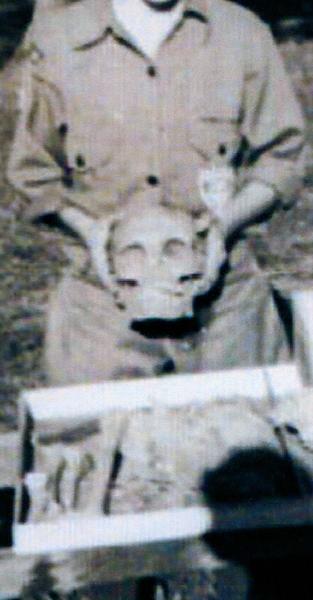
Events
| Birth | Bet 1769 and 1774 | ??England | |||
| Census | 1790 | Same man?, Laurens Co., South Carolina | |||
| Tax List | 1802 | One white over 21, personal tax only - Adair Co., Kentucky | |||
| Tax List - Real property | 1803 | 1 white male over 21 plus one horse. - 30 acres on the Cumberland, Adair Co., Kentucky | |||
| Property | 15 Nov 1808 | Deed from Director of the Town of Hillsboro to Edward J. Swanson, land in Hillsboro. Book E page 259. Transcription in book by David N. McBride. - Hillsboro, Highland Co., Ohio | |||
| Property | 12 Dec 1808 | Adam Brouse and Sarah his wife to Edward J. Swanson, land in Hillsboro. Transcription in book by David N. McBride. - Hillsboro, Highland Co., Ohio | |||
| Marriage | Bef 24 Jun 1809 | Mary | |||
| Property Sale | 24 Jun 1809 | Deed from Edward J. Swanson and Mary his wife to Benj. Golliday, land in Hillsboro. Transcription in book by David N. McBride. - Hillsboro, Highland Co., Ohio | |||
| Poll Books | 10 Oct 1809 | Poll Book for election in Liberty Twp., Highland Co., OH, published in Roots & Shoots, Spring 1992, lists Edward T. Swanson. - Liberty Twp., Highland Co., Ohio | |||
| Property Sale | 31 Oct 1809 | Deed from Edward J. Swanson and Mary his wife to James D. Scott, land in Hillsboro. Transcription in book by David N. McBride. - Hillsboro, Highland Co., Ohio | |||
| Poll Books | 11 Aug 1810 | Poll Book for election in Liberty Twp., Highland Co., OH, published in Roots & Shoots, Fall, 1992, lists Edward I. Swanson. - Liberty Twp., Highland Co., Ohio | |||
| Poll Books | 9 Oct 1810 | Poll Book for election in Liberty Twp., Highland Co., OH, published in Roots & Shoots, Summer, 1992, lists Edward I. Swanson. - Liberty Twp., Highland Co., Ohio | |||
| Marriage | 18 Jun 1811 | Franklin Co., Indiana - Mary MYERS |  | ||
| Military | Bet 28 Nov 1812 and 28 Feb 1813 | Private in Capt. William Holeman's Co., Indiana Militia. "Indiana War - Wayne Co., Indiana | |||
| Property | 28 Dec 1813 | With Michael Cullver, applied for patent on 156 acres at NE qtr S35 T12 2nd Rne of the Cincinnati dist, lying W. of the meridian line drawn from the mouth of the Great Miami River. Copy of patent in possession of the author. In Union Co. 1st Entry Book. - Union Co., Indiana | |||
| Census | 1820 | Brownsville Twp., Fayette Co., IN. | |||
| Residence | 1821 | In Union Twp., Ben Davis' Creek. Edward is listed as one of the very earliest to settle there. "History of Rush County, Indiana" 1888, Brant & Fuller, Chicago. - Union Twp., Rush Co., Indiana | |||
| Court Records | Oct 1822 | Edward was foreman of the Grand Jury in Rush Co., IN. - Rush Co., Indiana | |||
| Court Records | Mar 1827 | Edward paid $3.12 1/2 for work done on the farm for the Estate of John Harlock, Rush Co., IN. Probate Order Book V. 1-2, pg. 18, LDS film 1630370. Copy in file. - Rush Co., Indiana |  | | |
| Miscellaneous | Jan 1828 - Jul 1828 | Pages showing amount of rent paid and items purchased. - Rush Co., Indiana | | ||
| Miscellaneous | Oct 1828 | Edward shot and killed Elisha Clark - John Arnold's home and store, Union Twp., Rush Co., Indiana | |||
| Death | 11 May 1829 | Rushville, Rush Co., IN | |||
| Burial | 11 May 1929 | on David Looney's property, Rushville, Rush Co., Indiana | |||
| Reference No | 886 |
Families
| Spouse | Mary MYERS (1781 - 1853) |
| Child | John Henry SWANSON (1812 - 1863) |
| Child | Mary SWANSON (1814 - 1884) |
| Child | Edward J. SWANSON (1820 - 1852) |
| Spouse | Mary ( - 1811) |
| Child | Narcissa SWANSON (1810 - 1876) |
Notes
Court Records
On 25 Apr 2011, Eleanor Arnold, historian of Rush County, gave me a copy of a page with this receipt, written and signed by Edward J. Swanson. It shows date 26 day of August, but no year. There are two other receipts on that page dated in 1824.Endnotes
1. Indiana Marriages Through 1850atwww.state.lib.in.us/www/indiana/genealogy/mirr.html.
2. Franklin County, IN, records.
3. Probate File.
4. Original ledger in possession of Eleanor Arnold. Copies obtained April, 2011, from her. .