Individual Details
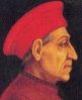
Cosimo de' Medici - il Pater Patrie
(10 Apr 1389 - 1 Aug 1464)
Cosimo was born in 1389, the son of Giovanni di Bicci de'Medici, and Piccarda (Nannina) Bueri. About 1416 he married Contessina de Bardi, daughter of Giovanni de Bardi, conte di Vernio, and Emilia Pannochieschi, dei conti d'Elci. They had two sons, Piero and Giovanni, who would both have progeny.
Cosimo was quietly dressed, modest in speech, and never conspicuous in the social life of Florence. By nature he was inclined to a scholarly life. He had an excellent classical education, learning Latin, German, and French; from an early age he cultivated the humanists in Florence and began to assemble a formidable collection of manuscripts.
Under Cosimo's sponsorship, Marsilio Ficino (1433-1499) one of the most influential humanist philosophers of the early Italian Renaissance, started a Platonic academy at the Villa Medici at Careggi outside Florence. Ficino a reviver of Neo-Platonism was in touch with every major academic thinker and writer of his day, and the first translator of Plato's complete extant works into Latin. His Florentine Academy, an attempt to revive Plato's school, had enormous influence on the direction and tenor of the Italian Renaissance and the development of European philosophy. However it was Giorgio Gemistos, known as Plethon (a 'second Plato'), who was the hidden hand providing the inspiration for Cosimo's actions. Gemistos met Cosimo in 1437 when Gemistos attended the ecumenical council of Florence/Ferrara as an unofficial advisor to the Greek delegation. During this council he spent time with Cosimo. His inspired vision of transforming religion and culture through a spiritual revival led Cosimo to redirect his own life. He began a fervent pursuit of the translation and introduction of classical texts and metaphysical ideas.
Cosimo also had a strong sense of duty. Until the death of his father he had played a vital but also modest role in the family bank, and even later he seems never to have developed the aura of a great banker. But although he was always approachable and was much liked by the ordinary people of the city, he was just as sharp as his father when it came to hard business. He did in fact make the Medici bank even richer and more powerful than before.
In 1437 he bought what was perhaps the largest private library then in existence, which had been created by his friend Niccolň Nicolě and consisted of over eight hundred volumes. To this he added his own library. To house this collection Cosimo commissioned Michelozzi to design a library in the monastery of San Marco, and in 1444 he opened the first public library in Europe. This lead in scholarship was paralleled by lavish promotion of the visual arts.
Cosimo died at the Villa Medici at Careggi on 1 August 1464.
Source: Leo vsan de Pas
Cosimo was quietly dressed, modest in speech, and never conspicuous in the social life of Florence. By nature he was inclined to a scholarly life. He had an excellent classical education, learning Latin, German, and French; from an early age he cultivated the humanists in Florence and began to assemble a formidable collection of manuscripts.
Under Cosimo's sponsorship, Marsilio Ficino (1433-1499) one of the most influential humanist philosophers of the early Italian Renaissance, started a Platonic academy at the Villa Medici at Careggi outside Florence. Ficino a reviver of Neo-Platonism was in touch with every major academic thinker and writer of his day, and the first translator of Plato's complete extant works into Latin. His Florentine Academy, an attempt to revive Plato's school, had enormous influence on the direction and tenor of the Italian Renaissance and the development of European philosophy. However it was Giorgio Gemistos, known as Plethon (a 'second Plato'), who was the hidden hand providing the inspiration for Cosimo's actions. Gemistos met Cosimo in 1437 when Gemistos attended the ecumenical council of Florence/Ferrara as an unofficial advisor to the Greek delegation. During this council he spent time with Cosimo. His inspired vision of transforming religion and culture through a spiritual revival led Cosimo to redirect his own life. He began a fervent pursuit of the translation and introduction of classical texts and metaphysical ideas.
Cosimo also had a strong sense of duty. Until the death of his father he had played a vital but also modest role in the family bank, and even later he seems never to have developed the aura of a great banker. But although he was always approachable and was much liked by the ordinary people of the city, he was just as sharp as his father when it came to hard business. He did in fact make the Medici bank even richer and more powerful than before.
In 1437 he bought what was perhaps the largest private library then in existence, which had been created by his friend Niccolň Nicolě and consisted of over eight hundred volumes. To this he added his own library. To house this collection Cosimo commissioned Michelozzi to design a library in the monastery of San Marco, and in 1444 he opened the first public library in Europe. This lead in scholarship was paralleled by lavish promotion of the visual arts.
Cosimo died at the Villa Medici at Careggi on 1 August 1464.
Source: Leo vsan de Pas
Events
| Birth | 10 Apr 1389 | Firence | |||
| Death | 1 Aug 1464 | Villa Careggi, Firence | |||
| Biography |  |  |
Families
| Spouse | Contessina di Bardi (1396 - 1473) |
| Child | Piero I. de' Medici - il Gottoso (1416 - 1469) |
| Father | Giovanni di Bicci de' Medici (1360 - 1429) |
| Mother | Picarda "Nannina" Bueri ( - 1432) |
| Sibling | Lorenzo de' Medici - il Vecchio (1395 - 1440) |
Notes
Biography
Cosimo was born in 1389, the son of Giovanni di Bicci de'Medici, and Piccarda (Nannina) Bueri. About 1416 he married Contessina de Bardi, daughter of Giovanni de Bardi, conte di Vernio, and Emilia Pannochieschi, dei conti d'Elci. They had two sons, Piero and Giovanni, who would both have progeny.Cosimo was quietly dressed, modest in speech, and never conspicuous in the social life of Florence. By nature he was inclined to a scholarly life. He had an excellent classical education, learning Latin, German, and French; from an early age he cultivated the humanists in Florence and began to assemble a formidable collection of manuscripts.
Under Cosimo's sponsorship, Marsilio Ficino (1433-1499) one of the most influential humanist philosophers of the early Italian Renaissance, started a Platonic academy at the Villa Medici at Careggi outside Florence. Ficino a reviver of Neo-Platonism was in touch with every major academic thinker and writer of his day, and the first translator of Plato's complete extant works into Latin. His Florentine Academy, an attempt to revive Plato's school, had enormous influence on the direction and tenor of the Italian Renaissance and the development of European philosophy. However it was Giorgio Gemistos, known as Plethon (a 'second Plato'), who was the hidden hand providing the inspiration for Cosimo's actions. Gemistos met Cosimo in 1437 when Gemistos attended the ecumenical council of Florence/Ferrara as an unofficial advisor to the Greek delegation. During this council he spent time with Cosimo. His inspired vision of transforming religion and culture through a spiritual revival led Cosimo to redirect his own life. He began a fervent pursuit of the translation and introduction of classical texts and metaphysical ideas.
Cosimo also had a strong sense of duty. Until the death of his father he had played a vital but also modest role in the family bank, and even later he seems never to have developed the aura of a great banker. But although he was always approachable and was much liked by the ordinary people of the city, he was just as sharp as his father when it came to hard business. He did in fact make the Medici bank even richer and more powerful than before.
In 1437 he bought what was perhaps the largest private library then in existence, which had been created by his friend Niccolò Nicolì and consisted of over eight hundred volumes. To this he added his own library. To house this collection Cosimo commissioned Michelozzi to design a library in the monastery of San Marco, and in 1444 he opened the first public library in Europe. This lead in scholarship was paralleled by lavish promotion of the visual arts.
Cosimo died at the Villa Medici at Careggi on 1 August 1464.
Source: Leo van de Pas
Endnotes
1. Genealogics.org, Leo van de Pas online [http://www.genealogics.org/index.php], accessed 2008 on, http://www.genealogics.org/getperson.php?personID=I00010767&tree=LEO.