Individual Details
Pope Paulus III (Alessandro Farnese)
(29 Feb 1468 - 10 Nov 1549)
Pope Paul III (Alessandro Farnese) 1534-1549 (1468)
Born at Rome or Canino, 29 Feb., 1468; elected, 12 Oct., 1534; died at Rome, 10 Nov., 1549. The Farnese were an ancient Roman family whose possessions clustered about the Lake at Bolsena. Although counted among the Roman aristocrats, they first appear in history associated with Viterbo and Orvieto. Among the witnesses to the Treaty of Venice between Barbarossa and the pope, we find the signature of a Farnese as Rector of Orvieto; a Farnese bishop consecrated the cathedral there. During the interminable feuds which distracted the peninsula, the Farnese were consistently Guelph. The grandfather of the future pontiff was commander-in-chief of the papal troops under Eugenius IV; his oldest son perished in the battle of Fornuovo; the second, Pier Luigi, married Giovannella Gaetani, sister to the Lord of Sermoneta. Among their children were the beautiful Giulia, who married an Orsini, and Alessandro, later Paul III. Alessandro received the best education that his age could offer; first at Rome, where he had Pomponio Leto for a tutor; later at Florence in the palace of Lorenzo the Magnificent, where he formed his friendship with the future Leo X, six years his junior. His contemporaries praise his proficiency in all the learning of the Renaissance, especially in his mastery of classical Latin and Italian. With such advantages of birth and talent, his advancement in the ecclesiastical career was assured and rapid. On 20 Sept., 1493 (Eubel), he was created by Alexander VI cardinal-deacon with the title SS. Cosmas and Damian. He wore the purple for over forty years, passing through the several gradations, until he became Dean of the Sacred College. In accordance with the abuses of his time, he accumulated a number of opulent benefices, and spent his immense revenue with a generosity which won for him the praises of artists and the affection of the Roman populace. His native ability and diplomatic skill, acquired by long experience, made him tower above his colleagues in the Sacred College, even as his Palazzo Farnese excelled in magnificence all the other palaces of Rome. That he continued to grow in favour under pontiffs so different in character as the Borgia, Rovera, and Medici popes is a sufficient proof of his tact.
He had already on two previous occasions, come within measurable distance of the tiara, when the conclave of 1534, almost without the formality of a ballot, proclaimed him successor to Clement VII. It was creditable to his reputation and to the good will of the cardinals, that the factions which divided the Sacred College were concordant in electing him. He was universally recognized as the man of the hour, and the piety and zeal, which had characterized him after he was ordained priest, caused men to overlook the extravagance of his earlier years.
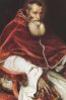
The Roman people rejoiced at the election to the tiara of the first citizen of their city since Martin V. Paul III was crowned 3 Nov., and lost no time in setting about the most needed reforms. No one, who has once studied his portrait by Titian, is likely to forget the wonderful expression of countenance of that worn-out, emaciated form. Those piercing little eyes, and that peculiar attitude of one ready to bound or to shrink, tell the story of a veteran diplomat who was not to be deceived or taken off guard. His extreme caution, and the difficulty of binding him down to a defininte obligation, drew from Pasquino the facetious remark that the third Paul was a "Vas dilationis." The elevation to the cardinalate of his grandsons, Alessandro Farnese, aged fourteen, and Guido Ascanio Sforza, aged sixteen, displeased the reform party and drew a protest from the emperor, but this was forgiven, when shortly after, he introduced into the Sacred College men of the calibre of Reginald Pole, Contanini, Sadoleto, and Caraffa.
Soon after his elevation, 2 June, 1536, Paul III summoned a general council to meet at Mantua in the following May; but the opposition of the Protestant princes and the refusal of the Duke of Mantua to assume the responsibility of maintaining order frustrated the project. He issued a new bull, convoking a council at Vicenza, 1 May, 1538; the chief obstacle was the renewed enmity of Charles V and Francis I. The aged pontiff induced them to hold a conference with him at Nizza and conclude a ten years' truce. As a token of good will, a granddaughter of Paul was married to a French prince, and the emperor gave his daughter, Margaret, to Ottavio, the son of Pier Luigi, founder of the Farnese dynasty of Parma.
Many causes contributed to delay the opening of the general council. The extension of power which a re-united Germany would place in the hands of Charles was so intolerable to Francis I, that he, who persecuted heresy in his own realm with such cruelty that the pope appealed to him to mitigate his violence, became the sworn ally of the Smalcaldic League, encouraging them to reject all overtures to reconciliation. Charles himself was in no slight measure to blame, for, notwithstanding his desire for the assembling of a council, he was led into the belief that the religious differences of Germany might be settled by conferences between the two parties. These conferences, like all such attempts to settle differences outside of the normal court of the Church, led to a waste of time, and did far more harm than good. Charles had a false idea of the office of a general council. In his desire to unite all parties, he sought for vague formulć to which all could subscribe, a relapse into the mistakes of theByzantine emperors. A council of the Church, on the other hand, must formulate the Faith with such precision that no heretic can subscribe to it. It took some years to convince the emperor and his mediating advisors that Catholicism and Protestantism are as opposite as light and darkness. Meanwhile Paul III set about the reform of the papal court with a vigour which paved the way for the disciplinary canons of Trent. He appointed commissions to report abuses of every kind; he reformed the Apostolic Camera, the tribunal of the Rota, the Penitentiaria, and the Chancery. He enhanced the prestige of the papacy by doing single-handed what his predecessors had reserved to the action of a council. In the constantly recurring quarrels between Francis and Charles, Paul III preserved a strict neutrality, notwithstanding that Charles urged him to support the empire and subject Francis to thecensures of the Church. Paul's attitude as a patriotic Italian would have been sufficient to prevent him from allowing the emperor to be sole arbiter of Italy. It was as much for the purpose of securing the integrity of the papal dominions, as for the exaltation of his family, that Paul extorted from Charles and his reluctant cardinals the erection of Piacenza and Parma into a duchy for his son, Pier Luigi. A feud arose with Gonzaga, the imperial Governor of Milan, which ended later in the assassination of Pier Luigi and the permanent alienation of Piacenza from the Papal States.
When the Treaty of Crespi (18 Sept., 1544) ended the disastrous wars between Charles and Francis, Paul energetically took up the project of convening a general council. Meanwhile it developed that the emperor had formed a programme of his own, quite at variance in some important points with the pope's. Since the Protestants repudiated a council presided over by the Roman pontiff, Charles was resolved to reduce the princes to obedience by force of arms. To this Paul did not object, and promised to aid him with three hundred thousand ducats and twenty thousand infantry; but he wisely added the proviso, that Charles should enter into no separate treaties with the heretics and make no agreement prejudicial to the Faith or to the rights of the Holy See. Charles now contended that the council should be prorogued, until victory had decided in favour of the Catholics. Furthermore, foreseeing that the struggle with the preachers of heresy would be more stubborn than the conflict with the princes, he urged the pontiff to avoid making dogmas of faith for the present and confine the labours of the council to the enforcement of discipline. To neither of these proposals could the pope agree. Finally, after endless difficulties (13 Dec., 1545) the Council of Trent held its first session. In seven sessions, the last 3 March, 1547, the Fathers intrepidly faced the most important questions of faith and discipline. Without listening to the threats and expostulations of the imperial party, they formulated for all time the Catholic doctrine on the Scriptures, original sin, justification, and the Sacraments. The work of the council was half ended, when the outbreak of the plague in Trent caused an adjournment to Bologna. Pope Paul was not the instigator of the removal of the council; he simply acquiesced in the decision of the Fathers. Fifteen prelates, devoted to the emperor, refused to leave Trent. Charles demanded the return of the council to German territory, but the deliberations of the council continued in Bologna, until finally, 21 April, the pope, in order to avert a schism, prorogued the council indefinitely. The wisdom of the council's energetic action, in establishing thus early the fundamental truths of the Catholic creed, became soon evident, when the emperor and his semi-Protestant advisers inflicted upon Germany their Interim religion, which was despised by both parties. Pope Paul, who had given the emperor essential aid in the Smalcaldic war, resented his dabbling in theology, and their estrangement continued until the death of the pontiff.
Paul's end came rather suddenly. After the assassination of Pier Luigi, he had struggled to retain Piacenza and Parma for the Church and had deprived Ottavio, Pier Luigi's son and Charles's son-in-law, of these duchies. Ottavio, relying on the emperor's benevolence, refusedobedience; it broke the old man's heart, when he learned that his favourite grandson, Cardinal Farnese, was a party to the transaction. He fell into a violent fever and died at the Quirinal, at the age of eighty-two. He lies buried in St. Peter's in the tomb designed by Michelangelo and erected by Guglielmo della Porta. Not all the popes repose in monuments corresponding to their importance in the history of the Church; but few will be disposed to contest the right of Farnese to rest directly under Peter's chair. He had his faults; but they injured no one but himself. The fifteen years of his pontificate saw the complete restoration of Catholic faith and piety. He was succeeded by many saintly pontiffs, but not one of them possessed all his commanding virtues. In Rome his name is written all over the city he renovated. The Pauline chapel, Michelangelo's work in the Sistine, the streets of Rome, which he straightened and broadened, the numerous objects of art associated with the name of Farnese, all speak eloquently of the remarkable personality of the pontiff who turned the tide in favour of religion. If to this we add the favour accorded by Paul to the new religious orders then appearing, the Capuchins, Barnabites, Theatines, Jesuits, Ursulines, and many others, we are forced to confess that his reign was one of the most fruitful in the annals of the Church.
Publication information
Written by James F. Loughlin. Transcribed by WGKofron. With thanks to St. Mary's Church, Akron, Ohio
The Catholic Encyclopedia, Volume XI. Published 1911. New York: Robert Appleton Company. Nihil Obstat, February 1, 1911. Remy Lafort, S.T.D., Censor. Imprimatur. +John Cardinal Farley, Archbishop of New York
Bibliography
PANVINIUS, Pont. Romanorum vitć; PALLAVICINI, Concilio di Trento; PASTOR, Gesch. der Päpste, V; EHSES, Concilium Tridentinum, V; VON RANKE, Hist. of the Popes in the XVI-XVIII Centuries: ARTAUD DE MONTOR, Hist. of the Popes (New York, 1867).
Source: New Advent, The Catholic Encyclopedia
http://www.newadvent.org/cathen/11579a.htm
Born at Rome or Canino, 29 Feb., 1468; elected, 12 Oct., 1534; died at Rome, 10 Nov., 1549. The Farnese were an ancient Roman family whose possessions clustered about the Lake at Bolsena. Although counted among the Roman aristocrats, they first appear in history associated with Viterbo and Orvieto. Among the witnesses to the Treaty of Venice between Barbarossa and the pope, we find the signature of a Farnese as Rector of Orvieto; a Farnese bishop consecrated the cathedral there. During the interminable feuds which distracted the peninsula, the Farnese were consistently Guelph. The grandfather of the future pontiff was commander-in-chief of the papal troops under Eugenius IV; his oldest son perished in the battle of Fornuovo; the second, Pier Luigi, married Giovannella Gaetani, sister to the Lord of Sermoneta. Among their children were the beautiful Giulia, who married an Orsini, and Alessandro, later Paul III. Alessandro received the best education that his age could offer; first at Rome, where he had Pomponio Leto for a tutor; later at Florence in the palace of Lorenzo the Magnificent, where he formed his friendship with the future Leo X, six years his junior. His contemporaries praise his proficiency in all the learning of the Renaissance, especially in his mastery of classical Latin and Italian. With such advantages of birth and talent, his advancement in the ecclesiastical career was assured and rapid. On 20 Sept., 1493 (Eubel), he was created by Alexander VI cardinal-deacon with the title SS. Cosmas and Damian. He wore the purple for over forty years, passing through the several gradations, until he became Dean of the Sacred College. In accordance with the abuses of his time, he accumulated a number of opulent benefices, and spent his immense revenue with a generosity which won for him the praises of artists and the affection of the Roman populace. His native ability and diplomatic skill, acquired by long experience, made him tower above his colleagues in the Sacred College, even as his Palazzo Farnese excelled in magnificence all the other palaces of Rome. That he continued to grow in favour under pontiffs so different in character as the Borgia, Rovera, and Medici popes is a sufficient proof of his tact.
He had already on two previous occasions, come within measurable distance of the tiara, when the conclave of 1534, almost without the formality of a ballot, proclaimed him successor to Clement VII. It was creditable to his reputation and to the good will of the cardinals, that the factions which divided the Sacred College were concordant in electing him. He was universally recognized as the man of the hour, and the piety and zeal, which had characterized him after he was ordained priest, caused men to overlook the extravagance of his earlier years.
The Roman people rejoiced at the election to the tiara of the first citizen of their city since Martin V. Paul III was crowned 3 Nov., and lost no time in setting about the most needed reforms. No one, who has once studied his portrait by Titian, is likely to forget the wonderful expression of countenance of that worn-out, emaciated form. Those piercing little eyes, and that peculiar attitude of one ready to bound or to shrink, tell the story of a veteran diplomat who was not to be deceived or taken off guard. His extreme caution, and the difficulty of binding him down to a defininte obligation, drew from Pasquino the facetious remark that the third Paul was a "Vas dilationis." The elevation to the cardinalate of his grandsons, Alessandro Farnese, aged fourteen, and Guido Ascanio Sforza, aged sixteen, displeased the reform party and drew a protest from the emperor, but this was forgiven, when shortly after, he introduced into the Sacred College men of the calibre of Reginald Pole, Contanini, Sadoleto, and Caraffa.
Soon after his elevation, 2 June, 1536, Paul III summoned a general council to meet at Mantua in the following May; but the opposition of the Protestant princes and the refusal of the Duke of Mantua to assume the responsibility of maintaining order frustrated the project. He issued a new bull, convoking a council at Vicenza, 1 May, 1538; the chief obstacle was the renewed enmity of Charles V and Francis I. The aged pontiff induced them to hold a conference with him at Nizza and conclude a ten years' truce. As a token of good will, a granddaughter of Paul was married to a French prince, and the emperor gave his daughter, Margaret, to Ottavio, the son of Pier Luigi, founder of the Farnese dynasty of Parma.
Many causes contributed to delay the opening of the general council. The extension of power which a re-united Germany would place in the hands of Charles was so intolerable to Francis I, that he, who persecuted heresy in his own realm with such cruelty that the pope appealed to him to mitigate his violence, became the sworn ally of the Smalcaldic League, encouraging them to reject all overtures to reconciliation. Charles himself was in no slight measure to blame, for, notwithstanding his desire for the assembling of a council, he was led into the belief that the religious differences of Germany might be settled by conferences between the two parties. These conferences, like all such attempts to settle differences outside of the normal court of the Church, led to a waste of time, and did far more harm than good. Charles had a false idea of the office of a general council. In his desire to unite all parties, he sought for vague formulć to which all could subscribe, a relapse into the mistakes of theByzantine emperors. A council of the Church, on the other hand, must formulate the Faith with such precision that no heretic can subscribe to it. It took some years to convince the emperor and his mediating advisors that Catholicism and Protestantism are as opposite as light and darkness. Meanwhile Paul III set about the reform of the papal court with a vigour which paved the way for the disciplinary canons of Trent. He appointed commissions to report abuses of every kind; he reformed the Apostolic Camera, the tribunal of the Rota, the Penitentiaria, and the Chancery. He enhanced the prestige of the papacy by doing single-handed what his predecessors had reserved to the action of a council. In the constantly recurring quarrels between Francis and Charles, Paul III preserved a strict neutrality, notwithstanding that Charles urged him to support the empire and subject Francis to thecensures of the Church. Paul's attitude as a patriotic Italian would have been sufficient to prevent him from allowing the emperor to be sole arbiter of Italy. It was as much for the purpose of securing the integrity of the papal dominions, as for the exaltation of his family, that Paul extorted from Charles and his reluctant cardinals the erection of Piacenza and Parma into a duchy for his son, Pier Luigi. A feud arose with Gonzaga, the imperial Governor of Milan, which ended later in the assassination of Pier Luigi and the permanent alienation of Piacenza from the Papal States.
When the Treaty of Crespi (18 Sept., 1544) ended the disastrous wars between Charles and Francis, Paul energetically took up the project of convening a general council. Meanwhile it developed that the emperor had formed a programme of his own, quite at variance in some important points with the pope's. Since the Protestants repudiated a council presided over by the Roman pontiff, Charles was resolved to reduce the princes to obedience by force of arms. To this Paul did not object, and promised to aid him with three hundred thousand ducats and twenty thousand infantry; but he wisely added the proviso, that Charles should enter into no separate treaties with the heretics and make no agreement prejudicial to the Faith or to the rights of the Holy See. Charles now contended that the council should be prorogued, until victory had decided in favour of the Catholics. Furthermore, foreseeing that the struggle with the preachers of heresy would be more stubborn than the conflict with the princes, he urged the pontiff to avoid making dogmas of faith for the present and confine the labours of the council to the enforcement of discipline. To neither of these proposals could the pope agree. Finally, after endless difficulties (13 Dec., 1545) the Council of Trent held its first session. In seven sessions, the last 3 March, 1547, the Fathers intrepidly faced the most important questions of faith and discipline. Without listening to the threats and expostulations of the imperial party, they formulated for all time the Catholic doctrine on the Scriptures, original sin, justification, and the Sacraments. The work of the council was half ended, when the outbreak of the plague in Trent caused an adjournment to Bologna. Pope Paul was not the instigator of the removal of the council; he simply acquiesced in the decision of the Fathers. Fifteen prelates, devoted to the emperor, refused to leave Trent. Charles demanded the return of the council to German territory, but the deliberations of the council continued in Bologna, until finally, 21 April, the pope, in order to avert a schism, prorogued the council indefinitely. The wisdom of the council's energetic action, in establishing thus early the fundamental truths of the Catholic creed, became soon evident, when the emperor and his semi-Protestant advisers inflicted upon Germany their Interim religion, which was despised by both parties. Pope Paul, who had given the emperor essential aid in the Smalcaldic war, resented his dabbling in theology, and their estrangement continued until the death of the pontiff.
Paul's end came rather suddenly. After the assassination of Pier Luigi, he had struggled to retain Piacenza and Parma for the Church and had deprived Ottavio, Pier Luigi's son and Charles's son-in-law, of these duchies. Ottavio, relying on the emperor's benevolence, refusedobedience; it broke the old man's heart, when he learned that his favourite grandson, Cardinal Farnese, was a party to the transaction. He fell into a violent fever and died at the Quirinal, at the age of eighty-two. He lies buried in St. Peter's in the tomb designed by Michelangelo and erected by Guglielmo della Porta. Not all the popes repose in monuments corresponding to their importance in the history of the Church; but few will be disposed to contest the right of Farnese to rest directly under Peter's chair. He had his faults; but they injured no one but himself. The fifteen years of his pontificate saw the complete restoration of Catholic faith and piety. He was succeeded by many saintly pontiffs, but not one of them possessed all his commanding virtues. In Rome his name is written all over the city he renovated. The Pauline chapel, Michelangelo's work in the Sistine, the streets of Rome, which he straightened and broadened, the numerous objects of art associated with the name of Farnese, all speak eloquently of the remarkable personality of the pontiff who turned the tide in favour of religion. If to this we add the favour accorded by Paul to the new religious orders then appearing, the Capuchins, Barnabites, Theatines, Jesuits, Ursulines, and many others, we are forced to confess that his reign was one of the most fruitful in the annals of the Church.
Publication information
Written by James F. Loughlin. Transcribed by WGKofron. With thanks to St. Mary's Church, Akron, Ohio
The Catholic Encyclopedia, Volume XI. Published 1911. New York: Robert Appleton Company. Nihil Obstat, February 1, 1911. Remy Lafort, S.T.D., Censor. Imprimatur. +John Cardinal Farley, Archbishop of New York
Bibliography
PANVINIUS, Pont. Romanorum vitć; PALLAVICINI, Concilio di Trento; PASTOR, Gesch. der Päpste, V; EHSES, Concilium Tridentinum, V; VON RANKE, Hist. of the Popes in the XVI-XVIII Centuries: ARTAUD DE MONTOR, Hist. of the Popes (New York, 1867).
Source: New Advent, The Catholic Encyclopedia
http://www.newadvent.org/cathen/11579a.htm
Events
| Birth | 29 Feb 1468 | Canino |  | ||
| Death | 10 Nov 1549 | Roma, Roma | |||
| Biography | Biography | |  |
Families
| Spouse | Silvia Ruffini (1475 - 1561) |
| Child | Constanza Farnese (1500 - ) |
| Child | Pier Luigi Farnese Duke of Parma (1503 - 1547) |
| Father | Pier Luigi Farnese of Montalto (1445 - 1487) |
| Mother | Giovana Caetani ( - ) |
| Sibling | Angelo Farnese ( - ) |
Notes
Birth
Alessandro Farnese, who became Paul III, was born on Feb. 29, 1468, in Canino into one of the more powerful Renaissance families of northern Italy. After his education in Rome and in Florence at the court of Lorenzo de' Medici, he entered the service of the Church. Created a cardinal in 1493 by Pope Alexander VI, he continued his warm friendships with artists, scholars, and humanists. He was ordained in 1519. In the conclaves of 1521 and 1523 he was almost elected to the papacy . This office he received on Oct. 13, 1534.During his 15 years as pope, Paul III created a new atmosphere about the papacy. He raised to the College of Cardinals most exemplary men, such as Marcello Cervini (who became Marcellus II), Reginald Pole, Giampietro Carafa (later Paul IV), and Gasparo Contarini. In 1526 Paul inaugurated the incisive review of the central problem of reform in the Church known as the Consilium de emandanda ecclesia. In 1542 he founded the Congregation of the Roman Inquisition , or the Holy Office, as the final court of appeal in trials of heresy . He encouraged many new religious communities and gave papal approbation of the Society of Jesus (Jesuits) in 1540 and of the Ursulines in 1544.
Paul's greatest encouragement to the Catholic reform was the opening of an ecumenical council which he tried to inaugurate as early as 1537 at Mantua. Because of immense difficulties, arising in large measure from the international rivalry between the Holy Roman emperor Charles V and the French king Francis I, he succeeded only in December 1545 in getting the council under way at Trent. Further difficulties followed, and Paul transferred the council to Bologna in February 1548 and finally suspended it in September 1549.
Retaining his early enthusiasm for art and scholarship, Paul was ambitious to give Rome the primacy in these fields. He restored the Roman University, which had been utterly destroyed in the sack of Rome (1527), and energetically tried to staff it with outstanding scholars. He arranged for new catalogs in the Vatican Library and for the preservation of damaged manuscripts. He commissioned Michelangelo to paint the Last Judgment in the Sistine Chapel and to reconstruct St. Peter's and the Capitol.
Paul marred his reign by the concern, so typical of the Renaissance, for the advancement of his family. He installed Pierluigi Farnese, one of the four natural children he had fathered before he became pope, as the Duke of Parma and Piacenza. After Paul became pope, he made two of his grandsons cardinals. Paul died on Nov. 10, 1549.
Biography
Pope Paul III (Alessandro Farnese) 1534-1549 (1468)Born at Rome or Canino, 29 Feb., 1468; elected, 12 Oct., 1534; died at Rome, 10 Nov., 1549. The Farnese were an ancient Roman family whose possessions clustered about the Lake at Bolsena. Although counted among the Roman aristocrats, they first appear in history associated with Viterbo and Orvieto. Among the witnesses to the Treaty of Venice between Barbarossa and the pope, we find the signature of a Farnese as Rector of Orvieto; a Farnese bishop consecrated the cathedral there. During the interminable feuds which distracted the peninsula, the Farnese were consistently Guelph. The grandfather of the future pontiff was commander-in-chief of the papal troops under Eugenius IV; his oldest son perished in the battle of Fornuovo; the second, Pier Luigi, married Giovannella Gaetani, sister to the Lord of Sermoneta. Among their children were the beautiful Giulia, who married an Orsini, and Alessandro, later Paul III. Alessandro received the best education that his age could offer; first at Rome, where he had Pomponio Leto for a tutor; later at Florence in the palace of Lorenzo the Magnificent, where he formed his friendship with the future Leo X, six years his junior. His contemporaries praise his proficiency in all the learning of the Renaissance, especially in his mastery of classical Latin and Italian. With such advantages of birth and talent, his advancement in the ecclesiastical career was assured and rapid. On 20 Sept., 1493 (Eubel), he was created by Alexander VI cardinal-deacon with the title SS. Cosmas and Damian. He wore the purple for over forty years, passing through the several gradations, until he became Dean of the Sacred College. In accordance with the abuses of his time, he accumulated a number of opulent benefices, and spent his immense revenue with a generosity which won for him the praises of artists and the affection of the Roman populace. His native ability and diplomatic skill, acquired by long experience, made him tower above his colleagues in the Sacred College, even as his Palazzo Farnese excelled in magnificence all the other palaces of Rome. That he continued to grow in favour under pontiffs so different in character as the Borgia, Rovera, and Medici popes is a sufficient proof of his tact.
He had already on two previous occasions, come within measurable distance of the tiara, when the conclave of 1534, almost without the formality of a ballot, proclaimed him successor to Clement VII. It was creditable to his reputation and to the good will of the cardinals, that the factions which divided the Sacred College were concordant in electing him. He was universally recognized as the man of the hour, and the piety and zeal, which had characterized him after he was ordained priest, caused men to overlook the extravagance of his earlier years.
The Roman people rejoiced at the election to the tiara of the first citizen of their city since Martin V. Paul III was crowned 3 Nov., and lost no time in setting about the most needed reforms. No one, who has once studied his portrait by Titian, is likely to forget the wonderful expression of countenance of that worn-out, emaciated form. Those piercing little eyes, and that peculiar attitude of one ready to bound or to shrink, tell the story of a veteran diplomat who was not to be deceived or taken off guard. His extreme caution, and the difficulty of binding him down to a defininte obligation, drew from Pasquino the facetious remark that the third Paul was a "Vas dilationis." The elevation to the cardinalate of his grandsons, Alessandro Farnese, aged fourteen, and Guido Ascanio Sforza, aged sixteen, displeased the reform party and drew a protest from the emperor, but this was forgiven, when shortly after, he introduced into the Sacred College men of the calibre of Reginald Pole, Contanini, Sadoleto, and Caraffa.
Soon after his elevation, 2 June, 1536, Paul III summoned a general council to meet at Mantua in the following May; but the opposition of the Protestant princes and the refusal of the Duke of Mantua to assume the responsibility of maintaining order frustrated the project. He issued a new bull, convoking a council at Vicenza, 1 May, 1538; the chief obstacle was the renewed enmity of Charles V and Francis I. The aged pontiff induced them to hold a conference with him at Nizza and conclude a ten years' truce. As a token of good will, a granddaughter of Paul was married to a French prince, and the emperor gave his daughter, Margaret, to Ottavio, the son of Pier Luigi, founder of the Farnese dynasty of Parma.
Many causes contributed to delay the opening of the general council. The extension of power which a re-united Germany would place in the hands of Charles was so intolerable to Francis I, that he, who persecuted heresy in his own realm with such cruelty that the pope appealed to him to mitigate his violence, became the sworn ally of the Smalcaldic League, encouraging them to reject all overtures to reconciliation. Charles himself was in no slight measure to blame, for, notwithstanding his desire for the assembling of a council, he was led into the belief that the religious differences of Germany might be settled by conferences between the two parties. These conferences, like all such attempts to settle differences outside of the normal court of the Church, led to a waste of time, and did far more harm than good. Charles had a false idea of the office of a general council. In his desire to unite all parties, he sought for vague formulæ to which all could subscribe, a relapse into the mistakes of theByzantine emperors. A council of the Church, on the other hand, must formulate the Faith with such precision that no heretic can subscribe to it. It took some years to convince the emperor and his mediating advisors that Catholicism and Protestantism are as opposite as light and darkness. Meanwhile Paul III set about the reform of the papal court with a vigour which paved the way for the disciplinary canons of Trent. He appointed commissions to report abuses of every kind; he reformed the Apostolic Camera, the tribunal of the Rota, the Penitentiaria, and the Chancery. He enhanced the prestige of the papacy by doing single-handed what his predecessors had reserved to the action of a council. In the constantly recurring quarrels between Francis and Charles, Paul III preserved a strict neutrality, notwithstanding that Charles urged him to support the empire and subject Francis to thecensures of the Church. Paul's attitude as a patriotic Italian would have been sufficient to prevent him from allowing the emperor to be sole arbiter of Italy. It was as much for the purpose of securing the integrity of the papal dominions, as for the exaltation of his family, that Paul extorted from Charles and his reluctant cardinals the erection of Piacenza and Parma into a duchy for his son, Pier Luigi. A feud arose with Gonzaga, the imperial Governor of Milan, which ended later in the assassination of Pier Luigi and the permanent alienation of Piacenza from the Papal States.
When the Treaty of Crespi (18 Sept., 1544) ended the disastrous wars between Charles and Francis, Paul energetically took up the project of convening a general council. Meanwhile it developed that the emperor had formed a programme of his own, quite at variance in some important points with the pope's. Since the Protestants repudiated a council presided over by the Roman pontiff, Charles was resolved to reduce the princes to obedience by force of arms. To this Paul did not object, and promised to aid him with three hundred thousand ducats and twenty thousand infantry; but he wisely added the proviso, that Charles should enter into no separate treaties with the heretics and make no agreement prejudicial to the Faith or to the rights of the Holy See. Charles now contended that the council should be prorogued, until victory had decided in favour of the Catholics. Furthermore, foreseeing that the struggle with the preachers of heresy would be more stubborn than the conflict with the princes, he urged the pontiff to avoid making dogmas of faith for the present and confine the labours of the council to the enforcement of discipline. To neither of these proposals could the pope agree. Finally, after endless difficulties (13 Dec., 1545) the Council of Trent held its first session. In seven sessions, the last 3 March, 1547, the Fathers intrepidly faced the most important questions of faith and discipline. Without listening to the threats and expostulations of the imperial party, they formulated for all time the Catholic doctrine on the Scriptures, original sin, justification, and the Sacraments. The work of the council was half ended, when the outbreak of the plague in Trent caused an adjournment to Bologna. Pope Paul was not the instigator of the removal of the council; he simply acquiesced in the decision of the Fathers. Fifteen prelates, devoted to the emperor, refused to leave Trent. Charles demanded the return of the council to German territory, but the deliberations of the council continued in Bologna, until finally, 21 April, the pope, in order to avert a schism, prorogued the council indefinitely. The wisdom of the council's energetic action, in establishing thus early the fundamental truths of the Catholic creed, became soon evident, when the emperor and his semi-Protestant advisers inflicted upon Germany their Interim religion, which was despised by both parties. Pope Paul, who had given the emperor essential aid in the Smalcaldic war, resented his dabbling in theology, and their estrangement continued until the death of the pontiff.
Paul's end came rather suddenly. After the assassination of Pier Luigi, he had struggled to retain Piacenza and Parma for the Church and had deprived Ottavio, Pier Luigi's son and Charles's son-in-law, of these duchies. Ottavio, relying on the emperor's benevolence, refusedobedience; it broke the old man's heart, when he learned that his favourite grandson, Cardinal Farnese, was a party to the transaction. He fell into a violent fever and died at the Quirinal, at the age of eighty-two. He lies buried in St. Peter's in the tomb designed by Michelangelo and erected by Guglielmo della Porta. Not all the popes repose in monuments corresponding to their importance in the history of the Church; but few will be disposed to contest the right of Farnese to rest directly under Peter's chair. He had his faults; but they injured no one but himself. The fifteen years of his pontificate saw the complete restoration of Catholic faith and piety. He was succeeded by many saintly pontiffs, but not one of them possessed all his commanding virtues. In Rome his name is written all over the city he renovated. The Pauline chapel, Michelangelo's work in the Sistine, the streets of Rome, which he straightened and broadened, the numerous objects of art associated with the name of Farnese, all speak eloquently of the remarkable personality of the pontiff who turned the tide in favour of religion. If to this we add the favour accorded by Paul to the new religious orders then appearing, the Capuchins, Barnabites, Theatines, Jesuits, Ursulines, and many others, we are forced to confess that his reign was one of the most fruitful in the annals of the Church.
Publication information
Written by James F. Loughlin. Transcribed by WGKofron. With thanks to St. Mary's Church, Akron, Ohio
The Catholic Encyclopedia, Volume XI. Published 1911. New York: Robert Appleton Company. Nihil Obstat, February 1, 1911. Remy Lafort, S.T.D., Censor. Imprimatur. +John Cardinal Farley, Archbishop of New York
Bibliography
PANVINIUS, Pont. Romanorum vitæ; PALLAVICINI, Concilio di Trento; PASTOR, Gesch. der Päpste, V; EHSES, Concilium Tridentinum, V; VON RANKE, Hist. of the Popes in the XVI-XVIII Centuries: ARTAUD DE MONTOR, Hist. of the Popes (New York, 1867).
Source: New Advent, The Catholic Encyclopedia
http://www.newadvent.org/cathen/11579a.htm
Endnotes
1. www.newadvent.org, http://www.newadvent.org/cathen/11579a.htm.