Individual Details
Charles V, Emperor of the Holy Roman Empire
(24 Feb 1500 - 21 Sep 1558)
Charles was born in Ghent on 24 February 1500, the son of Archduke Philip of Austria and Infanta Juana of Aragón. In 1506 he succeeded his father in The Netherlands with his grandfather Emperor Maximilian as regent, and in Castile with his other grandfather King Fernando of Aragón as regent. In 1516 Charles became king of Spain and in 1519 he was elected as Emperor of the Holy Roman Empire.
Charles V was vulnerable and diffident, in no way a scholar, keen on hunting, late developing, but blessed with a good enough mind to grasp fairly quickly both the essentials and the subtleties of statesmanship and diplomacy. He was a man who could recognise his own mistakes, and he did this all his life, even though the lessons he drew from them were sometimes the wrong lessons. He was one of the most remarkable rulers ever; however his whole career was to demonstrate the limitations that hedge in even the most gifted and nominally powerful who are not also unscrupulous egotists of an essentially destructive kind.
In 1517 Martin Luther had nailed his ninety-five theses to the church-door at Wittenberg, an action that would change the world forever. Charles was to be made very acutely aware of the disintegration of Christendom during the course of his long and laborious reign.
Before his marriage he fathered three illegitimate daughters and after his marriage he fathered an illegitimate son. On 10 March 1526 in Seville he married his cousin Isabella of Portugal, the daughter of Manuel I 'o Venturoso', king of Portugal, and his second wife Maria of Aragón. They had seven children of whom two were stillborn and two died young. Their son Philip and two daughters would have progeny. On 1 May 1539 Isabella died in Toledo.
As a young emperor he had set out from his coronation to meet Luther, dedicated to the task of unifying and purifying Christendom. In this task he failed.
It was still a fine and noble thing that he had raised his family to the heights of secular power and worldly splendour. He had thus done his duty by that family, and he was glad to see it prosper. But at fifty-six he wanted no more part of it. For thirty-five years he had fought and striven for the dream of one Europe, one world. He left two worlds angrily embattled against each other.
In 1555 he handed The Netherlands over to his son Philip II, who in 1556 also succeeded him as king of Spain; on 7 September 1556 he abdicated as emperor to be succeeded by his brother Ferdinand. He had one more journey to make, to the monastery of San Geronimo de Yuste in the heart of Spain. He had two more years to live. There was nothing ascetic about those years. He lived in perfect luxury, ministered to by a miniature court of fifty, continuing to defy his gout by eating rich and rare foodstuffs brought to him on mule-back packed in ice and nettles: oysters and fish from the Atlantic coast, pâté, game and pies from the Netherlands. He was surrounded by his books, by precious objects, tapestries and pictures, pottering with his fantastic collection of clocks. He lived like a king, but a king without responsibility, without care, more comfortably than ever before in his life, while the divided world went on outside. On 21 September 1558 he died at San Yuste.
REMARKS:
111 Knight of the Order of the Golden Fleece 1501
REMARKS:
264 Knight of the Garter - 1508
OTHER TITLES:
King of Spain 1516-1556
Charles V was vulnerable and diffident, in no way a scholar, keen on hunting, late developing, but blessed with a good enough mind to grasp fairly quickly both the essentials and the subtleties of statesmanship and diplomacy. He was a man who could recognise his own mistakes, and he did this all his life, even though the lessons he drew from them were sometimes the wrong lessons. He was one of the most remarkable rulers ever; however his whole career was to demonstrate the limitations that hedge in even the most gifted and nominally powerful who are not also unscrupulous egotists of an essentially destructive kind.
In 1517 Martin Luther had nailed his ninety-five theses to the church-door at Wittenberg, an action that would change the world forever. Charles was to be made very acutely aware of the disintegration of Christendom during the course of his long and laborious reign.
Before his marriage he fathered three illegitimate daughters and after his marriage he fathered an illegitimate son. On 10 March 1526 in Seville he married his cousin Isabella of Portugal, the daughter of Manuel I 'o Venturoso', king of Portugal, and his second wife Maria of Aragón. They had seven children of whom two were stillborn and two died young. Their son Philip and two daughters would have progeny. On 1 May 1539 Isabella died in Toledo.
As a young emperor he had set out from his coronation to meet Luther, dedicated to the task of unifying and purifying Christendom. In this task he failed.
It was still a fine and noble thing that he had raised his family to the heights of secular power and worldly splendour. He had thus done his duty by that family, and he was glad to see it prosper. But at fifty-six he wanted no more part of it. For thirty-five years he had fought and striven for the dream of one Europe, one world. He left two worlds angrily embattled against each other.
In 1555 he handed The Netherlands over to his son Philip II, who in 1556 also succeeded him as king of Spain; on 7 September 1556 he abdicated as emperor to be succeeded by his brother Ferdinand. He had one more journey to make, to the monastery of San Geronimo de Yuste in the heart of Spain. He had two more years to live. There was nothing ascetic about those years. He lived in perfect luxury, ministered to by a miniature court of fifty, continuing to defy his gout by eating rich and rare foodstuffs brought to him on mule-back packed in ice and nettles: oysters and fish from the Atlantic coast, pâté, game and pies from the Netherlands. He was surrounded by his books, by precious objects, tapestries and pictures, pottering with his fantastic collection of clocks. He lived like a king, but a king without responsibility, without care, more comfortably than ever before in his life, while the divided world went on outside. On 21 September 1558 he died at San Yuste.
REMARKS:
111 Knight of the Order of the Golden Fleece 1501
REMARKS:
264 Knight of the Garter - 1508
OTHER TITLES:
King of Spain 1516-1556
Events
| Birth | 24 Feb 1500 | Gent, Belgium | |||
| Death | 21 Sep 1558 | San Yuste, Toledo | |||
| Biography |  |  | |||
| Miscellaneous | The Holy Roman Empire | | |
Families
| Spouse | Johanna Maria van der Gheynst (1502 - 1541) |
| Child | Margarethe of Austria (Habsburg) (1522 - 1586) |
Notes
Biography
Charles V, Holy Roman Emperor > WebsiteSource: http://www.timelineindex.com/content/view/1236
Charles V was Holy Roman Emperor from 1519-1558; he was also King of Spain from 1516-1556, officially as Charles I of Spain, although often referred to as Charles V ("Carlos Quinto" or "Carlos V") in Spain and Latin America. He was the son of Philip I and Joanna of Castile and grandson of Ferdinand II of Aragon and Isabella I of Castile and of Maximilian I, Holy Roman Emperor and Marie, Duchess of Burgundy.
It is hard to say what nationality Charles was. He was a Habsburg on his father's side, but he was not German. His mother tongue was French, being the language of the aristocracy in the Low Countries (modern day Belgium, Luxembourg, French région of Nord-Pas-de-Calais and the Netherlands), where he grew up. He made frequent stays in Paris in his youth, then the largest city of Western Europe which, like most aristocrats of his days, he thoroughly enjoyed. In his words: "Paris is not a city, but a universe" (Lutetia non urbs, sed orbis). He also famously said: "I speak Spanish to God, Italian to women, French to men and German to my horse." His first language was French, but he was a lifelong enemy of the king of France. His mother was Spanish, and Spain was the core of his kingdom, but he was not Spanish. He probably felt more at home in the Low Countries where he had spent his youth. In Spain he was always felt as a foreign prince, and never totally integrated
Miscellaneous
The Holy Roman EmpireIntroduction
The Holy Roman Empire (official name: sacrum romanum imperium, 1254; more details below) designates a political entity that covered a large portion of Europe, centered on Germany, from 962 to 1806.
Origin and Evolution
The Holy Roman Empire originates in the eastern half of Charlemagne's empire, divided after his death. In 800, Charlemagne had received from the pope the title of Emperor (Imperator Augustus), reminiscent of the title held by Roman emperors, both in the Rome of old and in the Byzantium of the time. By 911 eastern and western Franconia, as the area was known, had completely separated, the latter continuing as the kingdom of the Franks, or France; the former continuing as the kingdom of Germany. In 962 Otto I the Great reclaimed the imperial dignity which had lost all prestige and was conferred by popes on bit players in Italian politics. This is usually taken to be the founding date of the Holy Roman Empire.
The Holy Roman Empire (HRE) never achieved the political unification that France did; a prolonged attempt at centralizing authority starting with Maximilian I (1493-1519) was wrecked by the Reformation and the ensuing wars, culminating with the Thirty Years War (1618-48) and the Treaty of Westphalia (1648). The latter formalized the relationship between the Emperor and his vassals, who thereby achieved all but complete sovereignty. As a result, the HRE was still composed at the end of the 18th century of around 360 distinct entities, differing widely in size, rank and power. Some were kings and princes, other were counts; some were clerics, other were secular rulers.
The nature of the Holy Roman Empire: limited elective monarchy
The HRE evolved over time into a limited elective monarchy, and at the same time a state composed of many states. At its head stood an elected emperor (Kaiser), who was the sole sovereign and monarch of Germany. The exercise of his power was considerably limited, however, by a body representing the member states, the Imperial Diet (Reichstag). Although the various princes and lords of the Empire were all his vassals and subjects, they possessed a number of privileges that brought them close to de facto sovereignty; in particular, the emperor could not intervene in their particular affairs as long as they ruled according to the law.
The Empire was an elective monarchy since the end of the Carolingian dynasty in the early 10th century, although the principle was not firmly set in writing until the constitution of 1338 and the Golden Bull of 1356 (see a picture here and the text here). Later, as part of every electioral capitulation, the newly elected emperor swore not to make his office hereditary.
The Empire was also a limited monarchy, in the sense that any exercise of the Emperor's powers that was not purely executive required the assent of the States of the Empire. This principle was only formulated at the peace of Westphalia in 1648, where (art. 8, sect. 2) the circumstances requiring the assent (and not merely the advice) of the States were listed explicitly. This assent could be expressed either by the States assembled in the Reichstag, or through a duly constituted deputation; the latter means rarely employed after the Diet became permanent in 1663. Assent was determined by majority voting, except in specific matters where consensus was required, mainly in religious matters.
Parts 1, 2 and 3 of this page are devoted to the Constitution of the Empire: executive, legislative and judicial branches of government, respectively. Part 4 looks at the geographical and political structure of the Empire: that is, the sub-units that made it up.
Sources of law
The fundamental documents on the constitution of the Empire were the following (several of these documents, and many others from the 9th to the 14th c., are available at the Erlangen Institut für Geschichte):
the constitutions of Frankfurt 1220 ( original text and partial German translation) and 1232( original text and partial German translation) recognising the rights of spiritual and temporal princes
the constitution of 1338 (Frankfurt) freeing the election of the emperor from papal control
the Golden Bull of 1356 on the electors (English translation, partial German translation)
the edict of pacification (ewiger Landfriede)of 1495, on criminal justice (partial German version)
the ordinances (Ordnungen) of 1495 (revised 1555) and 1518 (revised 1654) on the courts of justice
the Capitulatio Caesarea (Wahlkapitulation), issued at each election from 1519, consolidated in a perpetual edict in 1711
the religious treaties (Passau 1552, Augsburg 1555) on religious toleration
the concordats with the Holy See: Worms 1122 ( original text and German translation) Vienna 1448
the peace treaties of Westphalia of 1648 (english translation)
the main resolution of the imperial delegation (Reichsdeputationshauptschluß) of 1803.
The Official Name of the Holy Roman Empire
The word imperium appears in official documents of Otto I, but it denotes the imperial power, not the territory. After Henry II's death some Italian magnates offered the crown of Italy to the son of the duke of Aquitaine, and swore to help him acquire the "imperium" of the Romans; here, the word meant the title itself.
One has to wait until Conrad II to find Romanum imperium used to designate the lands ruled by the emperor (documents of 1034 and 1038). Curiously, the expression Romana res publica is used with the same meaning contemporaneously. The use of the phrase Romanum imperium remains rare under Henry II (in 1049, 1053) and successors until Frederic I. It is however, occasionally used in non-official documents, such as letters, chronicles, even Papal encyclicals (in 1076).
At the same tine, one finds the expression Romanum regnum (Roman realm) in an official document of 1041. In 1045, the signature of the emperor is described as signum regis invictissimi Henrici tertii, Burgundiorum primi, Romanorum secundi. Correspondingly, the title Rex Romanorum makes its apparition in 1040, and is officially adopted in the Intitulatio in 1041 and in the monogram in 1043.
The use of Romanum imperium becomes considerably more frequent under Frederic I Barbarossa (in 1152, 1155, 1157-9, 1162), In 1157, one finds a concurrent use of sacrum imperium et diva res publica (holy empire and holy commonwealth). The phrase sacrum imperium is found again in 1161, 1164, 1174, 1184-6. In 1159, one finds sacratissimum imperium, a phrase occasionally encountered until Otto IV.
The two expressions Romanum imperium and sacrum imperium are used concurrently in official documents for a century, but one does not find the two together until 1254: sacrum Romanum imperium. From that date, the new phrase never falls out of use although the shorter formulas continue to be used commonly.
Official documents in the German language show the phrase heiliges Reich or Römisches Reich frequently in documents of Ludwig of Bavaria, but heiliges Römisches Reich is rare; it first appears in 1340. It becomes common with Charles IV (1347).
The last transformation of the official name of the Empire took place in the late 15th c. A Reformation issued at the Reichstag of Frankfurt in 1442 speaks of dem heiligen Römischen Reich und Deutschen Landern. A similar phrase appears at the Reichstag of 1471: des heiligen Römischen Reichs und der widrigen Teutschen Nation (in Latin: sacri Romani imperii ac celeberrimae nationis Germanicae), and in the Landsfriede of Nürnberg of 1487: dem heiligen Reiche und deutscher Nation, the Landsfriede of 1486: das Römische Reich Teutscher Nation, the Worms diet of 1497: das heilige Reich Teutscher Nation, and the Köln diet of 1512: des heiligen Römischen Reichs Teutscher Nation. The phrase entered the Wahlkapitulation of 1519, by which the emperor promised to reside within dem heiligen Römischen Reiche Teutscher Nation.
From the late 16th c. to the 18th c. jurists debated the meaning of the phrase. Other early 16th c. documents suggest that it originally may have meant the German part of the Empire, with deutsche Nation in opposition to fremde Nation. Interestingly, the debate in the 17th c. was whether the phrase meant that Germany happened to be an empire, or whether the Empire happened to be located mainly in Germany. Increasingly, jurists and writers used the phrase imperium Romano-Germanicum. Significantly, the final acts of the Holy Roman Empire, namely the Reichsdeputationshauptschluß of 1803, the note of the French ambassador of August 1, 1806 and the abdication of Francis II, all use the phrase Deutsches Reich (confederation germanique) rather than the formal title.
(Source: Karl Zeumer: Heiliges römisches Reich deutscher Nation. in Quellen und Studien, Bd IV, Heft 2. Weimar, 1910.)
1. The Emperor
Qualifications
The Emperor had to be a worthy man, aged 18 or more, reside in the Empire, be of noble birth (all four grandparents had to be noble, according to the Schwabenspiegel), and of lay status (this was not explicitly stated). No law required that he be Catholic, and, although the text in a number of laws assumes that the emperor is Catholic, jurists saw no obstacle to the choice of a Protestant prince. Nor did he have to be German, as the examples of Alfonso of Castile and Charles V showed. By the 17th century, however, it seemed wise for any candidate to possess an estate within the boundaries of the Empire: when the French weighed in 1648 whether to let Alsace remain within the Empire, it was because it might allow the king of France to be a candidate for the throne. Similarly, in 1737 the duke of Lorraine was allowed to retain the county of Falkenstein so as not to jeopardize his future candidacy (Schoell 1:151, 2:252).
The office was not hereditary, but elective. However, from 1453 to 1740, a Habsburg was always Emperor. The last Habsburg Charles VI died leaving only daughters, and the Elector of Bavaria was elected as Charles VII in 1742, but he died in 1745 and Charles VI's son-in-law Francis of Lorraine was elected emperor in 1745; until the end of the Empire in 1806, the imperial crown was in the Habsburg-Lorraine family.
Beginning and End of Reign
The reign began with the swearing of the Wahlkapitulation, or electoral capitulation, a kind of contract between the Emperor and the Empire. Even a minor could take the oath (as did the 12-year old Joseph I in 1690), although he also promised to renew his oath upon assuming power. This oath preceded the coronation, led by the archbishop of Mainz. The imperial cities took an oath of loyalty at the time of coronation, but not the states of the empire, since each took such an oath at the time they inherited their fief.
The reign ended by death, abdication (Charles V in 1555) or deposition of the emperor. The latter could be declared by the Reichstag, although earlier texts (Schwabenspiegel and Sachsenspiegel, as well as the Golden Bull c5, §3) speak of a jurisdiction of the Count Palatine of the Rhine over the emperor, which was never formally abolished.
Successors and Replacements: the King of the Romans, the Vicars of the Empire
When a successor was elected during the lifetime of the Emperor, he bore the title of King of the Romans (Rex Romanorum, römischer König).
The election of a successor in the lifetime of the empire was practised up to Frederic II's sons Heinrich in 1220 and Konrad in 1237. It was then abandoned except for Wenceslas in 1376. The Habsburgs resumed it, with Charles V's brother Ferdinand's election in 1531, followed by Maximilian II in 1562, Ferdinand III in 1636, Ferdinand IV in 1653 [who died before his father], and Joseph I in 1690.
The King of the Romans bore his arms on a shield on the breast of a single-headed eagle sable (as opposed to the double-headed eagle of the Emperor). He had royal rank and came immediately after the Emperor in precedence. He succeeded the emperor immediately, without need for another coronation or Wahlkapitulation, since he had already been crowned and sworn a capitulation at the time of his election. He also ruled the empire in case the emperor was incapacitated (as did Joseph I in the last days of his father's reign), but stayed out of the government of the empire otherwise, according to the oath he took upon election.
If no king of the Romans existed, and if either the Emperor was incapacitated or under age (sede pleana), or there was no emperor (sede vacante, case of an interregnum), the imperial authority was held jointly by two Imperial Vicars (Reichsvikarien), although exercised in the name of the emperor in the first case. By virtue of the Golden Bull, these were the Elector Palatine and the Elector of Saxony, and each had special authority over a part of the empire, depending on which type of law was in force: the Elector Palatine in regions of Franconian law (Franconia, Swabia, the Rhine, southern Germany), while the Elector of Saxony in regions of Saxon law (Saxony, Westphalia, northern Germany, Hannover). The boundaries between the two areas (particularly in Hesse, Julich, Cleve, Berg, Liége, Ostfriesland) were disputed until 1750, and some regions (Bohemia, Austria) did not recognize any vicar. In Italy, the titular vicar was the duke of Savoy.
In 1623 the Elector Palatine lost his electorship to Bavaria, and in 1648 a new electorship was created for him. Thereafter Bavaria and Pfalz were in dispute as to who was vicar. In the 1659 interregnum both claimed to be vicars and issued documents on that authority, but the arch-chancellor and the other vicar recognized Bavaria, as did emperor Leopold after his election. In 1724 a family pact between the two branches of the Wittelsbach family set forth joint exercise of the vicariate, but this was not accepted by the Reichstag. In 1745 the two branches agreed to alternate, with Bavaria starting first in the 1745 interregnum. This was accepted by Francis I after his election and by the electors, and later confirmed in 1752 by the Reichstag. In 1777 the Bavarian branch became extinct and the agreement moot.
The imperial vicars exercised the powers of the emperor that were not explicitly reserved to his person, and in doing so were bound by the terms of the deceased emperor's capitulation. They handled all matters of grace: legitimations, emancipations, privileges, ennoblements and titles, etc. They exercised the emperor's judicial powers, they collected taxes in his name, nominated to ecclesiastical benefices, and invested vassals with imperial fiefs, whether inherited or newly conceded (except for principalities and Fahnlehen). The emperor was formally obliged to ratify the acts of the vicars after his election, although there are instances of such acts being repealed by the Reichshofrat. The vicariate ended once the new emperor had sworn to uphold his electoral capitulation.
Household
The emperor was entitled to have a Household, a real one as well as one "for show" composed of the High Offices of the Empire (Erzämter, archiofficia). The four High Offices appear under the Ottonian dynasty: at the coronation of Otto I in 936, each of the Stammherzöge held one of the functions. The Golden Bull of 1356 assigned them to the lay electors (in fact, some electors may have become so because they were High Officers). After a new electorate was created for the count Palatine, a new office of Arch-Treasurer was created for him, in 1652. In 1706, after Bavaria was banned, the elector palatine resumed his office of Arch-Steward, and the office of Arch-Treasurer passed in 1710 to the newly created elector of Hanover. In 1714, Bavaria was reinstated, and the elector palatine resumed the office of Treasurer, but Hanover continued to use the title and augmentation of arms until the merger of the Bavarian and Palatine electorates in 1777 allowed Hanover to exercise the office. New offices were planned but never chosen for the electors created in 1803.
Officers of the Empire Erzamt Holder Augment.
High Chancelor of Germany Erzkanzler durch Germanien Mainz (none)
High Chancelor in Italy Erzkanzler durch Italien Cologne (none)
High Chancelor in Gaul and Arles (or Burgundy) Erzkanzler durch Gallien und Arelat (Burgund) Trier (none)
Grand Cup-bearer (Butler) Erzschenk Bohemia -
High Steward Erztruchseß Palatinate (to 1623, 1706-14)
Bavaria (1623-1706, from 1714) gules an orb or
Grand Marshal Erzmarschall Saxony per fess sable and argent, two swords per saltire gules
High Chamberlain Erzkämmerer Brandenburg Azure a scepter per pale or
High Treasurer Erzschatzmeister Palatinate (1648-1706, 1714-77)
Hanover (1710-14, from 1777) gules plain/gules the crown of Charlemagne or
In the exercise of these functions outside of the coronations, the lay electors were represented by the holders of corresponding hereditary offices (Erbämter), and some were themselves represented in everyday activities by holders of hereditary offices (Hofämter: Obrist-Hofmeister, Obrist-Kämmerer, Obrist-Hofmarschall, Obrist-Stallmeister).
The hereditary lands of Austria (Upper and Lower Austria, Styria, Carinthia, Krain, Tirol, Salzburg, Bohemia) each had their own hereditary officers of the household as well: in the following table, the names of the officer-holders for Austria and their heraldic augmentation, if known, are listed as well.
The corresponding offices in the French Royal household were distinguished by external ornaments rather than augmentations to the coat of arms.
Hereditary Offices
of the Household (Erbämte) Imperial Austrian
English German French Latin Holder Augment. Holder Augment.
Butler Mundschenk bouteiller-échanson buticularius Limburg (to 1714), Althann cup or en surtout Barth v. Barthenheim azure a covered cup or
Steward Truchseß sénéchal dapifer Waldburg gules an orb or Schönborn-Buchheim ermine an imperial orb oron a cushion gules fringed of the second
Chamberlain Kämmerer chambellan camerarius Hohenzollern gules two scepters per saltire or Lamberg
Marshal Marschall maréchal Pappenheim per fess sable and argent, two swords per saltire gules Starhemberg
Treasurer Schatzmeister trésorier aerarius Sinzendorf gules plain/gules the crown of Charlemagne or ---
Other offices (Reichsämte)
Standard-Bearer Bannerherr Württemberg azure the Imperial banner in bend proper
Postmaster Postmeister Taxis
Usher Erbtürhüter capitaine de la porte Werthern sable a stick in bend sinister or, two leaves issuant in chief and one in base Chotek
Master of the Hounds Jägermeister veneur Urach or a bugle-horn gules garnished argent stringed azure Lamberg
Master of the Horses Stallmeister palefrenier equorum magister Schwarzburg, Leutenberg or a pitchfork and beneath a horsecomb both fesseways gules Harrach
Teichmeister Oldenburg
Fischmeister Wernigerode
Feuerherr & Schwertträger Lorraine
Falconer Falkenmeister fauconnier Thürheim
protovestiarius Geldern
Hofmeister grand maître praefectus aulae Bayern Ungnad-Weißenwolff
Küchenmeister queux Stiebar
Panier panetier Abensperg und Traun
Stäbelmeister magister stabuli Fuchs
Vorschneider écuyer-tranchant Althann
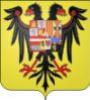
The arms of the Emperor were a double-headed eagle or on a field sable, charged with an escutcheon bearing his personal arms.
Powers
The powers of the Emperor were exercised in a broad range of areas, but restricted everywhere:
executive:
he enforced the laws and rulings of the empire, although most of this was delegated to the Reichskreise;
he appointed imperial officers;
legislative:
he could propose, approve and promulgate laws; in particular, he had the right to withhold approval;
but he could not levy taxes without approval
judiciary:
he was the ultimate judge in Germany, although he could only exercise this power through legally appointed courts, and had no right to intervene in the Reichskammergericht, but had in certain cases the final word in the Reichshofrat;
he had the right of pardon, as well as the right to confer exemptions and privileges (i.e., exceptions to the application of imperial laws);
international:
he alone represented the Empire abroad, although his ability to make war, peace and alliances was very limited;
feudal:
he was overlord of all imperial fiefs.
Jura reservata
The emperor had certain powers that flowed from his position as sovereign of the empire, from his plenitudo potestatis. Over time, this "plenitude of power" became restricted. By the 17th c., the powers of the emperor which were specifically his were called jura reservata or reserved rights; they were opposed to the powers of the Reichstag on one hand, the powers of the individual territories on the other.
The reserved rights were divided into the unrestricted (jura reservata illimita) and restricted (jura reservata limita) depending on whether the Reichstag was involved or not. They were also divided into exclusive (jura reservata exclusiva) or concurrent (jura reservata communia), depending on whether the individual territories also enjoyed those rights or not.
Examples of such imperial powers include:
jura reservata illimita + exclusiva: ennoblement and conferral of titles, foundation of universities
jura reservata limita: imposition of tolls, leasing of mints
jura reservata communia: grant legal majority, legitimize children, appoint notaries, grant arms
The emperor delegated the exercise of these rights to officials called counts palatine (Hofpfalzgrafen). Such delegated powers were called comitiva, and distinguished into the comitiva minor (power to grant majority, legitimize, appoint notaries, grant arms) and comitiva major (ennoblement and power to delegate the comitiva minor). The comitiva minor was commonly bestowed to rulers of territories or titular counts, as well as attached to certain positions (such as provosts of universities). The comitiva major was rarely bestowed, and it was hereditary in the houses of Pfalz and Schwarzburg.
Titles and Styles
See also the page on the title of emperor for the broader history of the title of "emperor".
Charles, king of the Franks, received the title of Emperor on Christmas Day 800 from Leo III in St. Peter's in Rome. According to his biographer Einhard (Vita Karoli Magni, par. 28) Charlemagne was taken by surprise and would never had entered the church that day had he known was the pope was up to. Nevertheless, he accepted the title. His official style in documents, as emperor, was: Imperator Augustus Romanum gubernans Imperium or serenissimus Augustus a Deo coronatus, magnus pacificus Imperator Romanorum gubernans Imperium. (All the Western original sources on Charlemagne's coronation are available). The title of Emperor was confirmed by Byzantium in 812.
Otto I, in 962, assumed the style of imperator augustus. In 966 he also used the style imperator augustus Romanorum ac Francorum, but reverted the same year to the previous, simpler style, which his successors kept. By the 12th century, the standard style was Dei gratia Romanorum imperator semper augustus, and it remained until the 16th c.
Throughout the Middle Ages, the convention was that the (elected) king of Germany (a kingdom formed by the division of the empire in 843 and the separation of the western Franconian kingdom in 888) was also Emperor of the Romans. His title was royal (king of the Germans, or from 1237 king of the Romans) from his election to his coronation in Rome by the pope; thereafter, he was emperor. After the death of Frederic II in 1250, however, formal coronation by the pope happened less frequently: Henry VII in 1312, Charles IV in 1355, Sigismund in 1433, Frederick III in 1452, Charles V in 1530. The title of "king of the Romans" became less and less reserved for the emperor-elect but uncrowned in Rome; the emperor-elect was either known as German king or simply styled himself "imperator" (see the example of Ludwig IV below). The reign was dated to begin either from the day of election (Philipp, Rudolf of Habsburg) or the day of the coronation (Otto IV, Heinrich VII, Ludwig IV, Karl IV). The election day became the starting date permanently with Siegmund.
Ultimately, Maximilian I changed the style of the emperor in 1508, with papal approval: after his German coronation, his style was Dei gratia Romanorum imperator electus semper augustus. That is, he was "emperor elect": a term that did not imply that he was emperor-in-waiting or not yet fully emperor, but only that he was emperor by virtue of the election rather than papal coronation (by tradition, the style of rex Romanorum electus was retained between the election and the German coronation). At the same time, the custom of having the heir-apparent elected as king of the Romans in the emperor's lifetime resumed. For this reason, the title king of the Romans (Rex Romanorum, sometimes king of the Germans or Rex Teutonicorum) came to mean heir-apparent, the successor elected while the emperor was still alive.
The German translation of the imperial style was Von Gottes Gnaden (erwählter) Römischer Kaiser, zur aller Zeit Mehrer des Reichs. The peculiar "translation" of semper augustus appears on a Lehenbrief (letter of enfeoffment) of 1301 in the form zu allen ziden ein merer des heiligen Romischen riches.
The emperor had precedence over all Christian monarchs. The emperor's wife, the Empress, also had rank, but not his children, since the office was elective.
Examples of imperial styles
Charlemagne, from his will of 806: Imperator caesar Karolus rex Francorum invictissimus et Romani rector imperii pius felix victor ac triumphator semper augustus in one version, Karolus serenissimus augustus, a Deo coronatus magnus pacificus imperator, Romanum gubernans imperium, qui et per misericordiam Dei rex Francorum atque Langobardorum in another
Otto I in 962: Dei gratia imperator augustus
Frederic I in 1140: Divina favente clementia Romanorum imperator augustus (from a diploma in the Vatican archives)
Frederic I in 1152: dei gratia Romanorum imperator et semper augustus (from the Landfriede). Note that Frederic I was not crowned until June 18, 1155.
Frederic II in 1220: divina favente clementiae Romanorum rex et semper augustus et rex Sicilie (from the constitution on ecclesiastical princes)
Frederic II in 1235: divina favente clemencia Romanorum imperator semper augustus, Jerusalem et Sicilie rex (from Peace of Mainz)
Louis of Bavaria in 1338: Ludovicus Dei gratia Romanorum imperator et semper augustus (from the law licet juris)
Karl IV of Bohemia in 1356: divina favente clementia Romanorum imperator semper augustus et Boemie rex (from the Golden Bull)
The Imperial Regalia in Aachen. See a closer picture here.
2. The Reichstag
The Reichstag was, in modern terms, the legislative body of the Empire. It should not be thought of as a representative institution in the modern sense, because many individuals and communities were not represented in it, yet its decisions were binding on all subjects of the Empire, and it was the only institution with which the Emperor dealt.
The composition of the Reichstag evolved over the Middle Ages. By 1495 it had been divided into three colleges or sections:
the Electoral Council (Kurfürstenrat),
the Council of Princes (Fürstenrat),
the Council of the Imperial Cities (Collegium der Reichstädte).
A. The States of the Empire
A State of the Empire (Reichsstand, status Imperii) was a member having a seat and a vote at the Reichstag (Sitz und Stimme). The corresponding adjective is reichsständisch. A few imperial officers, such as the hereditary marshal (Pappenheim) and the hereditary usher (Werthern), had seat without vote, and as such were not reichsständisch (Pappenheim, however, was able to obtain recognition as a mediatized family in Bavaria in 1831).
The status of State of the Empire was originally attached to a particular land, and was a right of the owner or ruler of that land. Consequently:
when several individuals jointly ruled the land they shared the vote;
conversely, the owner of several lands with votes attached exercised several votes;
the religion of a state was a characteristic of the state, not the owner (the electors of Saxony were Catholics in the 18th century, but their state continued to be regarded as Protestant);
the vote was inherited by the next possessor of the land; but for states created after 1648, it was usually considered that the vote belonged to a specific family, and could not be inherited outside of the original family.
Since 1653, admission to the Reichstag was not solely dependent on the emperor's will, but required qualification and cooptation by the Reichstag. The requirements were up to the individual colleges. Actual exercise of the rights to sit and vote was not necessary.
The creation of a new electorate required the approval of all three colleges.
The creation of a new prince with individual vote required
the possession of a significant immediate territory,
commitment to share in the financial and military burdens of the Empire (by being entered into the imperial Matrikel of taxes and military obligations),
adherence to one of the 10 Circles (Reichskreise)
the approval of the college of electors and the college of princes.
The creation of a new count in addition required the acceptance into one of the counts' benches.
Since 1653, the Emperor was forbidden in principle from making individuals into states (so-called reichsständische Personalisten), without the possession of a territory (an imperial knighthood was not enough). There were exceptions, however:
Auersperg was given in 1663 the lordship of Tengen as an imperial county, which allowed him to earn a seat and individual vote in the Reichstag, but the territory itself remained part of the Habsburg dominions in Swabia;
Lorraine-Nomény (created for the Habsburg-Lorraine family in 1736) was a personalist prince with an individual vote;
there were several personalists in the college of counts of Franconia, who had been admitted before they had acquired sufficient territory: Ursin von Rosenberg, Windischgrätz, Starhemberg, Wurmbrand, Giech, Khevenhüller, Colloredo, Pückler, Harrach, Neipperg.
After qualification and cooptation, the quality of State of the Empire was retained, whether or not the cooptation was followed by a formal admission, whether or not the seat was taken or the vote exercised.
A territory could lose the quality of State of the Empire
by being put under the imperial ban (Reichsacht), or banned, by the Emperor and the Reichstag; the most famous examples being the Palatinate in 1623, and Bavaria and Cologne in 1706;
by being ceded to a foreign power, unless explicit provisions to the contrary were made, as when Sweden acquired a vote in the Reichstag after 1648;
by being mediatized, i.e., becoming subject to the authority of another State; however, mediatization did not necessarily imply loss of the quality of State of the Empire; in such a case, the State was called Mediatstand or mittelbare Stand. Examples include the houses of Stolberg, Schönburg (1740) and Giech (1791);
by being inherited by another family, for states created after 1648, unless the beneficiary of a Prorogation, subject to the same qualification for the new holder.
The privileges of the States of the Empire, guaranteed by the Wahlkapitulation, were:
to have seat and vote at the Reichstag; the vote could be individual (Virilstimme) or shared (Curiatstimme)
to be suspended or deprived of their status only by their peers (except in cases of misuse of certain regalian rights like minting and tolls, in which case the Emperor or the imperial court could order the suspension)
to have their successoral treaties (Erbverbrüderungen) automatically approved by the Emperor;
precedence over all subjects of the Empire
autonomy with respect to their family affairs;
the right to form alliances with foreigners as well as with other states of the Empire (union of electors, union of princes, union of counts, the Hanse)
the right to assemble themselves by college
since 1648, the right to vote by religion (a procedure called itio in partes): within each body (the corpus catholicorum and the corpus evangelicorum), decisions were taken by majority vote, and if the two bodies disagreed no decision could be taken by the Reichstag. The procedure could be invoked on any matter, not only on religious matters. The archbishop of Mainz presided over the Catholic body, the elector of Saxony (even when he was a Catholic) over the Protestant body.
B. The Electors
The Emperor was chosen by the Elector princes (Kurfürsten). This institution emerges sometime in the first half of the 13th c., as a consequence of the crisis of 1198. It appears in the Sachsenspiegel, a compilation of German feudal law written between 1220 and 1235. Its composition seems to have been set fairly early, by the 1230s at the latest. Initially the electors nominated a candidate, subject to ratification by the magnates, but fairly quickly their choice became final. Its formal regulation came with the Golden Bull of 1356, although changes were made occasionally. by the late 15th c., the electors were understood to form a distinct college.
The composition was set as follows:
Three spiritual or cleric electors:
bishop of Mainz
bishop of Trier
bishop of Köln
Four temporal or lay electors:
king of Bohemia
count Palatine of the Rhine
elector of Saxony
margrave of Brandenburg
The Council was presided by the archbishop of Mainz, who had precedence over all electors.
The status of the king of Bohemia was controversial for a long time, because he was not (necessarily) German; on the other hand, he was the Butler of the Empire, and one theory founded the right to elect the Emperor on holding one of the four high offices. One view was that the king of Bohemia's vote was meant to be the deciding vote in case of an even split of the other six. The Sachsenspiegel did not include him as an elector, but the Schwabenspiegel did. It took the Golden Bull of 1356 to settle the matter definitively. The king of Bohemia did not attend the elections after Wenceslas in the 14th c., and in the 17th century was not present for the deliberations, until 7 Sep 1708, when Bohemia was admitted again as a full member of the Electoral college.
Changes to the list of electors were made in the 17th and 18th c.
On 23 Jan 1621, during the Thirty Years War, the count Palatine was banned and in 1623 his vote was transferred to his cousin the duke of Bavaria, of a junior line of the Wittelsbach. At the conclusion of the war at the peace of Westphalia in 1648, an 8th electorate was created and conferred on the count Palatine by way of restitution, with reversionary rights on the electorate of Bavaria. On extinction of the Bavarian line in 1777, the 8th electorate disappeared as the electore Palatine inherited the electorate of Bavaria.
On 19 Dec 1692 the emperor conferred on the house of Braunschweig-Lüneburg (Hannover) a 9th electorate, which was only recognized by the Diet in on 12 April 1710.
On 29 April 1706 the electors of Cologne and Bavaria were banned and lost their votes, but they were reinstated by the peace of Baden in 1714.
In 1801, the Lunéville peace treaty ceded to France the left bank of the Rhine, leading to the extinction of the electorates of Trier and Köln, and the transfer of the electorate of Mainz to the see of Regensburg. The Reichsdeputationshauptschluß of 1803 created 4 electorates for Würtemberg, Baden, Hessen-Kassel and Salzburg (a newly created temporal principality held by the former grand-duke of Tuscany), who never exercised their votes.
The number of electors was set at 7 in 1356, changed to 8 in 1648, 9 in 1708, 8 in 1777, 6 in 1801 and 10 in 1803.
The powers and rights of the electors were:
to elect the emperor and to establish the Wahlkapitulation with him (their right to modify the capitulation was not universally accepted);
to hold one of the High Offices;
to have royal rank and precedence, although only Bohemia was a kingdom, and be protected by statutes against lese majesty;
to propose legislation and to be consulted on all important affairs by the emperor;
to give their assent without the rest of the Reichstag in certain cases (tolls, minting privileges);
to meet on their own initiative in Kurfürstentagen;
to enjoy in their territories regal powers, and in particular judicial sovereignty (their subjects could not be tried in imperial courts, no appeals could be made to the imperial high courts except in cases of denial of justice).
Elections and Coronations
The electors elected the king of Germany or king of the Romans who, once crowned, became the Emperor. Under the Habsburgs, it had become usual for the Emperor to have his oldest son crowned as king of the Romans. At the peace of Westphalia, France and Sweden tried to have the right to elect the king of the Romans transferred to the Reichstag, without success. Finally, the electoral capitulation of 1711 included the stipulation that an election would take place only in case of extended absence, advanced age, permanent incapacity of the Emperor, or other urgent necessity. It was up to the electors to decide to hold an election. They were obligated to give the emperor prior notification, but could proceed without his approval.
The electors were free to elect whom they wished, and the Emperor, in his capitulation, promised not to interfere with this freedom or use any form of coercion. They could, nevertheless, pledge their vote: when Brunswick (later Hanover) was given an electorate in 1692, it promised in return never to vote for anyone else but the eldest-born archduke of Austria. (In the election of 1742, there were none, and the elector of Hanover was free to cast his vote). A spiritual elector could vote even before having been invested by the Pope and received the pallium, as long as he had been invested by the Emperor. Conversely, an archbishop deprived of his electorate but not of his see could not be replaced as elector and his vote was forfeited (as happened to Cologne in 1711). A minor's vote was cast by his tutor.
The electors were summoned by the archbishop of Mainz, or else by the archbishop of Trier, normally within a month of the death of the Emperor. The electors met in Frankfurt, as prescribed by the Golden Bull (when they didn't, the city protested and it was granted reversals reserving its rights for the future) normally within three months of notification. The Grand Marshal was responsible for the logistics and protection of the electors and their suites. Electors appeared in person, entrusted their vote to another elector, or more often sent an electoral embassy, even if they were present (as the king of Bohemia in 1657 and 1690, or the elector of Mainz in 1741). The ministers presented their credentials to the archbishop of Mainz, who presided over the deliberations, in particular the drafting of the electoral capitulation. When the moment to vote came, the Grand Marshal ordered all princes, noblemen, ambassadors, representatives etc. not part of an electoral suite out of the city. The electors proceeded on horseback from the city hall to the cathedral, and convened in the electoral chapel, and swore to choose the worthiest man, and to accept the majority vote. The elector of Mainz proceeded to collect the votes, starting with Trier and ending with Saxony, and then himself. Electors could vote for themselves, as the king of Bohemia frequently did (although formally, a majority voted for him and he then consented).
The candidate receiving more than half of the votes was elected. In modern times the votes were unanimous. However, some elections were contentious. The election of 1519 was one. As early as 1516, while Maximilian was not clear about his own intentions for his successor, the king of France François I had begun collecting votes, and by 1518 secured the votes of Trier, Mainz, Brandenburg and the Palatinate. Then Maximilian decided to have his grandson Charles elected before his own death, and soon had the commitment of Brandneburg, Cologne, Mainz and the Palatinate, with the vote of Bohemia (the minor king Louis II) cast by his guardians Maximilian and the king of Poland. With Maximilian's death all bets were off and negotiations began anew. Here, the order of voting mattered, and allowed electors to make conditional promises: thus, Joachim of Brandenburg (who voted 6th) could promise to vote for François if two electors had voted for him and if he knew that his brother the archbishop of Mainz (who voted last) would also vote for him. In the end, Charles secured enough votes to win the election, in part through payments to the electors (330,000 florins in lump-sum payments and a total of 30,000 florins in annual pensions promised to four electors). What happened on June 27 (when the voting began and broke off after an hour) and June 28 is unclear; there is a possibility that Frederick the Wise of Saxony was elected but declined. In the end, all electors voted for Charles, although the elector of Brandenburg made a notarized statement beforehand that his vote was not free. (see Henry J. Cohn, 'Did Bribes Induce the German Electors to Choose Charles V as Emperor in 1519?' German History 19(1):1-27.)
Another contested election was that of 1741. Karl VI had died in 1740, the last male Habsburg: there was no obvious successor for the first time in over two hundred years. In 1741 the electors decided to exclude the ambassadors of Karl's daughter Maria Theresia, queen of Bohemia, not because she was a woman but because of the pending dispute over that crown (the elector of Bavaria had just seized Prague and had himself crowned king of Bohemia in December 1741). She protested against the legality of the election until the treaty of April 22, 1745 with Bavaria, by which she posthumously recognized Karl VII as emperor. At the election of 1745, she voted, but the electors Palatine and of Brandenburg abstained, although the elector of Brandenburg later recognized the validity of the election on Dec. 25, 1745.
Once elected, the candidate was asked by the archbishop of Mainz if he accepted the election capitulation drafted by the electors (until 1708, the ambassadors of the king of Bohemia were shown the draft beforehand in an adjacent room). If he did, he was immediately proclaimed in the cathedral. In the elect's absence his ambassador or representative took the oath, but the imperial government remained in the hands of the vicars until the elect had taken the oath himself.
The procedures for electing a king of the Romans were identical, except that the king-elect swore not to intervene in the affairs of the Empire.
The Golden Bull prescribed that the German coronation take place in Aachen, although in modern times it usually took place in the same city as the election. According to an agreement of 16 June 1657, included in the Wahlkapitulation of 1658, the ceremony was performed either by the archbishop of Cologne or the archbishop of Mainz, according to whose province was the location of the coronation (Frankfurt was in the province of Mainz); and if it took place outside of either province (for example, Regensburg, in the province of Salzburg) then Cologne and Mainz alternated.
The insignia used in the coronation consisted of the crown, the silver scepter, two rings, a gold orb, the sword of Charlemagne and the sword of Saint Mauritius, various clothes, an illuminated Gospel, a sabre of Charlemagne, and a number of relics (the tablecloth of the Last Supper, the cloth with which Christ washed the feet of the Apostles, a thorn of his crown, a piece of the Cross, the spear that pierced his side, a piece of his crib, the arm of Saint Ann, a tooth of John the Baptist, the blood of Saint Stephen). These insignia and relics were kept in Aachen and Nürnberg and sent to the coronation. The emperor was crowned by either the archbishop of Mainz or that of Trier, depending on the diocese in which the ceremony took place (in 1742, the archbishop of Cologne, brother of Emperor Karl VII, officiated with the consent of the archbishop of Mainz). All three spiritual electors laid together the crown on the emperor's head. After the election the emperor was made a canon of the cathedral of Aachen. He then proceeded to the city hall for the banquet.
Images related to the elections and coronations in Frankfurt
The following table is incomplete.
Name elected crowned (Empire) crowned (Italy) ended
Karl I 25 Dec 800 S. Peter, Rome d. 28 Jan 814
Ludwig I Aug 816 Reims d. 20 Aug 840
Lothar I 5 Apr (Easter) 823 Rome 820 d. 29 Sep 855
Ludwig II 872 844 Rome d. 31 Aug 875
Karl II 25 Dec 875 Rome d. 6 Oct 877
Karl III 12 Feb 881 Rome 879/880 Ravenna dep. 887
Arnulf 28 Apr 896 Rome
Wido 21 Feb 891 884 Pavia (*) d. 894
Berangar I 888 Pavia
Lambert 892 d. 898
Arnold 27 Feb 896 d. 899
Ludwig III 12 Feb 901 900 Pavia (*) dep. 915
Berengar II 25 Dec 915 d. 924
Rudolf 922 Pavia (*)
Hugo 926 Pavia (*) abd. 945
Lothar 931 Pavia (*) d. 950
Beranger II 950 Pavia dep. 961
Adalbert 950 Pavia dep. 961
Otto I 2 Feb 962 Rome
Otto II
Otto III
Arduin 1002 Pavia
Heinrich II 1004 Pavia
Konrad II 8 Sep 1024
26 Mar 1027 Mainz
Rome 1026 Milan (+) d. 4 Jun 1032
Otto Milan(+)
Konrad 1093 Milan
Heinrich III 5 Oct 1056
Heinrich IV Nov 1053 Trebur 17 Jul 1054
31 Mar 1084
Rome d. 7 Aug 1106
Heinrich V 11 Apr 1111
Lothar II 4 Jun 1133 Rome
Konrad III 7 Mar 1138 26 Jun 1128 Monza d. 15 Feb 1152
Friedrich I 4 Mar 1154 Frankfurt 1 Aug 1167 S. Peter 18 Jun 1155 S. Peter
Heinrich VI 15 Apr 1191 S. Peter, Rome 1186 Monza (?)
Otto IV 22 Sep 1208 Halverstad 14 Oct 1209
Friedrich II 22 Nov 1220 13 Dec 1250
Konrad IV 1237 Wien d. 1254
Manfred Aug 1258 Palermo
Rudolf I 11 Sep 1273 Frankfurt
Adolf I
Albrecht I
Heinrich VII 27 Nov 1308 29 Jun 1312 Lateran, Rome 6 Jan 1311 Milan d. 24 Aug 1313
Ludwig IV 19 Oct 1314 17 Jan 1328 1327 Milan d. 11 Oct 1347
Karl IV 11 Jul 1346
17 Jun 1349 Rhens am Rhein
Frankfurt 26 Nov 1346
5 Apr 1355 Bonn
Rome 6 Jan 1355 Milan d. 29 Nov 1378
Ruprecht
Wenzel 10 Jun 1376 Rhens-am-Rhein 9 Jul 1376 Aachen
Sigismund 1431 1431 Milan
Albrecht II 18 Mar 1438 Frankfurt ? ?
d. 1439
Friedrich III 2 Feb 1440 ? 19 Mar 1452 Rome 19 Mar 1452 Rome d. 19 Aug 1493
Maximilian I 16 Feb 1486 Frankfurt 9 Apr 1486 Köln d. 12 Jan 1519
Karl V 28 Jun 1519 Frankfurt 24 Feb 1530 Bologna 22 Feb 1530 Bologna abd. 14 Mar 1558
Ferdinand I 5 Jan 1531 Köln 24 Mar 1558 Frankfurt d. 25 Jul 1564
Maximilian II 28 Nov 1562 Regensburg 30 Nov 1562 Frankfurt d. 12 Oct 1576
Rudolf II 27 Oct 1575 Regensburg 1 Nov 1575 Regensburg
d. 21 Jan 1612
Matthias 13 Jun 1612 Frankfurt 24-26 Jun 1612 Frankfurt d. 20 Mar 1619
Ferdinand II 26 Aug 1619 Frankfurt 9 Sep 1619 Frankfurt d. 15 Feb 1637
Ferdinand III 22 Dec 1636 Regensburg 30 Dec 1636 Regensburg d. 2 Apr 1657
Ferdinand IV 31 May 1653 Augsburg ? ?
d. 9 Jul 1654
Leopold I 18 Jul 1658 Frankfurt 1 Aug 1658 Frankfurt d. 5 May 1705
Joseph I 23 Jan 1690 Augsburg ? ? d. 17 Apr 1711
Karl VI 12 Oct 1711 Frankfurt 22 Dec 1711 Frankfurt d. 20 Oct 1740
Karl VII 24 Jan 1742 Frankfurt 12 Feb 1742 Frankfurt d. 20 Jan 1745
Franz I 13 Sep 1745 Frankfurt 4 Oct 1745 Frankfurt d. 18 Aug 1765
Joseph II 27 Mar 1764 Frankfurt 3 Apr 1764 Frankfurt d. 20 Feb 1790
Leopold II 30 Sep 1790 Frankfurt 9 Oct 1790 Frankfurt d. 1 Mar 1792
Franz II 5 Jul 1792 Frankfurt 14 Jul 1792 Frankfurt abd. 6 Aug 1806
C. The Princes
The second college of the Reichstag was composed of the princes, counts, lords and prelates who ranked as states of the Empire (Reichsstände). Not all were members of the college, or even directly represented. The composition of the assembly varied before it was formally organized; after 1489, however, no further increases were possible without a majority vote, and the membership list was formally set in 1582. The Council did not operate on a one-man one-vote principle. Accordingly, there were individual votes (Virilstimmen) and collective votes (Curiatstimmen).
The Council of Princes (Reichsfürstenrat) included both clerics and lay people.
Clerics, as in other European Estates such as the House of Lords in England or the Estates General, had a seat by virtue of the see or abbacy. Those prelates who did not have individual votes were grouped into two benches, the Bench of the Rhine and the Bench of Swabia, each with a collective vote.
The secular princes included the Princes (Fürsten) properly speaking (with titles of prince, grand-duke, duke, count palatine, margrave, landgrave) and the Counts and Lords (Grafen und Herren). The princes held individual votes (although sometimes held collectively by a family) while the counts and lords were grouped in Benches, each bench with one collective vote. The bench of Franconia was created in 1630-1641 from the bench of Swabia, and the bench of Westphalia was created in 1653 with part of the bench of Wetterau: thus, after 1653, there were four benches.
Until 1582, votes at the Reichstag were owned by individuals, and were often multiplied when inheritances were divided, or, more often, jointly held by several families. After 1582, votes were attached to a territory (in a few exceptional cases a vote was granted to an individual without territory), and were no longer multiplied, but could still be shared by various individuals (as result of an inheritance, typically).
By 1792, there were 100 votes in the Council of Princes, of which 55 were Catholic (although Osnabrück alternated between Catholic and Protestant since the peace of Westphalia). Of the 100 votes, 37 were clerics (35 individual votes and 2 collective votes), while 63 were lay (59 individual votes and 4 collective votes). (See the detailed composition.)
The peace of Lunéville of 1801 led to the elimination of 18 votes in territories ceded to France, almost all of them Catholic. Plans to redistribute votes floundered on the issue of maintaining the religious balance, and although a special committee of the Reichstag had reached and agreement in 1803, the Emperor had not yet ratified it by the time the Empire dissolved in 1806 (see below).
Secular votes in the Council of Princes, 1582
The following table (based on Arenberg 1951) lists the secular votes in the Reichsfürstenrat in 1582, the decisive moment when allocation of votes became determined by strict rules. The families who possessed those votes in 1582 are considered Hochadel: altfürstlich for the princely families, altgräflich for the comital families. Families who were elevated between 1582 and 1803 to princely (resp. comital) rank, with membership in the Council of Princes, are termed neufürstlich (resp. neugräflich).
Böhmen Pfalz-Zweibrücken Pommern-Stettin Holstein-Glückstadt
Kur-Pfalz Pfalz-Veldenz Mecklenburg-Schwerin Holstein-Gottorp (Oldenburg)
Kur-Sachsen Sachsen-Weimar Mecklenburg-Güstrow Sachsen-Lauenburg
Kur-Brandenburg Sachsen-Eisenach Würtemberg Savoie
Österreich (Austria) Sachsen-Coburg Hesse-Cassel Leuchtenberg
Tyrol Sachsen-Altenburg Hesse-Darmstadt Anhalt
Steiern Brandenburg-Ansbach Hesse-Rheinfels Henneberg
Burgund Braunschweig-Celle Hesse-Harburg Lorraine-Nomény
Bayern Braunschweig-Kahlenberg Baden-Baden Montbéliard
Pfalz-Lautern Braunschweig-Grubenhagen Baden-Durlach Arenberg
Pfalz-Simmern Braunschweig-Wolfenbüttel Baden-Hochberg La Marck-Arenberg (Jülich)
Pfalz-Neuburg Pommern-Wolgast Baden-Sausenberg Reichsgrafenbänke (Imperial counts, grouped in four benches)
Evolution of the Council of Princes from 1582 to 1803
With the peace of Westphalia in 1648, 9 ecclesiastical territories were secularized (the word was coined by the French delegation at the Westphalia negotiations), and the corresponding votes transferred to the Reichsfürstenrat, in the hands of the families who possessed the corresponding temporal estates:
Magdeburg, Halberstadt, Minden, Camin (to Brandenburg)
Bremen, Verden (to Hanover)
Schwerin (to Mecklemburg)
Ratzenburg (to Mecklemburg-Strelitz)
Hersfeld (to Hesse-Cassel).
From 1582 to 1803, only a small number of new princes were given Reichsstand (that is, with a vote at the Reichstag):
1641: Hohenzollern-Hechingen, Eggenberg (extinct 1717), Lobkowicz
1654: Salm, Dietrichstein, Piccolomini, Nassau-Hadamar, Nassau-Dillenburg, Auersperg
1667: Fürstenberg
1674: Schwarzenberg
1677: Ostfriesland
1713: Liechtenstein
1754: Schwarzburg, Thurn-Taxis
A number of titles of prince were created for members of the counts' benches, but without ever receiving an individual vote at the Reichstag: Öttingen (14 Oct 1674), Waldeck (17 Jul 1682), Nassau-Saarbrucken (4 Aug 1688), Nassau-Usingen (4 Aug 1688), Nassau-Idstein (4 Aug 1688), Nassau-Weilburg (4 Aug 1688), Reuß-Greitz (1778), Lippe-Detmold (1789), Reuß-Schleiz (1806), Schaumburg-Lippe (1807). (Note that most of them became sovereign families after 1815).
D. Imperial Cities
The Imperial Cities (Reichsstädte) contained 51 cities, grouped in the Bench of the Rhine (14 cities) and the Bench of Swabia (37 cities). Their position in the Reichstag was not always clear; in particular, their ability to cast decisive votes, which was nevertheless confirmed in 1648. They had no say on certain matters: the admission of new States of the Empire, the investiture of imperial fiefs (as long as they were not affected), imperial wars (after 1803, when they gained the neutrality they had long requested). The presiding city was the one in which the Reichstag was held, which was always Regensburg after 1663.
In 1803, 45 cities were mediatized, leaving 6 cities: Augsburg, Lübeck, Nürnberg, Frankfurt, Bremen, Hamburg. Augsburg and Nürnberg were absorbed by Bavaria in 1806. Frankfurt became a grand-duchy in 1810 but re-emerged with a minicipal government in 1813. Frankfurt was the seat of the Bund's assembly from 1816 to 1866; it was annexed by Prussia in that year. Lübeck was annexed to Schleswig-Holstein under the Nazis in 1937. At present, Bremen and Hamburg still exist as autonomous Länder in the Federal Republic of Germany, the last remnants of the Imperial cities.
E. Composition of the Reichstag in 1521, 1755, 1792
The composition of the Reichstag at these three dates is fairly well known, because of three sources:
the Reichsmatrikel of 1521, drawn for fiscal purposes, was the tax roll of the Empire
a textbook on public law written by the jurist Christian August von Beck c.1756 for the education of the future emperor Joseph II
the publications in 1792 of the jurist Johann Stephan Pütter, reprinted in several references
For the Handbuch der deutschen Geschichte, Oestreich and Holzer have collated these three lists and determined which members appeared or disappeared between those dates, and why. The lists are presented in a separate page (in German).
3. The Courts of the Empire
A. High Courts
Reichskammergericht
The Reichskammergericht (Camerae Imperialis Judicium), Imperial Chamber Court, was created at the Worms Reichstag of 1495. Its initial purpose was to sit in judgment of violations of the Landfrieden of 1495, but over time became the main court of the Empire and the guarantor of imperial law.
The Court consisted initially of a Judge assisted by 16 assessors (a number increased to 50 in 1648 and reduced to 25 in 1729). The Judge, two Presidents and one assessor were appointed by the Emperor, the other assessors by the electors and by the circles of the States of the Empire. The Judge was noble, or rank no less than a baron. Half of the assessors were noblemen, the others were doctors of law. The Judge, one President and 13 assessors were catholics, the other President and 12 assessors were protestants (Augsburg confession). The members, once appointed, were reichsunmittelbar and could not be removed except by the Court itself. The court also had 12 advocates and 30 procurators to process cases. Cases were examined by "senates" of 8 or 9 members, with equal numbers of protestants and catholics. When the senate was split evenly, additional members were appointed, or the case was sent to the full Court. In religious matters, members voted by religion (a procedure called itio in partes). If votes remained evenly split, the matter was sent to the Reichstag. On some procedural matters the Court could make interim rulings that had force of law until an imperial law was published.
The Court was competent in suits against immediate members of the empire, either in first or second instance; in civil matters involving mediate members of the empire, as appeals court from local courts (except when there was privilegium de non appellando, as for territories of electors); appeals on denials of justice; it could also confirm treaties, testaments, guardianships among immediate members. It had no jurisdiction over spiritual matters (including validity of marriages), cases involving major fiefs or matters of imperial grace, criminal cases involving immediate members. The court had exclusive jurisdiction over judicial matters involving its own members.
One could ask the Court to review its own rulings, or refer the matter to a Reichskammergerichtsvisitation, a commission appointed by the Reichstag to periodically review the Court's activities (initially annual, these visitations became scarcer after the 16th c.). Ultimately, it was always possible to appeal to the Reichstag itself.
Reichshofrath
Maximilian I had only reluctantly agreed to the formation of the Reichskammergericht. To help him in his direct administration of justice, he established in 1518 a Reichshofrath (Consulium imperiale aulicum), Imperial Court or Aulic Council, which became accepted as equal to the Reichskammergericht in 1648.
Contrary to the Court, this body was a creature of the Emperor. It had a president, a vice-president, and 16 councillors, all appointed by the Emperor. The imperial vice-chancellor, appointed by the arch-chancellor (the elector of Mainz) was also a member ex officio, and presided in the absence of the president. (The vice-chancellor and the president were the only Imperial Ministers). Members of the Council had to be German nationals, and the president and vice-president had to be noblemen of the empire (prince, count or baron). Members could not be removed except by a ruling of the Council itself, but the death of the emperor automatically brought the dissolution of the council and the imperial chancery.
The Council had two functions:
as Council of State, to which certain matters of state had to be referred (the Emperor was free, however, to surround himself with other advisors in ad-hoc councils, such as a war council or a secret council);
as a high court whose jurisdiction overlapped with that of the Court.
The Council had essentially the same jurisdiction as the Court, and it was up to the plaintiff to choose where to file his suit. There were other matters in which only the Council was competent; and there were matters where the Court's jurisdiction was acknowledged but which were routinely handled by the Council. Such was the case of criminal cases involving immediate members, and cases involving imperial favors or concessions.
All matters were decided by the whole Council. In case of split votes, the president could break the tie, or he could choose to refer the matter to the Emperor. In religious matters, an even split automatically referred the matter to the Reichstag. Appeals were handled the same way as for the Court, except that the right of visitations, in principle held by the arch-chancellor (elector of Mainz) were never exercised.
B. Lower Courts
4. Structure of the Empire
The Empire was made up of sub-units, either territories or people. They can be classified according to several related but distinct dichotomies:
allodial and feudal
states of the Empire and non-states
immediate and mediate lands or people
sovereign and subject
temporal (secular) and spiritual (ecclesiastic)
etc.
These distinctions will be explained below and their relationships explored.
A. Geographical Structure
External Boundaries
The external boundaries of the Empire varied over time. In particular, the western boundary shifted many times eastward, as French kings encroached on the Empire as they enlarged their domains. Thus Provence (1246), Dauphiné (1349), the bishoprics of Metz, Toul, Verdun (1558), Alsace (1648), Franche-Comté (1678), Lorraine (1736), the west bank of the Rhine (1801) were incorporated into France, losses that were eventually acknowledged by the Emperors. There were losses elsewhere: the Swiss cantons, practically independent of their Habsburg overlords since the Middle Ages, were formally set free at the Peace of Westphalia in 1648.
The Empire itself consisted of Imperial lands (Reichsländer) properly speaking, and neighbouring lands. The latter category included Lorraine, Burgundy, and Lombardy. Bohemia was part of the Imperial lands because its king was an elector, but its status as a kingdom was unique within the empire. When the elector of Brandenburg became king of Prussia, he was so only in his lands lying outside of the Empire.
The exact status of Northern Italy within the Empire became rather confused over time. By the 18th century, what remained formally were a collection of imperial fiefs of various sizes: 13 in Lombardy (including the duchies of Milan, Mantua, Monferrat, the principality of Mirandola, the Gonzaga territories), 19 in Liguria, 20 in the region of Bologna (including the duchies of Modena and Ferrara), 10 in Tuscany (the grand-duchy of Tuscany, Piombino, Soramo, Comacchio) and 11 in Tirnisani.
Internal Units
The territorial components of the Empire fell into one of the following categories:
principalities (Fürstentümer, principatus in Latin), subdivided into
electorates,
duchies,
principalities,
palatine counties, margraviats, landgraviats, princely counties (gefürstete Grafschaften)
imperial counties (Reichsgrafschaften)
free lordships (freie Herrschaften, dominia)
ecclesiastical territories (praelaturae)
free imperial cities (Reichsstädte)
free imperial villages (Reichsdörfer, pagi imperii)
Independently of the above classification, territories can also be classified into feudal and allodial. A feudal territory was held from the Emperor as a fief, that is, by virtue of a certain type of contract. In exchange for enjoyment of the territory, the vassal owed certain duties, and was subject to certain restrictions and oversight of the Emperor. An allodial territory was a territory for which no feudal contract existed. It was subject to the emperor as sovereign but not to the emperor as overlord. A territory was presumed to be allodial unless shown otherwise. The term "free", also applied to certain counties, indicated that the territory was allodial. Major ecclesiastical territories were typically allodial.
Under Maximilian I the imperial states had been organized in Imperial Circles (Reichskreise). The original 6 Circles of 1500 (Swabia, Bavaria, Franconia, upper Saxony, lower Saxony, Westphalia) were increased in 1512 to 10 (Austria, Rhine, Saxony, Burgundy). The role of the circles was to serve as administrative units in the enforcement of imperial law and order. Each was headed by a prince as Kreisoberst, and regional assemblies called Kreistage were held (which could include territories that were not imperial states).
The Imperial Circles in 1789
This list (based on Arenberg 1951) shows the territories arranged by Reichskreis, with some indication of the relative size of the Kreise.
Österreichischer Kreis (Austrian Circle)
pop: 4.8m, area: 2565 sq mi
Archduchy of Austria County of Tyrol
Duchy of Styria (Steier) Bishopric of Trento
Duchy of Carinthia (Kärnter) Bishopric of Brixen (Bressanone)
Duchy of Carniola Principality of Dietrichstein (Trasp)
County of Gorizia (including Trieste)
Burgundischer Kreis (Burgundian Circle)
pop: 2.0m, area: 470 sq mi
Duchy of Brabant Duchy of Limburg
County of Hainaut Duchy of Gelderland
County of Flanders Marquisate of Antwerp
County of Namur Lordship of Malines
Duchy of Luxemburg Lordship of Tournai
Note: within Brabant was the Duchy of Aerschot (baronies of Aerschot, Bierbeek, Rotselaer and Héverlé) belonging to the duke of Arenberg.
Kurrheinischer Kreis (Circle of the Rhenish Electorates)
pop: 1.185m, area: 460 sq mi Electorate of Mainz duchy of Westphalen (owned by Köln)
Electorate of Trier county of Recklinghausen (owned by Köln)
Electorate of Köln Burgraviate of Rheineck
Palatinate Teutonic territories in Koblenz
duchy of Arenberg lordship of Beilstein
county of Nieder-Isenburg
Hoch-rheinischer Kreis (Upper-Rhenish Circle)
pop: 1.17m, area: 500 sq mi
Landgraviat of Hesse County of Sponheim
Chapter of Fulda Territories of the Princes and Counts of Salm (Salm-Salm, Salm-Kyrburg, Salm-Reifferscheidt)
County of Hanau County of Linange
Lordship of Hanau-Lichtenberg County of Kirchingen (owned by count of Wied-Runkel)
County of Isenburg Lordship of Dachstuhl (owned by count of Öttingen-Baldern)
County of Solms Lordship of Bretzenheim (owned by count of Isenburg)
County of Königstein County of Falkenstein
Chapter (Hochstift) or Bishopric of Worms County of Wartenberg
Chapter or Bishopric of Speier County of Wittgenstein
Provosty of Wissemburg County of Waldeck
Chapter of the Knights at Bruchsal Lordship of Ollbruck (owned by baron of Waldbott-Bassenheim)
Chapter of Strassburg Lordship of Münzfelden
Chapter or Bishopric of Basel Imperial City of Frankfurt
Principality of Heiersheim (owned by Knights of Saint John) Imperial City of Wetzlar
Abbey of Prüm (owned by Trier) Imperial City of Worms
Principalities of Simmern, Lautern, Veldenz (owned by Pfalz-Wittelsbach) Imperial City of Speier
Principality of Zweibrücken Imperial City of Friedberg
Territories of the Princes of Nassau
Schwäbischer Kreis (Swabian Circle)
pop: 2.0m, area: 730 sq mi
Duchy of Württemberg with Weilsheim and Justingen County of Öttingen (owned by the three lineages of Öttingen)
Marquisate of Baden County of Thengen (owned by prince of Auersperg)
Lordships of Biesensteig, Mindelheim, Schwabeck (owned by Wittelsbach of Bayern) Chapter or Bishopric of Augsburg
Territories of the Princes of Fürstenberg Abbey of Ellwangen
Territories of the Princes of Hohenzollern Abbey of Kempten
Territories of the Princes of Thurn-Taxis Abbey of Lindau
Principality of Liechtenstein Abbey of Buchau
Territories of the Counts of Waldburg Chapter or Bishopric of Constanz
County of Klettgau (owned by prince of Schwarzenberg) Territories of the Teutonic Order
Territories of Princes Fugger Imperial City of Augsburg
County of Hohenems (owned by Habsburg) Imperial City of Ulm
County of Hohengeroldseck (owned by count van der Leyen) Imperial City of Esslingen
Territories of the Count of Königsegg Imperial City of Lindau
County of Bonndorf (owned by Abbey of Sankt Blasius) Imperial City of Kempten
Lordship of Egloff (owned by counts of Traun and Abensberg) Imperial City of Ravensburg
Lordship of Thannhausen (owned by count of Stadion) Imperial City of Memmingen
Lordship of Tettnang and Argen (owned by Habsburg) 24 Imperial Cities
Bayrischer Kreis (Bavarian Circle)
pop: 1.198m, area: 1200 sq mi
Archishopric of Salzburg Abbeys of Nieder- and Hoch-Munster
Provosty of Berchtesgaden Chapter or Bishopric of Passau
Electorate of Bavaria County of Ortenburg
Chapter of Freysing with Werdenfels County of Sternstein (owned by prince Lobkowicz)
Chapter of Regensburg Free City of Regensburg
Abbey of St Emmeran
Frankischer Kreis (Franconian Circle)
pop: 1.1m, area: 485 sq mi
Bishopric of Bamberg County of Reineck (owned by count of Nostiz-Rieneck)
Bishopric of Würzburg County of Erlach
Bishopric of Eichstädt Lordship of Limpurg
Territories of the Teutonic Order at Mergentheim Lordship of Reichelsberg (owned by count Schönborn)
Principalities of Ansbach and Bayreuth (owned by Prussia) Lordship of Welsheim (owned by Württemberg)
County of Henneberg (owned by various houses of Saxony) Free City of Nürnberg
County of Schwarzenberg with Lordship of Seinsheim (owned by prince of Schwarzenberg) Free City of Rothenburg
Principality of Hohenlohe Free City of Windheim
County of Castell Free City of Schweinfurt
County of Wertheim Free City of Wissemburg
Hohersächsicher Kreis (Circle of Upper Saxony)
pop: 4.0m, area: 2000 sq mi c
Electorate of Brandenburg Principality of Sachsen-Meiningen
Electorate of Saxony Principality of Sachsen-Hildburghausen
Swedish Pomerania (Pommern) County of Schwarzburg
County of Mansfeld (owned by Brandenburg and Saxony) County of Stolberg and Weiningerode
Principality of Sachsen-Weimar Territories of the Princes of Reuss
Principality of Sachsen-Gotha Principality of Anhalt
Principality of Sachsen-Coburg Chapter of Walkenried
Niedersächsicher Kreis (Circle of Lower Saxony)
pop: 2.25m, area: 1280 sq mi
Duchy of Magdeburg (owned by Prussia) Chapter of Lübeck
Principality of Halberstadt (owned by Prussia) Free City of Hamburg
Duchy of Braunschweig Free City of Bremen
Territories of the Elector of Hannover Free City of Lübeck
Bishopric of Hildesheim Free City of Goslar
Duchy of Holstein Free City of Mühlhausen
Duchy of Mecklemburg Free City of Nordhausen
Westphalischer Kreis (Westphalian Circle)
pop: 2.3m, area: 1250 sq mi
Territories of the Elector of Hannover County of Virnenburg (owned by prince of Loewenstein-Wertheim)
Territories of the Elector of Brandenburg County of Kaunitz
Duchies of Jülich and Berg (owned by Wittelsbach of Pfalz) County of Pyrmont (owned by prince of Waldeck)
Bishopric of Müster County of Gronsfeld (owned by count Törring)
Bishopric of Osnabrück County of Reckheim (owned by prince of Anhalt-Bernburg)
Bishopric of Paderborn Lordship of Anholt (owned by prince of Salm-Salm)
Bishopric of Lüttich (Liége) Lordships of Winneburg and Beilstein (owned by count of Metternich)
Abbey of Corvey County of Blankenheim and Gerolstein (owned by count of Limpurg)
Abbey of Malmédy Lordship of Witten (owned by count of Plettenberg)
Abbey of Stavelot Lordship of Gimborn (owned by count Wallmoden)
Abbey of Werden Lordship of Wickeradt (owned by count of Quadt)
Abbey of Essen Lordship of Mylendonk (owned by count of Ostein)
Abbey of Cornelimünster Lordship of Reichenstein (owned by count Nesselrode)
Abbey of Thorn Lordship of Kerpen (owned by duke of Arenberg)
Abbey of Herford County of Schleiden (owned by duke of Arenberg)
Territories of the Princes of Orangen-Nassau County of Hallermund (owned by count of Platen)
County of Wied Free City of Köln
County of Sayn Free City of Aachen
County of Schaumburg-Lippe Free City of Dortmund
County of Bentheim
Other Territories of the Empire
The Circles did not include all territories of the Empire: notably, Bohemia (pop: 2.9m, area 982 sq mi), Moravia (Mähren; pop: 1.2m, 468 sq mi), Lusatia (0.45m, 180 sq mi) and a number of others totalling 0.25m and 200 sq mi.
B. Political Structure
Sovereignty
The motley and variable collection of powers and rights held by rulers of territories within the Empire were collectively known as sovereignty (Landeshoheit, Landesherrlichkeit, Landesobrigkeit, Landesfürstlichkeit, jus territoriale). This covered a number of substantially different rights:
regalian rights, held from the Emperor, such as the right to dispense justice, collect taxes and tolls, mint coins, exploit mines, etc
right of enfeoffment: the ability to have knights in one's service and call them to war
seigniorial rights and feudal rights.
These rights were possessed to varying degrees, and there were disputes over who was sovereign and who wasn't. Definitive signs of sovereignty were the right to collect taxes, the receipt of homage from the inhabitants, the existence of local estates representing knights, prelates and cities; and above all jurisdiction in first instance and appeal in civil cases. Curiously, jurisdiction over criminal cases, and even the ability to impose death sentences (Blutbann) was not in of itself a sign of sovereignty. Jurisdiction included not just the ability to rule in particular cases, but also the ability to publish general rules, in other words legislate. The legislative ability was somewhat constrained by the overall framework of imperial legislation which it could not contradict, but the latter served mainly to complement the local legislation.
Sovereignty was considered to be bestowed by the Emperor, and its possession to result from an investiture by the Emperor. This was true of imperial fiefs, which were themselves granted by investiture, but also of allodial lands. The right to receive the investiture was nevertheless attached to the land, and could not be denied by the Emperor.
Sovereignty was exercised: by hereditary lords, by elected prelates, by municipal governments. It could pass by inheritance, testament, investiture, infeoffment, or even sale or lien. Its possession or enjoyment did not require noble status. It could be owned jointly in condominium.
Immediate and Mediate Status
Whether or not an individual, an institution or an area was directly subject to the emperor's authority defined the status of "immediate" and "mediate" subject of the Empire (reichsunmittelbar, reichsmittelbar). This distinction has nothing to do with being noble or commoner: for example, a number of high officials in the imperial courts and the chancery were immediate, whether noble or not. The status of immediate subject was also distinct from that of state of the Empire: there were many immediate territories that were not states of the Empire, and there could be states that were not immediate. Examples of tiny immediate territories include the villages of Goschheim and Seenfald near Schweinfurt, the four villages of Kahldorf, Petersbach, Biburg, and Wangen, some farms in Upper Swabia, etc. The status of immediate subject of the emperor could be held by an institution, such as the Schoppenstuhl in Aachen.
Knights of the Empire
The Knights of the Empire (Reichsrittern) were nobles whose direct overlord was the Emperor, remnants of the medieval Edelfrei and Ministerialen who never achieved status of upper nobility. To protect their rights, they organized themselves into three unions (Partheien) in the late 15th century and into a single Corpus in 1577, and fought hard to win recognition. Their immediate status was recognized at the Peace of Westphalia. They never gained access to the Reichstag, and were not considered Hochadel. In 1650 they organized themselves into three circles, subdivided into cantons:
Swabian Circle: 668 territories, pop: 0.16m, 70 sq mi (cantons: an der Donau; im Hegau, Algau & am Bodensee; am Neckar, am Schwarzwald & and der Ortenau; am Kocher; im Craichgau)
Franconian Circle: 702 territories, pop: 0.2m, 80 sq mi (cantons: Odenwald; Gebürg; Röhn-Werra; am Steigerwald; an der Altmühl; an der Baunach)
Rhenish Circle: 0.09m, 40 sq mi (cantons: Oberrheinstrom; Mittelrhein- & Unterrheinstrom)
5. The End of the Empire (1803-06)
A. The Secularization of 1803
The French Revolution and the European war that broke out as a result in 1792 ultimately led to the destruction of the Holy Roman Empire and the redrawing of the map of Europe. As a result of French victories in 1794-95, French troops occupied the whole Left Bank of the Rhine, including the Circle of Burgundy and other territories. These losses, ratified by the treaty of Campoformio on 17 Oct 1797, were supposed to lead to compensations within the Empire for the dispossessed families. The congress at Rastadt had begun work on this compensation, on the basis of secularization of almost all ecclesiastical Reichsstände (the only survivors were the archbishop of Mainz, the knights of St. John and the Teutonic Knights). War broke out again from 1798 to 1800, but the Treaty of Lunéville in 1801 confirmed the loss of the left bank of the Rhine; it also spelled out the principle that territorial losses by members of the German empire should be compensated within the Empire out of the secularized states.
An imperial delegation (Reichsdeputation) representing the Reichstag was sent to Paris to negotiate with Bonaparte the conditions under which this secularization would take place. Their main resolution, the famous Reichsdeputationshauptschluß of 25 Feb 1803, was ratified by the Reichstag on 24 March 1803 and by the Emperor on 27 April 1803, with a reservation concerning the new allocation of votes in the Reichstag. The new number of votes was 131, but with an overwhelming Protestant majority which the Emperor did not accept. The new distribution of votes thus never took legal effect, but mediatization and land reallocation did. Although this new arrangement barely lasted at all, it had important consequences because the situation in which families stood as of 1806 determined their subsequent status within Germany after 1815 (more on this later).
The new distribution increased the number of votes from 100 (35 spiritual princes, 2 prelates' benches, 59 temporal princes, 4 counts' benches) to 131.
-2: all members of the two prelates' benches of Swabia and the Rhine were allocated to various princes and counts.
-7: of the temporal princes, 7 seats were eliminated.
-11: of the 35 existing spiritual states, 3 survived (archduke of Austria, the Teutonic Order and the Order of St. John), 11 were formally eliminated (annexed by France) and the rest secularized and transferred to existing (18) or new (3) princes.
+51: To maintain a balance in the council of princes, a number of new votes were created as well, either in favor of existing members (31), or to introduce new members (20). Some new members had already been made titular princes but without votes (Nassau-Usingen, Nassau-Weilburg, Waldeck, Öttingen, Reuß-Plauen-Greitz), others numbered among the counts; four new members were not previously members of the Reichstag either as princes or counts: the former grand-duke of Tuscany, the former duke of Modena, Ligne and Looz.
The following list provides more details; by "states" I mean here states with an individual vote in the Reichstag.
States eliminated (18):
[spiritual electors: Trier, Cologne]
spiritual (11): Burgund, Bisanz (Besançon), Worms, Speyer, Straßburg, Basel, Lüttich (Liége), Chur (Swiss since 1648), Weißenburg, Prüm, Stablo
temporal (7): Pfalz-Lautern, Pfalz-Simmern, Pfalz-Zweibrücken, Pfalz-Veldenz (Wittelsbach); Mömpelgard (Württemberg); Savoy;Lorraine-Nomény (Habsburg)
Spiritual states secularized in favor of existing states (18)
Arch-chancellor (formerly Mainz): Regensburg
Bavaria: Bamberg, Würzburg, Augsburg, Freising, Kempten, Passau
Baden: Konstanz
Prussia: Hildesheim, Paderborn
Austria: Trient, Brixen
Hanover: Osnabrück
Oldenburg: Lübeck
Württemberg: Ellwangen
Nassau-Dillenburg: Fulda, Korvey
(divided between Prussia, Arenberg, Looz, Salm, Croy): Münster
Spiritual states secularized in favor of new states (3)
Salzburg (Archduke grand-duke): Salzburg, Eichstädt, Berchtesgaden
new seats created for existing states (31)
Austria (4): Styria, Carinthia, Krain, Tirol
Bavaria (4): Lower Bavaria, Sulzbach, Berg, Mindelheim
Saxony (4): Meissen (margraviate), Meissen (burggraviate), Thuringia (shared by Albertine and Ernestine branches), Querfurt
Württemberg (3): Teck, Tübingen, Zwiefalten
Prussia (2): Eichsfeld, Erfurt
Baden (2): Bruchsal, Ettenheim
Hesse-Cassel (2): Hanau, Fritzlar
Hesse-Darmstadt (2): Westphalia, Starkenburg
Denmark: Plön
Hanover: Göttingen
Arch-chancellor (formerly Mainz): Aschaffenburg
Brunswick: Blankenburg
Mecklenburg-Strelitz: Stargard
Fürstenberg: Baar
Schwarzenberg: Klettgau
Taxis: Buchau
new seats created for new states (20)
Modena (2 votes): Breisgau, Ortenau
Nassau-Usingen
Nassau-Weilburg
Hohenzollern-Sigmaringen
Salm-Kirburg
Waldeck
Löwenstein
Ötttingen-Spielberg
Ötttingen-Wallerstein
Solms-Braunfels
Hohenlohe-Neuenstein
Hohenlohe-Waldenburg-Schillingsfürst
Hohenlohe-Waldenburg-Bartenstein
Isenburg-Bierstein
Kaunitz-Rittberg
Reuß-Plauen-Graiz
Leiningen
Ligne
Looz
The dissolution of 1806 and mediatization
The Empire, which had become a loose confederation of virtually sovereign states in 1648, was close to collapse after the major territorial changes wrought by France. Napoleon, whose ambitions found Russia, Prussia and Austria arrayed against him, tried to create a coalition of German states free from the influence of either Prussia or Austria. More generally, he was trying to achieve a longstanding goal of French policy: to establish her dominance over Germany. Napoleon succeeded in making allies of Baden and Württemberg, and keeping Prussia neutral, in the war of September-December 1805 which ended with the crushing victory of Austerlitz (Dec 2). The resulting peace treaty of Pressburg (Dec 26) enlarged Napoleon's allies and made them kings, while Austria lost all remaining possessions in Italy.
These results decided a number of German states to abandon the Empire and form a new Confederation under Napoleon's protection. This was the Confederation of the Rhine (Rheinbund), formed 12 July 1806 and initially composed of ten members, enlarged by 1808 to thirty and made up of almost all German states, the exceptions being Austria and Prussia.
The treaty of 12 July 1806 obligated its members to announce their separation from the Empire by Aug 1 (art. 3). Accordingly, on that date, the members of the Confederation published a note declaring that, in their view, the Empire had ceased to exist. Here is an excerpt of the text (see the full text):
« Die Begebenheiten der drei letzten Kriege, und die Politischen Veränderungen, welche daraus ensprungen sind, haben die traurige Wahrheit in das hellste Licht gesetzt, dass das Band, welches, bisher die verschiedenen Glieder des teutschen Staatskörpers miteinander vereinigen sollte, für diesen Zweck nicht mehr hinreiche oder vielmehr, dass es in der Tat schon aufgelöst sei...
Nur diesem Umstande muss man ohne Zweifel die im Jahre 1795 im Reiche selbst hervorgetane Trennung zuschreiben, die eine Absonderung des Interesses des nördlichen und des südlichen Deutschlands zur Folge hatte... Die Frankreich zunächst gelegenen, von allem Schutz entblössten und allen Drangsalen eines Krieges, dessen Beendigung in den verfassungsmässigen Mitteln zu suchen nicht in ihrer Gewalt stand, ausgesetzten Fürsten sahen sich gezwungen sich durch Separatfrieden von dem allgemeinen Verbande in der That zu trennen... Indem sie sich durch gegenwärtige Erklärung von ihrer bisherigen Verbindung mit dem teutschen Reichskörper lossagen, befolgen sie bloss das durch frühere Vorgänge und selbst durch Erklärungen der mächtigeren Reichstände aufgestellte System... Dass die kostbare Ruhe der Hauptzweck des rheinischen Bundes sei, davon fanden die bisherigen Reichsmitstände der Souveräns, in deren Namen die gegenwärtige Erklärung geschieht, den deutlichen Beweis darin, dass jeder unter ihnen, dessen Lage ihm eine Theilnahme daran erwünschlich machen kann, der Beitritt zu demselben offen gelassen ist »
(Jean-Engelbert d'Arenberg: Les Princes du St-Empire ŕ l'époque napoléonienne, Louvain 1951, pp. 142-3)
On the same day, the French ambassador to the Reichstag issued a note stating that "S.M. L'Empereur et Roi est donc obligé de déclarer qu'il ne reconnaît plus l'existence de la constitution germanique, en reconnaissant néanmoins la souveraineté entičre et absolue de chacun des princes dont les états composent aujourd'hui l'Allemagne et en conservant avec eux les męmes relations qu'avec les autres puissances indépendantes de l'Europe" (HM the Emperor and King is thus forced to declare that he does not recognize anymore the existence of the German state, but nevertheless recognizes the complete and absolute sovereignty of each of the princes whose states presently compose Germany, and maintaining with them the same relations as with the other independent powers of Europe).
abdication of Francis II (1806)
As early as May 1806, the Austrian minister of foreign affairs Friedrich von Stadion had asked two advisers (his brother Lothar von Station and Alois von Hügel) their opinions on the advisability of the Emperor's abdication. The memos were finished on May 17 and presented to the Emperor on June 17. Both advisers were of the opinion that, while the Empire could in principle survive the peace of Pressburg, in reality it was Napoleon's intent to use his German allies and destroy the Empire or subjugate it, and that the Emperor would ultimately fail to prevent this; the time would soon come when the advantages of the German imperial crown would outweigh its benefits. Stadion endorsed the reports, and the Emperor essentially agreed that at some point, it would be time to abdicate the crown.
The time came soon: on July 22, Napoleon gave Austrian diplomats an ultimatum: either the German Emperor abdicated by August 10 or else war would resume. Francis II drew the logical conclusions, and on August 6, the Austrian chancery in Vienna published the following declaration (see translations in French and English):
Source: Corpus Iuris Confoederationis Germanicae vol. 1 p. 72; see Karl Zeumer: Quellensammlung zur Geschichte der Deutschen Reichsverfassung, Tübingen, 1913, p. 538. See also another copy of the German text.
« Wir, Franz der Zweite, von Gottes Gnaden erwählter römischer Kaiser, zu allen Zeiten Mehrer des Reichs, Erbkaiser von Osterreich, etc, K&ounml;nig in Germanien, zu Hungarn, Böheim, Croatien, Dalmazien, Slavonien, Galizien, Lodomerien und Jerusalem, Erzherzog zu Oesterreich, etc.
Nach dem Abschlusse des Presburger Friedens war Unsere ganze Aufmerksamkeit und Sorgfalt dahin gerichtet, allen Verpflichtungen, die Wir dadurch eingegangen hatten, mit gewohnter Treue und Gewissenhaftigkeit das vollkommenste Genüge zu leisten, und die Segnungen des Friedens Unsern Völkern zu erhalten, die glücklich wieder hergestellten friedlichen Verhältnisse allenthalben zu bestetigen, und zuerwarten, ob die durch diesen Frieden herbeigeführetn wesentlichen Veränderungen im deutschen Reiche es Uns ferner möglich machen würden, den nach der kaiserlichen Wahlcapitulation Uns als Reichs-Oberhaupt obliegenden schweren Pflichten genug zu thun. Die Folgerungen, welche mehreren Artikeln des Presburger Friedens gleich nach dessen Bekanntwerdung und bis jetzt gegeben worden, und die allgemein bekannten Ereignisse, welche darauf im deutschen Reiche Statt hatten, haben Uns aber die Ueberzeugung gewährt, daß es unter den eingtretenen Umständen unmöglich seyn werde, die durch den Wahlvertrag eingegangenen Verpflichtungen ferner zu erfüllen: und wenn noch der Fall übrig blieb, daß sich nach fördersamer Beseitigung eingetretener politischer Verwickelungen ein veränderter Stand ergeben dürfte, so hat gleichwohl die am 12. julius zu Paris unterzeichnete, und seitdem von den betreffenden Theilen begnehmigte, Uebereinkunft mehrerer vorzüglichen Stände zu ihrer gänzlichen Trennung von dem Reiche und ihrer Vereinigung zu einer besondern Conföderation, die gehegte Earwartung vollends vernichtet.
Bei der hierdurch vollendeten Ueberzeugung von der gänzlichen Unmöglichkeit, die Pflichten Unseres kaiserlichen Amtes länger zu erfüllen, sind Wir es Unsern Grundsätzen und Unserer Würde schuldig, auf eine Krone zu verzichten, welche nur so lange Werth in Unsern Augen haben konnte, als Wir dem von Churfürsten, Fürsten und Ständen und übrigen Angehörigen des deutschen Reichs Uns bezeigten Zutrauen su entsprechen und den übernommenen Obliegenheiten ein Genüge zu leisten im Stande waren.
Wir erklären demnach durch Gegenwärtiges dass wir das Band, welches uns bis jetzt an den Staatskörper des deutschen Reichs gebunden hat, als gelöst ansehen, dass wir das reichsoberhauptliche Amt und Würde durch die Vereinigung der conföderierten rheinischen Stände als erloschen und uns dadurch von allen übernommenen Pflichten gegen das Deutsche Reich losgezahlt betrachten und die von wegen desselben 'bis jetzt getragene Kaiserkrone und geführte Kaiserliche Regierung, wie hiermit geschieht, niederlegen.
Wir entbinden zugleich Kurfürsten, Fürsten und Stände und alle Reichsangehörigen, insonderheit auch die Mitglieder der höchsten Reichsgerichte und übrige Reichsdienerschaft von ihren Pflichten, womit sie an uns, als das gesetzliche Oberhaupt des Reichs, durch die Konstitution gebunden waren. Unsere sämmtlichen (sie) teutschen Provinzen und Reichsländer zählen wir dagegen wechselseitig von allen Verpflichtungen, die sie bis jetzt unter was einen Titel gegen das teutsche Reich getragen haben, los, und wir werden selbige in ihrer Vereinigung mit dem ganzen österreichischen Staatskörper, als Kaiser von Oesterreich unter den wiederhergestellten und bestehenden friedlichen Verhältnissen mit allen Mächten und benachbarten Staaten zu jener Stufe des Glücks und Wohlstandes zu bringen beflissen sein, welche das Ziel aller unserer Wünsche, der Zweck unserer angelegensten Sorgfalt stets sein wird.
Gegeben in Unserer Haupt- und Residenzstadt Wien, den schsten August im einteausend achthundert und sechsten, Unserer Reiche des Römischen und der Erbländischen im fünfzehnten Jahre. (L.S.) Franz
Johann Philipp Graf von Stadion. Ad Mandatum Sacrae Caesareae ac caes. regiae apost. Maj. proprium
Hofrath von Hudelist.
(ibid., pp. 144-5)
The declaration did more than simply abdicate the crown. Francis II also dissolved the Holy Roman Empire by freeing all his former subjects from its laws. While it was certainly in his power to abdicate (Charles V had done so), it is difficult to argue that he had the power to unilaterally dissolve the Empire. His declaration was not communicated to the Reichstag by the normal procedure (the so-called Diktatur) but instead simply circulated to the other envoys at Regensburg by the Austrian envoy (who was under instruction not to accept any response). The Reichstag itself was in recess for three months from July 7.
German jurists of the 18th c. had elaborated a theory that the Emperor could use emergency powers with the consent of the Reichstag, or at least the consent of the Electors (more controversially, some asserted that he could do so without any consent) in order to fulfill his obligation to preserve the Empire. The advisers of Francis II made the argument that it was not enough to abdicate: Napoleon could have used an interregnum to wreak further damage or even have himself installed as emperor, and it was in the members' best interests to deprive Napoleon of such tools. But it seems difficult to argue that the Emperor was legally founded to use his emergency powers to destroy the Empire in order to save it.
The legality of the dissolution could be founded on the tacit consent of the members of the Empire; but there was at least one dissent, namely the Elector of Hanover (king George III of Great Britain). The text of the protest is not known, but its existence was asserted by the Hanoverian envoy to the Vienna Congress in two declarations of Sep 1, 1813 and Nov 25, 1814 (Ompteda, Politischer Nachlaß, 2:3:232 and Klüber 1:1:83 for the texts). The Elector of Hanover continued to style himself as such until October 12, 1814.
All other parties accepted the dissolution of the Empire. Obviously, the signatories of the August 1 declaration did. Denmark recognized the dissolution and annxed Holstein on Sept. 9, 1806; Sweden (which possessed Pomerania) did the same on Aug 22. Prussia recognized the Confederation of the Rhine by the treaty of Tilsit of Jul 9, 1807, and Austria by the treaty of Oct 14, 1809. Only Great Britain never recognized the Confederation, and by 1813-14 continued to negate the dissolution of the Empire, and even (briefly) argue for its restoration.
(For more information seeWalter, Gero: Der Zusammenbruch des Heiligen Römischen Reichs deutscher Nation und die Problematik seiner Restauration in den Jahren 1814/15. Heidelberg ; Karlsruhe : Müller, Juristischer Verl., 1980.)
Mediatization
Heraldry in Holy Roman Empire
References and Resources
Most of the material on the legal and political structure in this page is taken from
Heinrich Zoepfl: Grundsätze des gemeinen deutschen Staatsrechts, Leipzig 1863; reprint Scriptor Reprints, Regensburg 1975
Recht und Verfassung des Reiches in der Zeit Maria Theresias (edited by Hermann Conrad), Westdeutscher Verlag, Cologne, 1964 (which is the publication of a manuscript textbook on imperial law written by the jurist Christian August von Beck in the 1750s for the education of archduke Joseph).
Here are some online resources:
Verfassungen.de (a collection of current and historical constitutional documents, in German)
History of Germany: Primary Documents (a collection of links)
Document Archiv (many original texts, 19th-20th c.)
A number of important legal texts (including works by Johann Jakob Moser and J. S. Pütter, the preeminent 18th c. jurists of the HRE) are available in image format at the Bibliothek der Universität Bielefeld.
The German Reigning Houses by Val Rozn
Christos Nüssli's Historical Atlas is not free, but there is a trial version. The site also has some old maps.
--------------------------------------------------------------------------------
National Heraldry Page | Search Heraldica | Heraldic Glossary | Contact
--------------------------------------------------------------------------------
François Velde
Feb 13, 2008
Endnotes
1. Time Line Index, http://www.timelineindex.com/content/view/1236.
2. Heraldica, http://www.heraldica.org/topics/national/hre.htm.