Individual Details
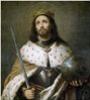
Saint Fernando III King of Castilla
(1200 - 1252)
Fernando was born at the monastery of Valparaiso, the son of Alfonso IX, king of León and his second wife Berenguela of Castile. His year of birth is variously given as 1198, 1199 or 1201. When his parents were divorced by order of Pope Innocent III in 1204, Berenguela took their children, including Fernando, to the court of her father. In 1217 her younger brother Enrique I died and she succeeded him to the Castilian throne, but she immediately surrendered it to her son Fernando, for whom she initially acted as regent. When Alfonso died in 1230, Fernando also inherited León, though he had to fight for it with Alfonso's designated heirs Sancha and Dulce, the daughters of his first wife. He thus became the first sovereign of both kingdoms since the death of Alfonso VII in 1157.
Fernando married twice. In 1219 he married Elisabeth von Hohenstaufen, daughter of the German king Philipp von Hohenstaufen (son of Emperor Friedrich I Barbarossa) and Eirene Angelina (daughter of Isaac II Angelos, emperor of Byzantium). They had ten children of whom their sons Alfonso and Manuel would have progeny. Elisabeth died in 1235, and in 1237 Fernando married Jeanne de Dammartin, comtesse de Ponthieu, daughter of Simon de Dammartin, comte d'Aumale, and Marie (Jeanne), comtesse de Ponthieu. Their son Fernando and daughter Eleanor would both have progeny. Three other sons died young, Jeanne was presumably the eldest of her parents' five daughters, four of who would have progeny (two sons died in childbirth); through his marriage to her Fernando was also count of Aumale.
Early in his reign, Fernando had to deal with a rebellion of the House of Lara. He also established a permanent border with the kingdom of Aragóon by the Treaty of Almizra in 1244.
Fernando spent much of his reign fighting the Moors. Through diplomacy and war, exploiting the internal dissensions in the Moorish kingdoms, he triumphed in expanding Castilian power over the southern Iberian Peninsula. He captured the towns of Ubeda in 1233, Cordoba in 1236, Jaén in 1246, and Seville in 1248, and he occupied Murcia in 1243, thereby conquering all Andalusia save Granada, whose king nevertheless did homage to Fernando. Fernando divided the conquered territories between the knights, the Church and the nobility, whom he endowed with great estates. When he took Córdoba, he ordered the _Liber Iudiciorum_ (Visigothic Code) to be adopted and observed by its citizens, and caused it to be rendered, albeit inaccurately, into Castilian.
The capture of Córdoba was the result of an uneven and uncoordinated process whereby parts (the Ajarquia) of the city first fell to the independent almogavars of the Sierra Madre to the north, which Fernando had not at the time subjugated. Only in 1236 did Fernando arrive with a royal army to take Medina, the religious and administrative centre of the city. Fernando set up a council of partidores to the divide the conquests and between 1237 and 1244 a great deal of land was parcelled out to private individuals and members of the royal family as well as the Church. On 10 March 1241 Fernando established seven outposts to define the boundary of the province of Córdoba.
On the domestic front he strengthened the university of Salamanca and founded the current cathedral of Burgos. He was a patron of the newest movement in the Church: that of the friars. Whereas the Benedictines and then the Cistercians and Cluniacs had taken a major part in the _Reconquista_ up to then, Fernando founded Dominican, Franciscan, Trinitarian, and Mercedarian houses in Andalusia, thus determining the religious future of that region. Fernando has also been credited with sustaining the _convivencia_ (the movement for religious tolerance between Christians, Moslems and Jews) in Andalusia.
Fernando died in Seville on 30 May 1252. The _Primera Crónica General de Espańa_ asserts that, on his death bed, Fernando commended his son Alfonso X: 'you are rich in lands and in many good vassals - more so than any other king in Christendom,' probably in recognition of his expansive conquests. He was buried within the cathedral of Seville by Alfonso X. His tomb is inscribed with four languages: Arabic, Hebrew, Latin and an early incarnation of Castilian. Fernando was canonised by Pope Clement X in 1671.
Source: Leo van de Pas
Fernando married twice. In 1219 he married Elisabeth von Hohenstaufen, daughter of the German king Philipp von Hohenstaufen (son of Emperor Friedrich I Barbarossa) and Eirene Angelina (daughter of Isaac II Angelos, emperor of Byzantium). They had ten children of whom their sons Alfonso and Manuel would have progeny. Elisabeth died in 1235, and in 1237 Fernando married Jeanne de Dammartin, comtesse de Ponthieu, daughter of Simon de Dammartin, comte d'Aumale, and Marie (Jeanne), comtesse de Ponthieu. Their son Fernando and daughter Eleanor would both have progeny. Three other sons died young, Jeanne was presumably the eldest of her parents' five daughters, four of who would have progeny (two sons died in childbirth); through his marriage to her Fernando was also count of Aumale.
Early in his reign, Fernando had to deal with a rebellion of the House of Lara. He also established a permanent border with the kingdom of Aragóon by the Treaty of Almizra in 1244.
Fernando spent much of his reign fighting the Moors. Through diplomacy and war, exploiting the internal dissensions in the Moorish kingdoms, he triumphed in expanding Castilian power over the southern Iberian Peninsula. He captured the towns of Ubeda in 1233, Cordoba in 1236, Jaén in 1246, and Seville in 1248, and he occupied Murcia in 1243, thereby conquering all Andalusia save Granada, whose king nevertheless did homage to Fernando. Fernando divided the conquered territories between the knights, the Church and the nobility, whom he endowed with great estates. When he took Córdoba, he ordered the _Liber Iudiciorum_ (Visigothic Code) to be adopted and observed by its citizens, and caused it to be rendered, albeit inaccurately, into Castilian.
The capture of Córdoba was the result of an uneven and uncoordinated process whereby parts (the Ajarquia) of the city first fell to the independent almogavars of the Sierra Madre to the north, which Fernando had not at the time subjugated. Only in 1236 did Fernando arrive with a royal army to take Medina, the religious and administrative centre of the city. Fernando set up a council of partidores to the divide the conquests and between 1237 and 1244 a great deal of land was parcelled out to private individuals and members of the royal family as well as the Church. On 10 March 1241 Fernando established seven outposts to define the boundary of the province of Córdoba.
On the domestic front he strengthened the university of Salamanca and founded the current cathedral of Burgos. He was a patron of the newest movement in the Church: that of the friars. Whereas the Benedictines and then the Cistercians and Cluniacs had taken a major part in the _Reconquista_ up to then, Fernando founded Dominican, Franciscan, Trinitarian, and Mercedarian houses in Andalusia, thus determining the religious future of that region. Fernando has also been credited with sustaining the _convivencia_ (the movement for religious tolerance between Christians, Moslems and Jews) in Andalusia.
Fernando died in Seville on 30 May 1252. The _Primera Crónica General de Espańa_ asserts that, on his death bed, Fernando commended his son Alfonso X: 'you are rich in lands and in many good vassals - more so than any other king in Christendom,' probably in recognition of his expansive conquests. He was buried within the cathedral of Seville by Alfonso X. His tomb is inscribed with four languages: Arabic, Hebrew, Latin and an early incarnation of Castilian. Fernando was canonised by Pope Clement X in 1671.
Source: Leo van de Pas
Events
| Birth | 1200 | ||||
| Death | 1252 | ||||
| Marriage | Elisabeth von Hohenstaufen |
Families
| Spouse | Elisabeth von Hohenstaufen (1202 - 1234) |
| Child | Alfonso X "The Wise" King of Castilla y León (1221 - 1284) |
| Father | Alfonso IX King of León and Castilla (1171 - 1230) |
| Mother | Berenguela Infanta of Castilla (1180 - 1246) |