Individual Details
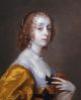
Lady Mary Villiers
(Est 1622 - )
Lady Mary Villiers was one of the three children of George Duke of Buckingham, ''Sweet Steenie'', the consummate intriguer who had been the Favourite of King James I and then of his son, and of his wife Lady Catherine Manners daughter of the Earl of Rutland. When the Duke was murdered in 1628 few mourned him, and his death was seen as the removal of a pernicious influence on the government of the country and of an impediment in the King's relations with his wife, whom Buckingham had hated. The King, however, remained devoted to his friend's memory, and to his children, who were raised in the Royal Household almost as part of the King's own family. As a result, the eldest boy, George, 2nd Duke of Buckingham, was from earliest years a boon companion of Charles Prince of Wales, and was his closest friend through the Civil Wars, a shared exile and finally government, until the latter's death in 1685.
Lady Mary too enjoyed a status little removed from that of Princess, and was recognised, both by her family's wealth and their closeness to the Royal family, as a highly desirable prize in a Court marriage. It must also have been apparent as she approached her teens that she would be a woman of some beauty. In 1634 negotiations were concluded for the marriage of Lady Mary, then aged twelve, to Charles Lord Herbert of Shurland, eldest son and heir of Philip Herbert Earl of Pembroke. Pembroke, himself a former favourite of James I, was the king's Lord Chamberlain, a magnate of considerable wealth and power, and a very natural sponsor of such a profitable alliance. Lord Herbert and Lady Mary were married on January 8th or 18th 1634/5 in the Royal Closet at Whitehall. The employment of the King's private chapel is a sufficient demonstration of the affection in which both were held by King Charles.
It is uncertain how much time the couple spent together, given their youth -the groom was only fifteen years old- and, in any case, Lord Herbert travelled alone to Italy later in the year in order to serve in the army of the Grand Duke of Tuscany. There he suffered an attack of smallpox, and died at Florence in January 1635/6. There was one very significant fruit, however, of this otherwise brief association with the Herbert family. Lord Pembroke was one of the earliest and most enthusiastic patrons of Sir Anthony van Dyck. In addition to individual portraits, Pembroke commissioned the painter's largest work, the great portrait now hanging in the Double Cube Room at Wilton. This painting, most probably executed early in 1634 before the painter's return to Antwerp, is a magnificent expression of the Earls'' dynastic ambitions. Enthroned in the centre before a cloth of Estate the Earl and Countess are surrounded by their children, living and -depicted as putti- dead, and by their son and future daughter-in-law, the present sitter. Lady Mary is shown standing in front of and slightly below the Earl and Countess. The white dress that she wears in the portrait both alludes to her virginity and establishes her as the focus of the composition, an appropriate position for one who was also the hope of Pembroke's succession.
As Duchess of Richmond, and later as the wife of Colonel Howard, Lady Mary was a prominent figure at Court after the Restoration. Several poems by the anonymous Stuart poetess known as Ephelia (whose works were published in 1679 as ''Female Poems... by Ephelia'') were dedicated to her, and it has been established in the last decade by Maureen Mulvihill of the Princeton Research Forum that Ephelia was in fact Lady Mary herself. This poet produced an intriguing set of texts, some privately-printed, being bold political broadsheets against the Popish Plot and the rising of James, Duke of Monmouth, as well as amusing coterie verse, songs, a collection of female poems, amorous verse-letters, and ‘a damn'd play’, evidently a farce-burlesque on the debauched private lives of Charles II and his brother, James, Duke of York. This new identification suggests that Lady Mary Villiers was the most highly-placed, publishing woman writer of the Stuart period.
Source: Historical Portraits, Image Library
http://www.historicalportraits.com/InternalMain.asp
Lady Mary too enjoyed a status little removed from that of Princess, and was recognised, both by her family's wealth and their closeness to the Royal family, as a highly desirable prize in a Court marriage. It must also have been apparent as she approached her teens that she would be a woman of some beauty. In 1634 negotiations were concluded for the marriage of Lady Mary, then aged twelve, to Charles Lord Herbert of Shurland, eldest son and heir of Philip Herbert Earl of Pembroke. Pembroke, himself a former favourite of James I, was the king's Lord Chamberlain, a magnate of considerable wealth and power, and a very natural sponsor of such a profitable alliance. Lord Herbert and Lady Mary were married on January 8th or 18th 1634/5 in the Royal Closet at Whitehall. The employment of the King's private chapel is a sufficient demonstration of the affection in which both were held by King Charles.
It is uncertain how much time the couple spent together, given their youth -the groom was only fifteen years old- and, in any case, Lord Herbert travelled alone to Italy later in the year in order to serve in the army of the Grand Duke of Tuscany. There he suffered an attack of smallpox, and died at Florence in January 1635/6. There was one very significant fruit, however, of this otherwise brief association with the Herbert family. Lord Pembroke was one of the earliest and most enthusiastic patrons of Sir Anthony van Dyck. In addition to individual portraits, Pembroke commissioned the painter's largest work, the great portrait now hanging in the Double Cube Room at Wilton. This painting, most probably executed early in 1634 before the painter's return to Antwerp, is a magnificent expression of the Earls'' dynastic ambitions. Enthroned in the centre before a cloth of Estate the Earl and Countess are surrounded by their children, living and -depicted as putti- dead, and by their son and future daughter-in-law, the present sitter. Lady Mary is shown standing in front of and slightly below the Earl and Countess. The white dress that she wears in the portrait both alludes to her virginity and establishes her as the focus of the composition, an appropriate position for one who was also the hope of Pembroke's succession.
As Duchess of Richmond, and later as the wife of Colonel Howard, Lady Mary was a prominent figure at Court after the Restoration. Several poems by the anonymous Stuart poetess known as Ephelia (whose works were published in 1679 as ''Female Poems... by Ephelia'') were dedicated to her, and it has been established in the last decade by Maureen Mulvihill of the Princeton Research Forum that Ephelia was in fact Lady Mary herself. This poet produced an intriguing set of texts, some privately-printed, being bold political broadsheets against the Popish Plot and the rising of James, Duke of Monmouth, as well as amusing coterie verse, songs, a collection of female poems, amorous verse-letters, and ‘a damn'd play’, evidently a farce-burlesque on the debauched private lives of Charles II and his brother, James, Duke of York. This new identification suggests that Lady Mary Villiers was the most highly-placed, publishing woman writer of the Stuart period.
Source: Historical Portraits, Image Library
http://www.historicalportraits.com/InternalMain.asp
Events
| Birth | Est 1622 | ||||
| Baptism | 30 Mar 1622 | St. Martin-in-the-Field | |||
| Marriage | 3 Aug 1637 | Lambeth - James Stuart, 4th Duke of Lennox and 1st Duke of Richmond | |||
| Burial | 28 Nov 1685 | Westminster Abbey |
Families
| Spouse | James Stuart, 4th Duke of Lennox and 1st Duke of Richmond (1612 - 1655) |
| Child | Lady Mary Stuart (1651 - 1667) |
| Father | George Villiers, 1st Duke of Buckingham (1592 - 1628) |
| Mother | Lady Catherine Manners ( - 1649) |