Individual Details
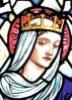
St. Margaret of Scotland
(Abt 1045 - 16 Nov 1092)
Saint Margaret of Scotland 1045 1092
Born about 1045, died 16 Nov., 1092, was a daughter of Edward "Outremere", or "the Exile", by Agatha, kinswoman of Gisela, the wife of St. Stephen of Hungary. She was the granddaughter of Edmund Ironside. A constant tradition asserts that Margaret's father and his brother Edmund were sent to Hungary for safety during the reign of Canute, but no record of the fact has been found in that country. The date of Margaret's birth cannot be ascertained with accuracy, but it must have been between the years 1038, when St. Stephen died, and 1057, when her father returned to England. It appears that Margaret came with him on that occasion and, on his death and the conquest of England by the Normans, her mother Agatha decided to return to the Continent. A storm however drove their ship to Scotland, where Malcolm III received the party under his protection, subsequently taking Margaret to wife. This event had been delayed for a while by Margaret's desire to entire religion, but it took place some time between 1067 and 1070.
In her position as queen, all Margaret's great influence was thrown into the cause of religion and piety. A synod was held, and among the special reforms instituted the most important were the regulation of the Lenten fast, observance of the Easter communion, and the removal of certain abuses concerning marriage within the prohibited degrees. Her private life was given up to constant prayer and practices of piety. She founded several churches, including the Abbey of Dunfermline, built to enshrine her greatest treasure, a relic of the true Cross. Her book of the Gospels, richly adorned with jewels, which one day dropped into a river and was according to legend miraculously recovered, is now in the Bodleian library at Oxford. She foretold the day of her death, which took place at Edinburgh on 16 Nov., 1093, her body being buried before the high altar at Dunfermline.
In 1250 Margaret was canonized by Innocent IV, and her relics were translated on 19 June, 1259, to a new shrine, the base of which is still visible beyond the modern east wall of the restored church. At the Reformation her head passed into the possession of Mary Queen of Scots, and later was secured by the Jesuits at Douai, where it is believed to have perished during the French Revolution. According to George Conn, "De duplici statu religionis apud Scots" (Rome, 1628), the rest of the relics, together with those of Malcolm, were acquired by Philip II of Spain, and placed in two urns in the Escorial. When, however, Bishop Gillies of Edinburgh applied through Pius IX for their restoration to Scotland, they could not be found.
The chief authority for Margaret's life is the contemporary biography printed in "Acta SS.", II, June, 320. Its authorship has been ascribed to Turgot, the saint's confessor, a monk of Durham and later Archbishop of St. Andrews, and also to Theodoric, a somewhat obscure monk; but in spite of much controversy the point remains quite unsettled. The feast of St. Margaret is now observed by the whole Church on 10 June.
Source: New Advent, The Catholic Enciclopedia
http://www.newadvent.org/cathen/09655c.htm
Born about 1045, died 16 Nov., 1092, was a daughter of Edward "Outremere", or "the Exile", by Agatha, kinswoman of Gisela, the wife of St. Stephen of Hungary. She was the granddaughter of Edmund Ironside. A constant tradition asserts that Margaret's father and his brother Edmund were sent to Hungary for safety during the reign of Canute, but no record of the fact has been found in that country. The date of Margaret's birth cannot be ascertained with accuracy, but it must have been between the years 1038, when St. Stephen died, and 1057, when her father returned to England. It appears that Margaret came with him on that occasion and, on his death and the conquest of England by the Normans, her mother Agatha decided to return to the Continent. A storm however drove their ship to Scotland, where Malcolm III received the party under his protection, subsequently taking Margaret to wife. This event had been delayed for a while by Margaret's desire to entire religion, but it took place some time between 1067 and 1070.
In her position as queen, all Margaret's great influence was thrown into the cause of religion and piety. A synod was held, and among the special reforms instituted the most important were the regulation of the Lenten fast, observance of the Easter communion, and the removal of certain abuses concerning marriage within the prohibited degrees. Her private life was given up to constant prayer and practices of piety. She founded several churches, including the Abbey of Dunfermline, built to enshrine her greatest treasure, a relic of the true Cross. Her book of the Gospels, richly adorned with jewels, which one day dropped into a river and was according to legend miraculously recovered, is now in the Bodleian library at Oxford. She foretold the day of her death, which took place at Edinburgh on 16 Nov., 1093, her body being buried before the high altar at Dunfermline.
In 1250 Margaret was canonized by Innocent IV, and her relics were translated on 19 June, 1259, to a new shrine, the base of which is still visible beyond the modern east wall of the restored church. At the Reformation her head passed into the possession of Mary Queen of Scots, and later was secured by the Jesuits at Douai, where it is believed to have perished during the French Revolution. According to George Conn, "De duplici statu religionis apud Scots" (Rome, 1628), the rest of the relics, together with those of Malcolm, were acquired by Philip II of Spain, and placed in two urns in the Escorial. When, however, Bishop Gillies of Edinburgh applied through Pius IX for their restoration to Scotland, they could not be found.
The chief authority for Margaret's life is the contemporary biography printed in "Acta SS.", II, June, 320. Its authorship has been ascribed to Turgot, the saint's confessor, a monk of Durham and later Archbishop of St. Andrews, and also to Theodoric, a somewhat obscure monk; but in spite of much controversy the point remains quite unsettled. The feast of St. Margaret is now observed by the whole Church on 10 June.
Source: New Advent, The Catholic Enciclopedia
http://www.newadvent.org/cathen/09655c.htm
Events
| Birth | Abt 1045 | Hungary | |||
| Marriage | Abt 1069 | Malcolm III, King of Scotland | |||
| Death | 16 Nov 1092 | ||||
| Canonised | 1251 | Pope Inocent IV | |||
| Biography | Leo |  |
Families
| Spouse | Malcolm III, King of Scotland (1030 - 1092) |
| Child | Princess Mathilda of Scotland (1079 - 1118) |
| Father | Edward 'the Exile' Atheling (1010 - 1057) |
| Mother | Agatha ( - ) |
Notes
Biography
Margaret was born about 1045 in Hungary, the daughter of Edward Atheling and Agatha. She later came to England, but after the Norman Conquest she fled with her mother, sister and brother from Northumberland to Scotland, where they placed themselves under the protection of King Malcolm. The _Worcester Manuscript_ relates the following:'Then the king Malcolm began to desire Margaret as wife, but her brother and his men opposed it for a long time, and also she herself refused, and declared that she would not have him, nor any, if the Graciousness on high would grant her that with bodily heart she might please the mighty Lord with pure continence in maidenhood in this short life.
'The king eagerly pressed her brother until he said 'yes' to it, also he dared not otherwise, because they had come into his power. So it came to pass as provided by God, and it could not be otherwise, just as he himself says in his gospel that even one sparrow cannot fall into a snare without his providence.
'The king then received her, although it was against her will; and her customs pleased him, and he thanked God, who so powerfully gave him such a consort, and reflected wisely, since he was very prudent, and turned himself toward God, and despised every impurity.'
Young, lovely, vivacious, learned and pious, Margaret had won the heart of the Scottish king, Malcolm Canmore, and they were married. They had eight children of whom four, including two future kings of the Scots, would have progeny. She did much to civilise the northern realm and still more to assimilate the old Celtic church to the rest of Christendom. In 1251 she was canonised by Pope Innocent IV.
Source: Leo van de Pas