Individual Details
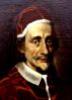
Pope (Blessed) Innocentius XI (Benedetto Odescalchi)
(16 May 1611 - 12 Aug 1689)
• Benedetto Odescalchi was elected Pope 1676. He took the name Innocentius XI.
• Was beatified by Pope Pius XII in 1956.
• Was beatified by Pope Pius XII in 1956.
Events
| Birth | 16 May 1611 | Como, Italy |  | ||
| Election | 1676 | ||||
| Death | 12 Aug 1689 | Roma, Italy | |||
| Blessing | 7 Oct 1956 | was blessed by Pope Pius XII | |||
| Biography | Biography | |  |
Families
| Father | Livio Odescalchi (1580 - ) |
| Mother | Paola Castelli ( - ) |
| Sibling | Count Carlo Odescalchi (1607 - 1673) |
| Sibling | Lucrezia Odescalchi (1605 - ) |
Notes
Birth
Innocent XI (Benedetto Odescalchi) (May 16, 1611 - August 12, 1689) was pope from 1676 to 1689.He was born at Como in 1611, studied law at Rome and Naples, held successively the ofices of protonotary, president of the apostolic chamber, commissary of the Marco di Roma, and governor of Macarata; in 1647 Innocent X made him cardinal, and he afterwards successively became legate to Ferrara and bishop of Novara. In all these capacities, the simplicity and purity of character which he displayed combined with his unselfish and openhanded benevolence to secure for him a high place in the popular affection and esteem; and two months after the death of Clement X he was, on September 21, 1676, in spite of French opposition, chosen his successor. He lost no time in declaring and practically manifesting his zeal as a reformer of manners and a corrector of administrative abuses. He sought to abolish sinecures and to put the papal finances otherwise on a sound footing; beginning with the clergy, he sought to raise the laity also to a higher moral standard of living. In 1679 he publicly condemned sixty-five propositions, taken chiefly from the writings of Escobar, Suarez, and the like, as "propositiones laxorum moralistarum" and forbade anyone to teach them under penalty of excommunicaton.
Personally not unfriendly to Molinos, he nevertheless yielded to the enormous pressure brought to bear upon him to confirm in 1687 the judgement of the inquisitors by which sixty-eight Molinist propositions were condemned as blasphemous and heretical.
His pontificate was marked by the prolonged struggle with Louis XIV of France on the subject of the so-called "Gallican Liberties", and also about certain immunities claimed by ambassadors to the papal court. He died after a long period of feeble health on August 12, 1689.
The case for his canonization was introduced in 1714 but the influence of France forced it to be suspended in 1744. In the 20th century it was reintroduced, and Pius XII announced his beatification on October 7, 1956.
The feast day of Innocent XI is August 12.
Robert Browning's work The Ring and the Book features Innocent as an important character, providing the theological monologue that makes up the tenth book of the poem.
Biography
Blessed Pope Innocentius XI (Benedetto Odescalchi) 1676-1689 (1611)Born at Como, 16 May, 1611; died at Rome, 11 August, 1689. He was educated by the Jesuits at Como, and studied jurisprudence at Rome and Naples. Urban VIII appointed him successively prothonotary, president of the Apostolic Camera, commissary at Ancona, administrator of Macerata, and Governor of Picena. Innocentius X made him Cardinal-Deacon of Santi Cosma e Damiano on 6 March, 1645, and, somewhat later, Cardinal-Priest of Sant' Onofrio. As cardinal he was beloved by all on account of his deep piety, charity, and unselfish devotion to duty. When he was sent as legate to Ferrara in order to assist the people stricken with a severe famine, the pope introduced him to the people of Ferrara as the "father of the poor", "Mittimus patrem pauperum". In 1650 he became Bishop of Novara, in which capacity he spent all the revenues of his see to relieve the poor and sick in his diocese. With the permission of the pope he resigned as Bishop of Novara in favour of his brother Giulio in 1656 and went to Rome, where he took a prominent part in the consultations of the various congregations of which he was a member.
He was a strong candidate for the papacy after the death of Clement IX on 9 December, 1669, but the French Government rejected him. After the death of Clement X, King Louis XIV of France again intended to use his royal influence against the election of Odescalchi, but, seeing that the cardinals as well as the Roman people were of one mind in their desire to have Odescalchi as their pope, he reluctantly instructed the cardinals of the French party to acquiesce in his candidacy. After an interregnum of two months, Odescalchi was unanimously elected pope on 21 September, 1676, and took the name of Innocentius XI. Immediately upon his accession he turned all his efforts towards reducing the expenses of the Curia. He passed strict ordinances against nepotism among the cardinals. He lived very parsimoniously and exhorted the cardinals to do the same. In this manner he not only squared the annual deficit which at his accession had reached the sum of 170,000 scudi, but within a few years the papal income was even in excess of the expenditures.
The whole pontificate of Innocentius XI is marked by a continuous struggle with the absolutism of King Louis XIV of France. As early as 1673 the king had by his own power extended the right of the régale over the provinces of Languedoc, Guyenne, Provence, and Dauphiné, where it had previously not been exercised, although the Council of Lyons in 1274 had forbidden under pain of excommunication to extend the régale beyond those districts where it was then in force. Bishops Pavillon of Alet and Caulet of Pamiers protested against this royal encroachment and in consequence they were persecuted by the king. All the efforts of Innocentius XI to induce King Louis to respect the rights of the Church were useless. In 1682, Louis XIV convoked an Assembly of the French Clergy which, on 19 March, adopted the four famous articles, known as "Déclaration du clergé français" (see GALLICANISM). Innocentius annulled the four articles in his rescript of 11 April, 1682, and refused his approbation to all future episcopal candidates who had taken part in the assembly. To appease the pope, Louis XIV began to pose as a zealot of Catholicism. In 1685 he revoked the Edict of Nantes and inaugurated a cruel persecution of the Protestants. Innocentius XI expressed his displeasure at these drastic measures and continued to withhold his approbation from the episcopal candidates as he had done heretofore. He irritated the king still more by abolishing the much abused "right of asylum" in a decree dated 7 May, 1685. By force of this right the foreign ambassadors at Rome had been able to harbour in their palaces and the immediate neighbourhood any criminal that was wanted by the papal court of justice. Innocentius XI notified the new French ambassador, Marquis de Lavardin, that he would not be recognized as ambassador in Rome unless he renounced this right. But Louis XIV would not give it up. At the head of an armed force of about 800 men Lavardin entered Rome in November, 1687, and took forcible possession of his palace. Innocentius XI treated him as excommunicated and placed under interdict the church of St. Louis at Rome where he attended services on 24 December, 1687.
The tension between the pope and the king was still increased by the pope's procedure in filling the vacant archiepiscopal See of Cologne. The two candidates for the see were Cardinal Wilhelm Fürstenberg, then Bishop of Strasburg, and Joseph Clement, a brother of Max Emanuel, Elector of Bavaria. The former was a willing tool in the hands of Louis XIV, and his appointment as Archbishop and Elector of Cologne would have implied French preponderance in north-western Germany. Joseph Clement was not only the candidate of Emperor Leopold I of Austria but of all European rulers, with the exception of the King of France and his servile supporter, King James II of England. At the election, which took place on 19 July, 1688, neither of the candidates received the required number of votes. The decision, therefore, fell to the pope, who designated Joseph Clement as Archbishop and Elector of Cologne. Louis XIV retaliated by taking possession of the papal territory of Avignon, imprisoning the papal nuncio and appealing to a general council. Nor did he conceal his intention to separate the French Church entirely from Rome. But the pope remained firm. The subsequent fall of James II of England destroyed French preponderance in Europe and soon after Innocentius' death the struggle between Louis XIV and the papacy was settled in favour of the Church. Innocentius XI did not approve the imprudent manner in which James II attempted to restore Catholicism in England. He also repeatedly expressed his displeasure at the support which James II gave to the autocratic King Louis XIV in his measures hostile to the Church. It is, therefore, not surprising that Innocentius XI had little sympathy for the Catholic King of England, and that he did not assist him in his hour of trial. There is, however, no ground for the accusation that Innocentius XI was informed of the designs which William of Orange had upon England, much less that he supported him in the overthrow of James II. It was due to Innocentius' earnest and incessant exhortations that theGerman Estates and King John Sobieski of Poland in 1683 hastened to the relief of Vienna which was being besieged by the Turks. After the siege was raised, Innocentius again spared no efforts to induce the Christian princes to lend a helping hand for the expulsion of the Turks from Hungary. He contributed millions of scudi to the Turkish war fund in Austria and Hungary and had the satisfaction of surviving the capture of Belgrade, 6 Sept., 1688.
Innocentius XI was no less intent on preserving the purity of faith and morals among the clergy and the faithful. He insisted on a thorough education and an exemplary life of the clergy, reformed the monasteries of Rome, passed strict ordinances concerning the modesty of dress among Roman ladies, put an end to the ever increasing passion for gambling by suppressing the gambling houses at Rome and by a decree of 12 February, 1679, encouraged frequent and even daily Communion. In his Bull "Sanctissimnus Dominus", issued on 2 March, 1679, he condemned sixty-five propositions which favoured laxism in moral theology, and in a decree, dated 26 June, 1680, he defended the Probabiliorism of Thyrsus González, S.J. This decree (see authentic text in "Etudes religieuses", XCI, Paris, 1902, 847 sq.) gave rise to the controversy, whether Innocentius XI intended it as a condemnation of Probabilism. The Redemptorist Francis Ter Haar, in his work: "Ben. Innocentii PP. XI de probabilismo decreti historia" (Tournai, 1904), holds that the decree is opposed to Probabilism, while August Lehmkuhl, S.J., in his treatise: "Probabilismus vindicatus" (Freiburg, 1906), 78-111, defends the opposite opinion. In a decree of 28 August, 1687, and in the Constitution "Cœlestis Pastor" of 19 November, 1687, Innocentius XI condemned sixty-eight Quietistic propositions (see QUIETISM) of Miguel de Molinos. Towards the Jansenists Innocentius XI was lenient, though he by no means espoused their doctrines. The process of his beatification was introduced by Benedict XIV and continued by Clement XI and Clement XII, but French influence was for a long time breaking the intention. Finnally, in 1956, Innocentius XI was beatified by Pope Pius XII. His "Epistolæ ad Principes" were published by Berthier (2 vols., Rome, 1891-5), and his "Epistolæ ad Pontifices", by Bonamico (Rome, 1891).
Publication information
Written by Michael T. Ott. Transcribed by Douglas J. Potter. Dedicated to the Immaculate Heart of the Blessed Virgin Mary
The Catholic Encyclopedia, Volume VIII. Published 1910. New York: Robert Appleton Company. Nihil Obstat, October 1, 1910. Remy Lafort, S.T.D., Censor. Imprimatur. +John Cardinal Farley, Archbishop of New York
Bibliography
IMMICH, Papst Innocenz XI. (Berlin, 1900); MICHAUD, Louis XIV et Innocent XI (4 vols., Paris, 1882 - ) written from Gallican standpoint; GÉRIN, Le Pape Innocent XI et la révolution anglaise de 1688 in Revue des questions historiques, XX (Paris, 1876); IDEM, Le Pape Innocent XI et la Révocation de l'Edit de Nantes, ibidem, XXIV (1878); IDEM, Le pape Innocent XI et l'Election de Cologne en 1688, ibidem, XXXIII (1883); IDEM, Le Pape Innocent XI et le siège de Vienne en 1683, ibidem, XXXIX (1886); FRAKNOI, Papst Innocenz XI. und Ungarns Befreiung von der Türkenherrschaft, translated into German from the Hungarian by JEKEL (Freiburg im Br., 1902); GIUSSANI, Il conclave di Innocenzo XI (Como, 1901). A contemporary biography by LIPPI was newly edited by BERTHIER (Rome, 1889). Sea also HORVARTH in Catholic University Bulletin, XV (Washington, 1909), 42-64; cf. ibid., IX 1903, 281.
Source: New Advent, The Catholic Encyclopedia
http://www.newadvent.org/cathen/08021a.htm
Endnotes
1. www.newadvent.org, http://www.newadvent.org/cathen/08021a.htm.