Individual Details
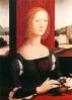
Caterina Sforza Countess of Forli
(1462 - 28 May 1509)
Events
| Birth | 1462 | ||||
| Marriage | 1497 | Giovanni de' Medici | |||
| Death | 28 May 1509 | Firenze | |||
| Biography |  |  |
Families
| Spouse | Giovanni de' Medici (1467 - 1498) |
| Child | Giovanni "delle Bande Nere" de' Medici (1498 - 1526) |
Notes
Biography
Caterina was born in late 1462 or early 1463, an illegitimate daughter of Galeazzo Maria Sforza, duke of Milan, by Lucrezia Landriani. The Duke legitimised her and brought her up with his legitimate children. Lucrezia Landriani seems to have been generous with her favours; she had children not only by her husband, but also by the duke and others.At the age of nine Caterina was engaged to Girolamo Riario, brutal and cowardly, the son of Paolo Riario di Savona and Bianca della Rovere, sister of Pope Sixtus IV (Francesco della Rovbere). They married in February 1477 and she departed for Rome. The 14 year old bride, tall, slim, blond and very attractive, was received with ceremonies and banquets.
Girolamo Riario was made captain-general of the Church and commander of the Castel Sant' Angelo. Fat, lazy, arrogant and suspected of numerous murders, he had to have an armed escort when going out. Even though it seems unlikely that she loved her husband, they had seven children, none of whom would have progeny.
In 1484 Pope Sixtus died, and in the turbulence that usually followed a pontiff's death, she took control of the Castel Sant' Angelo in the name of her absent husband. The garrison obeyed her even though she was only twenty-one and seven months pregnant. She remained in charge for thirteen days, and when she realised she was without her husband's support she surrendered the fortress to the cardinals.
With her husband she went to Forli to rule Imola and Forli, where they built a palace. Girolamo tried to make himself popular by paying his soldiers well and reducing the taxes for his people, only to run out of money. Then he made himself hated and feared by all, including his wife, by raising the taxes and confiscating properties.
While they were at Imola in 1487, a few people in Forli tried to rise against them. As Girolamo was ill, Caterina returned to Forli where she had six rebels decapitated in the city square. However this was not the end of the uprisings against Girolamo Riario; on 14 April 1488 Cecco Orsi, captain of Riario's guard, together with two accomplices, murdered the forty-five-year-old tyrant.
According to legend, Caterina Sforza locked herself and her children in her room, but Cecco Orsi soon had them extricated. She had been able to instruct Tommaso Feo, who was in control of the citadel of Ravaldino, not to surrender no matter what she might say later. Whoever was in control of Ravaldino would be in control of Imola and Forli. She was taken to the castle's walls imploring Tommaso Feo to surrender; but his reply was that Cecco Orsi, for fear of her brother Gian Galeazzo, now the duke of Milan, would not dare harm her.
A second time Caterina was taken to the citadel and this time she persuaded her captors to allow her to enter the castle with the pretext of persuading Tommaso Feo in person to surrender, as her children were being held as security for her return. Once inside she refused to return, and when Cecco Orsi threatened to kill her children, she stood on the castle wall and lifted her skirts to display 'the mould for casting more'. Realising he was outwitted, Cecco Orsi fled.
Back in control, Caterina pursued and arrested as many conspirators as possible. As well, she vowed to hang anyone who had ransacked the Riario palace unless they restored the booty. Consequently Cecco Orsi's aged father was executed.
She was regent for her eldest son Ottaviano, but as he too was fat and lazy she continued ruling Imola and Forli even when he came of age. As lover she had taken Tommaso Feo's younger brother Giacomo, and secretly married him. He was beautiful and only twenty-years-old. Later he was made vice-regent of Imola and Forli, only to become arrogant and resented by the population. Perhaps he felt secure as Caterina had become pregnant and later produced a son, Bernardino.
One day Caterina and her children---Ottaviano, Cesare and Bianca---went hunting with Giacomo Feo. They were waylaid and Giacomo Feo was murdered. The chief murderer, Gian Antonio Ghetti, maintained that Caterina and Ottaviano had ordered the murder and he may well have believed this, but Caterina took revenge. Ghetti was killed and his wife and two small children were thrown into a spiked well. Altogether forty people, guilty or innocent, were killed.
The 28-year-old Giovanni de' Medici then came to Forli and became Caterina's lover, political advisor and ruler of Forli. Again she married him secretly and another son, Giovanni delle Bande Nere, was born. However only a year later Giovanni died. Alone she continued to rule Imola and Forli.
In 1499 Cesare Borgia began his quest for a state for himself. Supported by his father, Pope Alexander VI, he attacked Forli. Caterina tried to defend herself but failed in an attempt to poison the pope. Her children were taken for safekeeping to Florence while she built up the security of Ravaldino. She also took hostages from local prominent families she expected to be hostile to her.
The city of Imola surrendered first to Cesare Borgia, followed by Forli. However, Caterina refused to surrender Ravaldino. Cesare placed a price on her head of ten thousand ducats, dead or alive; her answer was a price on his head of ten thousand ducats alive, but only five thousand for a dead Cesare.
The siege began on 19 December 1499 and lasted for twenty-four days in terrible winter weather. Wearing armour, Caterina took part in the defence. Entering Ravaldino, Cesare's army slaughtered the defenders. Caterina was captured and raped by Cesare who boasted that she had been more determined in the defence of Ravaldino than in the defence of her virtue. He then raped her several times more before locking her up in the Vatican. When she attempted to escape, she was locked up in Castel Sant' Angelo. A prisoner for almost sixteen months, French pressure eventually secured her release. Having been in damp and filthy dungeons with insufficient food, she was now thin and haggard with her hair turning white.
She went to Florence where she died eight years later of a liver ailment, peritonitis and pleurisy. She was forty-six.
Endnotes
1. Genealogics.org, Leo van de Pas online [http://www.genealogics.org/index.php], accessed 2008 on, http://www.genealogics.org/getperson.php?personID=I00004102&tree=LEO.