Individual Details
Lucrezia Tornabuoni
(1425 - 25 Mar 1482)
Events
| Birth | 1425 | ||||
| Marriage | 3 Jun 1444 | Piero I. de' Medici - il Gottoso |  | ||
| Death | 25 Mar 1482 | ||||
| Biography |  | |
Families
| Spouse | Piero I. de' Medici - il Gottoso (1416 - 1469) |
| Child | Lorenzo I de' Medici - il Magnifico (1449 - 1492) |
| Child | Giuliano de' Medici (1453 - 1478) |
Notes
Biography
Lucrezia was born in 1425, the daughter of Francesco Tornabuoni and Selvaggia degli Alessandri. On 3 April 1444 she married Piero 'il Gottoso' de' Medici, son of the great Cosimo 'Pater Patrie' de' Medici, and they had two sons who would have progeny, and three daughters.Lucrezia was very popular with the Florentines. She was charming and spirited, profoundly religious and very accomplished. Her family, formerly Tornaquinci, had once been noble; they were still very rich, but in order to evade the disadvantages attaching to their birth they had changed their name, altered their arms and abandoned their former pretensions.
Lucrezia was a poet of real ability. Her poems reflected her theological interests, but they displayed a depth of feeling as well as literary quality. Neither her spiritual bent nor her intellectual leanings prevented her from being an admirable wife and mother. Her husband and her surviving children, as well as her father-in-law, all seem to have adored her.
Her eldest child was the future Lorenzo 'the Magnificent'. When Lorenzo was nineteen it was decided that he should marry. The bride selected for him was Clarice Orsini, a sixteen-year-old heiress from Rome. Lucrezia travelled to Rome to inspect the girl, and sent a fair and balanced report back to her son.
In 1469 Piero died, and Lorenzo became, at 20, the head of the family, and of Florence. Before his death Piero had assigned to his wife the right to distribute as charity the income from some of the Medici properties, an unusual role for a non-royal woman. With this and with her influence over the young Lorenzo, Lucrezia became powerful in her own right. She also became involved in business, investing her own capital in real estate projects and financing small traders and artisans. Her profit went largely to charity, most frequently to help the powerless. Such gifts had the effect of expanding the Medici's political base, but there is no evidence that they were made cynically; Lucrezia's letters indicate that she truly believed that what was good for the Medici was good for Florence and her territories.
In 1478 Florentine opponents of the Medici tried to murder both of Lucrezia's sons; Giuliano was killed but Lorenzo escaped. In the battles that followed and the plague that followed the battles, Lucrezia stayed in Florence by Lorenzo's side. She died on 25 March 1482.
Lucrezia and her husband had invited Botticelli (Alessandro di Mariano Filipepi) to live with them at the Medici palace in Florence, treating him as one of their own family. In the _Madonna of the Magnificat_ of about 1480, Botticelli is said to have introduced both sons, Lorenzo and the late Giuliano, as angels kneeling before the Madonna.
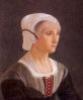
Lucrezia herself was painted twice by Domenico Ghirlandaio. His portrait of her from about 1475, when she was in her mid 40s, hangs in the National Gallery of Art in Washington.
Endnotes
1. Genealogics.org, Leo van de Pas online [http://www.genealogics.org/index.php], accessed 2008 on, http://www.genealogics.org/getperson.php?personID=I00004096&tree=LEO.
2. Geneall, Guarda Mor online [http://www.geneall.net], accessed 2008 on, http://www.geneall.net/I/per_page.php?id=35329.
3. Genealogics.org, Leo van de Pas online [http://www.genealogics.org/index.php], accessed 2008 on, http://www.genealogics.org/getperson.php?personID=I00004096&tree=LEO.