Individual Details
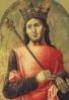
Saint Louis IX King of France
(25 Apr 1214 - 25 Aug 1270)
St. Louis IX, King of France, canonised 11 August 1297 by Pope Boniface VIII
St. Louis was born at Poissy on 25 April 1214, the son of Louis VIII, king of France, and Blanche of Castile. He was twelve years old when he became king on the death of his father, although his right of succession was at first disputed. However his formidable mother, the queen-regent, twice had to take up arms to defeat rebellious nobles. In 1234 Louis married Marguerite de Provence, daughter of Raimund Berengar V, comte de Provence, and Beatrice de Savoie. In 1236 he took over the reins of government.
However, Blanche of Castile was reluctant to let go of power, and because of this, Louis IX treated her with extravagant respect. She was also jealous of Marguerite de Provence, and in the first years of their married life she tried to keep Louis and Marguerite apart. Nevertheless Louis proved to be the stronger character, and even though he put up with his mother's caprices he had his way in essential matters.
Louis IX and Marguerite had nine children, of whom three sons and three daughters would have progeny. Marguerite also wanted to interfere in politics but in these matters Louis IX kept her at arm's length, though he took her with him on his first crusade. Louis IX was a very handsome man, tall and elegant, and his people noted his mild and kind look. Early in the morning he would leave the palace to distribute money to the poor as anonymously as possible. At midnight he would hear Mass for the dead. On Fridays he neither indulged any frivolity nor, in memory of Christ's the crown of thorns, wore a hat; and like most monarchs he washed the feet of the poor.
His dress was almost like a monk's. One day his wife reproached him for not wearing more regal dress. He responded that each spouse had to please the other and so he would dress more richly to please her, but then she would have to please him by disposing of her rich dresses. Always self-confident, he loved to sing and jest with his companions, and was so strong of will that most men feared him.
In 1248 he went on crusade accompanied by his wife and two brothers. In 1249 he took Damietta on the mouth of the Nile and should have continued on to take Cairo. However he stayed to pray while his crusaders enjoyed the fleshpots of the Near East.
The sultan was then able to bring reinforcements, and when Louis and his army marched to Cairo they were cut off from Damietta and no food could reach the French. Louis and his army suffered from dysentery and finally had to surrender to the Muslims, although in Damietta the queen and her force still held out.
Louis IX was led around in triumph. However the Egyptians felt embarrassed at having so many prisoners At night they were taken to the Nile in groups of three or four hundred, where their heads were cut off and they were thrown into the river. Louis IX and those nobles still alive were ransomed and returned to the queen in Damietta, which had to be returned to the Muslims. After this disaster Louis stayed two more years in Palestine, but he remained unsuccessful as no support was offered from Europe, which had lost the taste for crusades. Back in France he won victories over the English at Taillebourg and Saintes. To the surprise of Europe, the victorious king gave back three provinces of France to Henry III, stating that there should be peace and amity between Christians. However he demanded that the English king should pay him homage and abandon all claims to the throne of France.
In the summer of 1270 Louis IX set out for another crusade. As he believed the Bey of Tunis intended to become a Christian, he thought it would be a friendly visit. More probably he was induced to go to Tunis by his brother Charles of Anjou, king of Sicily, who wanted to stop the pirates using Tunis as their base.
Some people regarded the whole expedition as a sin as the kingdom was at peace with all its neighbours, including Tunis. Another reason was Louis IX's physical condition; he could not bear to be carried or to ride on horseback. He landed at Carthage in mid-summer when the pest was raging in Tunisia. After a victorious fight before the walls of Tunis, the French army was immobilised by the disease, and on 25 August 1270 the king died of it.
Source: Leo van de Pas
St. Louis was born at Poissy on 25 April 1214, the son of Louis VIII, king of France, and Blanche of Castile. He was twelve years old when he became king on the death of his father, although his right of succession was at first disputed. However his formidable mother, the queen-regent, twice had to take up arms to defeat rebellious nobles. In 1234 Louis married Marguerite de Provence, daughter of Raimund Berengar V, comte de Provence, and Beatrice de Savoie. In 1236 he took over the reins of government.
However, Blanche of Castile was reluctant to let go of power, and because of this, Louis IX treated her with extravagant respect. She was also jealous of Marguerite de Provence, and in the first years of their married life she tried to keep Louis and Marguerite apart. Nevertheless Louis proved to be the stronger character, and even though he put up with his mother's caprices he had his way in essential matters.
Louis IX and Marguerite had nine children, of whom three sons and three daughters would have progeny. Marguerite also wanted to interfere in politics but in these matters Louis IX kept her at arm's length, though he took her with him on his first crusade. Louis IX was a very handsome man, tall and elegant, and his people noted his mild and kind look. Early in the morning he would leave the palace to distribute money to the poor as anonymously as possible. At midnight he would hear Mass for the dead. On Fridays he neither indulged any frivolity nor, in memory of Christ's the crown of thorns, wore a hat; and like most monarchs he washed the feet of the poor.
His dress was almost like a monk's. One day his wife reproached him for not wearing more regal dress. He responded that each spouse had to please the other and so he would dress more richly to please her, but then she would have to please him by disposing of her rich dresses. Always self-confident, he loved to sing and jest with his companions, and was so strong of will that most men feared him.
In 1248 he went on crusade accompanied by his wife and two brothers. In 1249 he took Damietta on the mouth of the Nile and should have continued on to take Cairo. However he stayed to pray while his crusaders enjoyed the fleshpots of the Near East.
The sultan was then able to bring reinforcements, and when Louis and his army marched to Cairo they were cut off from Damietta and no food could reach the French. Louis and his army suffered from dysentery and finally had to surrender to the Muslims, although in Damietta the queen and her force still held out.
Louis IX was led around in triumph. However the Egyptians felt embarrassed at having so many prisoners At night they were taken to the Nile in groups of three or four hundred, where their heads were cut off and they were thrown into the river. Louis IX and those nobles still alive were ransomed and returned to the queen in Damietta, which had to be returned to the Muslims. After this disaster Louis stayed two more years in Palestine, but he remained unsuccessful as no support was offered from Europe, which had lost the taste for crusades. Back in France he won victories over the English at Taillebourg and Saintes. To the surprise of Europe, the victorious king gave back three provinces of France to Henry III, stating that there should be peace and amity between Christians. However he demanded that the English king should pay him homage and abandon all claims to the throne of France.
In the summer of 1270 Louis IX set out for another crusade. As he believed the Bey of Tunis intended to become a Christian, he thought it would be a friendly visit. More probably he was induced to go to Tunis by his brother Charles of Anjou, king of Sicily, who wanted to stop the pirates using Tunis as their base.
Some people regarded the whole expedition as a sin as the kingdom was at peace with all its neighbours, including Tunis. Another reason was Louis IX's physical condition; he could not bear to be carried or to ride on horseback. He landed at Carthage in mid-summer when the pest was raging in Tunisia. After a victorious fight before the walls of Tunis, the French army was immobilised by the disease, and on 25 August 1270 the king died of it.
Source: Leo van de Pas
Events
| Birth | 25 Apr 1214 | Poissy, Yvelines | |||
| Marriage | 27 May 1234 | Sens - Marguerite of Provence | |||
| Death | 25 Aug 1270 | Carthage, Tunisia | |||
| Canonised | 11 Aug 1297 | was canonised by Pope Boniface VIII, Crusader | |||
| Burial | St. Denis | ||||
| Biography | Biography |  |  |
Families
| Spouse | Marguerite of Provence (1221 - 1295) |
| Child | Philippe III "le Hardi" King of France (1245 - 1285) |
| Father | Louis VIII King of France (1187 - 1226) |
| Mother | Blanca Infanta de Castile (1188 - 1252) |
| Sibling | Charles I Etienne King of Naples and Sicily (1226 - 1285) |
Notes
Biography
St. Louis IX, King of FranceKing of France, son of Louis VIII and Blanche of Castile, born at Poissy, 25 April, 1215; died near Tunis, 25 August, 1270.
He was eleven years of age when the death of Louis VIII made him king, and nineteen when he married Marguerite of Provence by whom he had eleven children. The regency of Blanche of Castile (1226-1234) was marked by the victorious struggle of theCrown against Raymond VII in Languedoc, against Pierre Mauclerc in Brittany, against Philip Hurepel in the Ile de France, and by indecisive combats against Henry III of England. In this period of disturbances the queen was powerfully supported by the legate Frangipani. Accredited to Louis VIII by Honorius III as early as 1225, Frangipani won over to the French cause the sympathies of Gregory IX, who was inclined to listen to Henry III, and through his intervention it was decreed that all the chapters of the dioceses should pay to Blanche of Castile tithes for the southern crusade. It was the legate who received the submission of Raymond VII, Count of Languedoc, at Paris, in front of Notre-Dame, and this submission put an end to the Albigensian war and prepared the union of the southern provinces to France by the Treaty of Paris (April 1229). The influence of Blanche de Castile over the government extended far beyond St. Louis's minority. Even later, in public business and when ambassadors were officially received, she appeared at his side. She died in 1253.
In the first years of the king's personal government, the Crown had to combat a fresh rebellion against feudalism, led by the Count de la Marche, in league with Henry III. St. Louis's victory over this coalition at Taillebourg, 1242, was followed by the Peace of Bordeaux which annexed to the French realm a part of Saintonge.
It was one of St. Louis's chief characteristics to carry on abreast his administration as national sovereign and the performance of his duties towards Christendom; and taking advantage of the respite which the Peace of Bordeaux afforded, he turned his thoughts towards a crusade. Stricken down with a fierce malady in 1244, he resolved to take the cross when news came that Turcomans had defeated the Christians and the Moslems and invaded Jerusalem. (On the two crusades of St. Louis [1248-1249 and 1270] see CRUSADES.) Between the two crusades he opened negotiations with Henry III, which he thought would prevent new conflicts between France and England. The Treaty of Paris (28 May, 1258) which St. Louis concluded with the King of England after five years' parley, has been very much discussed. By this treaty St. Louis gave Henry III all the fiefs and domains belonging to the King of France in the Dioceses of Limoges, Cahors, and Périgueux; and in the event of Alphonsus of Poitiers dying without issue, Saintonge and Agenais would escheat to Henry III. On the other hand Henry III renounced his claims to Normandy, Anjou, Touraine, Maine, Poitou, and promised to do homage for the Duchy of Guyenne. It was generally considered and Joinville voiced the opinion of the people, that St. Louis made too many territorial concessions to Henry III; and many historians held that if, on the contrary, St. Louis had carried the war against Henry III further, the Hundred Years War would have been averted. But St. Louis considered that by making the Duchy of Guyenne a fief of the Crown of France he was gaining a moral advantage; and it is an undoubted fact that the Treaty of Paris, was as displeasing to the English as it was to the French. In 1263, St. Louis was chosen as arbitrator in a difference which separated Henry III and the English barons: by the Dit d'Amiens (24 January, 1264) he declared himself for Henry III against the barons, and annulled the Provisions of Oxford, by which the barons had attempted to restrict the authority of the king. It was also in the period between the two crusades that St. Louis, by the Treaty of Corbeil, imposed upon the King of Aragon the abandonment of his claims to all the fiefs in Languedoc excepting Montpellier, and the surrender of his rights to Provence (11 May, 1258). Treaties and arbitrations prove St. Louis to have been above all a lover of peace, a king who desired not only to put an end to conflicts, but also to remove the causes for fresh wars, and this spirit of peace rested upon the Christian conception.
St. Louis's relations with the Church of France and the papal Court have excited widely divergent interpretations and opinions. However, all historians agree that St. Louis and the successive popes united to protect the clergy of France from the encroachments or molestations of the barons and royal officers. It is equally recognized that during the absence of St. Louis at the crusade, Blanche of Castile protected the clergy in 1251 from the plunder and ill-treatment of a mysterious old maurauder called the "Hungarian Master" who was followed by a mob of armed men - called the "Pastoureaux." The "Hungarian Master" who was said to be in league with the Moslems died in an engagement near Villaneuve and the entire band pursued in every direction was dispersed and annihilated.
But did St. Louis take measures also to defend the independence of the clergy against the papacy? A number of historians once claimed he did. They attributed to St. Louis a certain "pragmatic sanction" of March 1269, prohibiting irregular collations of ecclesiastical benefices, prohibiting simony, and interdicting the tributes which the papal Court received from the French clergy. The Gallicans of the seventeenth and eighteenth centuries often made use of this measure against the Holy See; the truth is that it was a forgery fabricated in the fourteenth century by juris-consults desirous of giving to the Pragmatic Sanction of Charles VII a precedent worthy of respect. This so-called pragmatic of Louis IX is presented as a royal decree for the reformation of the Church; never would St. Louis thus have taken upon himself the right to proceed authoritatively with this reformation. When in 1246, a great number of barons from the north and the west leagued against the clergy whom they accused of amassing too great wealth and of encroaching upon their rights, Innocent IV called upon Louis to dissolve this league; how the king acted in the matter is not definitely known. On 2 May, 1247, when the Bishops of Soissons and of Troyes, the archdeacon of Tours, and the provost of the cathedral of Rouen, despatched to the pope a remonstrance against his taxations, his preferment of Italians in the distribution of benefices, against the conflicts between papal jurisdiction and the jurisdiction of the ordinaries, Marshal Ferri Pasté seconded their complaints in the name of St. Louis. Shortly after, these complaints were reiterated and detailed in a lengthy memorandum, the text of which has been preserved by Mathieu Paris, the historian. It is not known whether St. Louis affixed his signature to it, but in any case, this document was simply a request asking for the suppression of the abuses, with no pretensions to laying down principles of publicright, as was claimed by the Pragmatic Sanction.
Documents prove that St. Louis did not lend an ear to the grievances of his clergy against the emissaries of Urban IV and Clement IV; he even allowed Clement IV to generalize a custom in 1265 according to which the benefices the titularies of which died while sojourning in Rome, should be disposed of by the pope. Docile to the decrees of the Lateran Council (1215), according to which kings were not to tax the churches of their realm without authority from the pope, St. Louis claimed and obtained from successive popes, in view of the crusade, the right to levy quite heavy taxes from the clergy. It is again this fundamental idea of the crusade, ever present in St. Louis's thoughts that prompted his attitude generally in the struggle between the empire and the pope. While the Emperor Frederick II and the successive popes sought and contended for France's support, St. Louis's attitude was at once decided and reserved. On the one hand he did not accept for his brother Robert of Artois, the imperial crownoffered him by Gregory IX in 1240. In his correspondence with Frederick he continued to treat him as a sovereign, even after Frederick had been excommunicated and declared dispossessed of his realms by Innocent IV at the Council of Lyons, 17 July, 1245. But on the other hand, in 1251, the king compelled Frederick to release the French archbishops taken prisoners by the Pisans, the emperor's auxiliaries, when on their way in a Genoese fleet to attend a general council at Rome. In 1245, he conferred at length, at Cluny, with Innocent IV who had taken refuge in Lyons in December, 1244, to escape the threats of the emperor, and it was at this meeting that the papal dispensation for the marriage of Charles Anjou, brother of Louis IX, to Beatrix, heiress of Provençe was granted and it was then that Louis IX and Blanche of Castile promised Innocent IV their support. Finally, when in 1247 Frederick II took steps to capture Innocent IV at Lyons, the measures Louis took to defend the pope were one of the reasons which caused the emperor to withdraw. St. Louis looked upon every act of hostility from either power as an obstacle to accomplishing the crusade. In the quarrel over investitures, the king kept on friendly terms with both, not allowing the emperor to harass the pope and never exciting the pope against the emperor. In 1262 when Urban offered St. Louis, the Kingdom of Sicily, a fief of the Apostolic See, for one of his sons, St. Louis refused it, through consideration for the Swabian dynasty then reigning; but when Charles of Anjou accepted Urban IV's offer and went to conquer the Kingdom of Sicily, St. Louis allowed the bravest knights of France to join the expedition which destroyed the power of the Hohenstaufens in Sicily. The king hoped, doubtless, that the possession of Sicily by Charles of Anjou would be advantageous to the crusade.
St. Louis led an exemplary life, bearing constantly in mind his mother's words: "I would rather see you dead at my feet than guilty of a mortal sin." His biographers have told us of the long hours he spent in prayer, fasting, and penance, without the knowledge of his subjects. The French king was a great lover of justice. French fancy still pictures him delivering judgements under the oak of Vincennes. It was during his reign that the "court of the king" (curia regis) was organized into a regular court of justice, having competent experts, and judicial commissions acting at regular periods. These commissions were called parlements and the history of the "Dit d'Amiens" proves that entire Christendom willingly looked upon him as an international judiciary. It is an error, however, to represent him as a great legislator; the document known as "Etablissements de St. Louis" was not a code drawn up by order of the king, but merely a collection of customs, written out before 1273 by a jurist who set forth in this book the customs of Orléans, Anjou, and Maine, to which he added a few ordinances of St. Louis.
St. Louis was a patron of architecture. The Sainte Chappelle, an architectural gem, was constructed in his reign, and it was under his patronage that Robert of Sorbonne founded the "Collège de la Sorbonne," which became the seat of the theological faculty of Paris.
He was renowned for his charity. The peace and blessings of the realm come to us through the poor he would say. Beggars were fed from his table, he ate their leavings, washed their feet, ministered to the wants of the lepers, and daily fed over one hundred poor. He founded many hospitals and houses: the House of the Felles-Dieu for reformed prostitutes; the Quinze-Vingt for 300 blind men (1254), hospitals at Pontoise, Vernon, Compiégne.
The Enseignements (written instructions) which he left to his son Philip and to his daughter Isabel, the discourses preserved by the witnesses at judicial investigations preparatory to his canonization and Joinville's anecdotes show St. Louis to have been a man of sound common sense, possessing indefatigable energy, graciously kind and of playful humour, and constantly guarding against the temptation to be imperious. The caricature made of him by the envoy of the Count of Gueldre: "worthless devotee, hypocritical king" was very far from the truth. On the contrary, St. Louis, through his personal qualities as well as his saintliness, increased for many centuries the prestige of the French monarchy. St. Louis's canonization was proclaimed at Orvieto in 1297, by Boniface VIII. Of the inquiries in view of canonization, carried on from 1273 till 1297, we have only fragmentary reports published by Delaborde ("Mémoires de la société de l'histoire de Paris et de l'Ilea de France," XXIII, 1896) and a series of extracts compiled by Guillaume de St. Pathus, Queen Marguerite's confessor, under the title of "Vie Monseigneur Saint Loys" (Paris, 1899).
Background
APA citation. Goyau, G. (1910). St. Louis IX. In The Catholic Encyclopedia. New York: Robert Appleton Company. Retrieved January 25, 2009 from New Advent: http://www.newadvent.org/cathen/09368a.htm
MLA citation. Goyau, Georges. "St. Louis IX." The Catholic Encyclopedia. Vol. 9. New York: Robert Appleton Company, 1910. 25 Jan. 2009
Transcription. This article was transcribed for New Advent by Paul T. Crowley. In Memoriam, Mrs. Margaret McHugh & Miss Jeanette Farrell, Third Order of St. Francis, Cap.
Ecclesiastical approbation. Nihil Obstat. October 1, 1910. Remy Lafort, Censor. Imprimatur. +John M. Farley, Archbishop of New York.
Endnotes
1. www.newadvent.org, http://www.newadvent.org/cathen/09368a.htm.