Individual Details
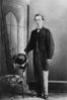
John Alexander Larnach
(17 Feb 1836 - 14 Oct 1887)
Events
| Birth | 17 Feb 1836 | Singleton, New South Wales, Australia | |||
| Occupation | 1861 | Bank Manager |  | ||
| Marriage | 17 Jan 1861 | Sydney, New South Wales, Australia - Margaret Dick | |||
| Death | 14 Oct 1887 | Died in a fire at the hotel - Victoria Hotel, Rockhampton, Queensland, Australia |
Families
| Spouse | Margaret Dick (1835 - 1884) |
| Child | Arthur Fitz Arundel Larnach (1861 - 1866) |
| Child | May Charlotte Milford Larnach (1863 - 1866) |
| Father | John Larnach (1805 - 1869) |
| Mother | Emily Mudie (1807 - 1882) |
| Sibling | Maria Little Larnach (1828 - 1833) |
| Sibling | George Mudie Larnach (1829 - 1838) |
| Sibling | Margaret Amelia Larnach (1831 - 1915) |
| Sibling | William James Mudie Larnach C.M.G. (1833 - 1898) |
| Sibling | Emily Larnach (1834 - 1902) |
| Sibling | Albert John Larnach (1836 - 1905) |
| Sibling | George Mudie Larnach (1841 - 1915) |
| Sibling | Mary Mudie Larnach (1842 - 1857) |
Notes
Occupation
One of the drawbacks of early Rockhampton and Central Queensland was the paucity of cash, so that the opening of branches of the banks established in southern cities was of paramount importance. This state of affairs meant that a lot of the business of the rising town was done by cheques or order on Brisbane or further south. With such a large floating population in many cases there was no means of ascertaining whether such cheques were negotiableable or not, and occasionally they were not worth the paper they were written on.The announcement therefore that the Australian Joint Stock Bank (now the Australian Bank of Commerce) intended to open a branch in Quay street, was heard with widespread pleasure. Premises were ready in 1861 and Mr. John A Larnach was the first manager. He was a good man for such an undertaking, and assumed all the importance of the Governor. As he was one of the first in the town to possess a buggy, the vehicle gave him an added dignity, particularly when he drove his wife round the streets shopping.
The Bank of course did a big business, but did not by any means do away with the excessive cheque system of exchange, Gold and silver coinage remained very scarce, and it was only rarely that copper pennies and half pennies were met with. Instead several prominent firms had copper tokens struck advertising their business. Among others D. T. Mulligan, a general merchant, distributed a considerable number of these tokens. The resembled genuine pence only in shape and size, in fact they were considerably larger than the bronze coinage. These copper coins were taken in general business, but, of course, were not really negotiable. They were a convenience undoubtedly, though many people left that portion of their change rather than be burdened with the weight. It was some years before the bronze coinage was sufficient to do away with these undesirable tokens.
As manager of the only Bank John Larnach soon became an important man in the business life of the thriving town, and there were very few public movements that he was not identified with, and influenced to a considerable extent.
George Ranken was sent to Rockhampton to open a branch of the Bank of New South Wales about 1862. He was succeeded by a Buchanan, and then the present “Cooinda” was built at the corner of Denham and Bolsover streets. It was at that time about the finest building in the town, and a ball was given in honour of the occasion and all the elite of the town and district was present. The manager at that time was the popular R. H. D. White, who became Captain White, of the Rifle Volunteers.
Then followed the Union Bank of Australasia, with J. T. Sale as opening manager. The same site was occupied as at present. In a short time E. P. Tregurtha took up the management of the branch, and after a few years was succeeded by G. E. Tuson, who held the position for some years. Rockhampton was then well supplied with banking institutions and smaller branches were with all expedition extended to outside places like Clermont, Mackay, and Gladstone.
The mention of Mr. Tuson’s name recalls the fact that he stuttered in his speech, a decided drawback to a public man. Mr. Hardie Buzacott, then proprietor of the “Bulletin,” also had an impediment in his speech. When these two gentlemen met, as they frequently did, their stammering appeared almost comical to a third person, as it seemed as though they might be mocking each other. Mr. W. R. O. Hill, a Police Magistrate of early days, yes also a stutterer. All three of these gentlemen were good singers, when the inflicion was absent.
The writer has forgotten when the Commercial Bank started business, but it was fairly early. It was in the seventies that the Queensland National Bank opened business in a very small way in the building next to the old Bulletin Office, in which the Northern Argus had started business. All of these and other branches started in a modest way, but blossomed out some buildings in which their business into important concerns as the hand is now conducted abundantly testifies.
John Larnach was so closely identified with the early life of Rockhampton, apart from his being its first banker, that some further particulars of this remarkable gentleman may be given. He was promoted elsewhere after some years, and is believed to have lost his wife through death. He returned to Rockhampton alone about 1880, having retied from the bank, probably on the account of age. He still remained the fiery and irascible man of his younger days, and the writer remembers Mrs. M’Master, then licensee of the Blue Bell Hotel, Emu Park, complaining of the trouble he gave as a temporary boarder. Like Bret Harte’s Heathen Chinee, the old gentleman’s language “was frequent under free,” as many were able to testify. However, his end came in a startling and tragic manner.
Blazius Brogli kept the Victoria Hotel at the corner of Kent and Denham streets, and Larnach when he returned from Emu Park became a boarder.
One night he was reading in bed by the light of a kerosene lamp. Somehow the lamp exploded or capsized, and set the mosquito curtains and bed sheets on fire. In a few seconds John Larnach’s clothing was in flames, and the poor old man was so terribly burned that his recovery was hopeless, and after enduring great agony for a day or two death relieved him of his sufferings. It was a sad ending to a life of energetic effort and usefulness, but “He that dies pays all debts.”