Individual Details
Andrew "Andreas" Barthle Sr
(November 16, 1802 - February 6, 1891)
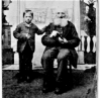
Photo: Andrew "Andreas" Barthle and his grandson, John Buttweiler
"The beginning of the Barthle Family in Florida"
They had moved from Minnesota where only years earlier emigrated from the Black Forest Area of Germany.
June 1883. Andrew Barthle (1802-1891) and Charles Barthle (1852-1936) built the first permanent home in what would become St. Joseph.
Begining in 1883, the Barthle family led a number of Catholic immigrants from the German Empire into the area (by way of Minnesota) and founded St. Joseph, the last and only survivor of Edmund Dunne's planned villages. It was due north of San Antonio. A little board- and-batten church was built there in 1888 and dedicated to the Sacred Heart of Jesus.
San Antonio and the surrounding area maintained a distinctly Germanic character until the era of the First World War when Florida was convulsed with an unprecedented wave of AntiGerman feeling combined with a strong Anti-Catholic movement led by the state's governor, Sidney J. Catts.
Governor Catts was widely quoted (and widely believed) to the effect that the "German" monks at St. Leo had an arsenal and were planning to arm Florida Negroes for an insurrection in favor of Kaiser Wilhelm II, after which the Pope would take over Florida and move the Vatican to San Antonio (and, of course, close all protestant churches). A number of German settlers moved away to friendlier parts of the country. Others stayed and took the pressure.
In 1926, during the Florida land boom, San Antonio was reorganized as the "City of Lake Jovita and its boundaries extended a considerable distance. In an effort to "modernize," Judge Dunne's street names were changed: Sacred Heart Street becoming Rhode Island Avenue, Pius IX Avenue becoming Curley Street, etc. The land boom ended abruptly in the same year, causing bank failures throughout the state.
A community with deep roots in the past and strong agricultural ties, Judge Dunne's Catholic Colony is now comprised of the Cities of San Antonio and St. Leo, the unincorporated village of St. Joseph and miles of orange trees and pasture lands. The central role played by the Catholic church in the life of the community and the deep commitment to agriculture by generations of residents are, like San Antonio's town square, reminders of what Judge Dunne envisioned in 1882.
Faces & Places
"The Tampa Trubune (Pasco) Jan 23, 2002"
Barthles spread Word About St. Joe
St. Joseph
---It may be the tiny Kumquat that puts this little community on the map these days. But officially, St. Joseph has been on the map for more than 100 years
And even with the attention brought by Saturday's Dade City Kumquat Festival, St. Joe most likely well return to its low-key profile in the days that follow. That's the way it's been, and that's the way folks in this rural "kumquat capital of the world" want it to stay.
Indeed, the notheast Pasco community has been know for its kumquats since 1926. But St. Joe's history dates to the 1880's, when Andrew Barthle came from Minnesota seeking the sun-drenched Florida countryside.
Barthle stayed three months before returning to tell family and friends in St. Joseph, Minn., about Florida's virtues. Soon, his older brother, Bernard, moved down with his wife and eight children. In June 1883 they set up the first permanent home, on what is now County road 578, west of Scharber Road.
Andrew Barthle returned with his family in 1885 and settled 40 acres opposite his brother's home. The youngest Barthle brother, Charles, came a short time later and acquired 40 acres east of Andrew' land. Andrew Barthle Sr., father of the three brothers, also settled in the area. First known as Barthle Settlement and Barthle Crossing, by 1888 it was called St. Joseph after the Barthles' Minnesota hometown.
Making Themselves At Home
The Barthles were German Catholic immigrants who settled in Ohio in the mid-19th century. They later moved to Minnesota, but found their permanent home in Florida.
Other families, many from Minnesota, also came to Florida's St. Joseph. By 1888, the area had enough familes to warrant a church and school closer than those located about four miles south in the Catholic Colony of San Antonio.
That July, Father Gerard Pilz, the Benedictine pastor of St. Anthony of Padua parish in San Autonio, approved a new venture at St. Joseph. The pioneers built their own German Catholic school and church on five acres acquired from the Plant Investment Co.
On Oct. 1, Pilz dedicated the small frame Jubilee Chapel and celebrated the first Mass, naming the parish for the Sacred Heart of Jesus. Almost from that day, Jubilee Chapel was used as a schoolhouse, with Bernard Barthle as the first teacher.
Nums Were In, Out, In Again
By September 1889, the Benedictine Sisters of Holy Name Convent, who had come to provide educational services for San Antonio earlier that year, had taken over teaching St. Joseph school's 35 students.
The school originally was organized as part of the parish. But around the turn of the century, a freeze left people without money to support the school, so the county asssumed financial responsibility.
Nuns continued teaching there until anti-Catholic governor Sidney Catts was elected in 1917 and made good his threat to remove them from the public school payroll. At the time, sisters from Holy Name Priory were teaching at St. Joseph and St. Anthony church's pastor, it became public.
St. Anthony School had been opened to serve the San Antonio Catholic collony in 1883. In 1891, at the request of St. Anthony church's pastor, it became public.
Nuns returned to teach at St. Joseph public school in 1921 when Catts was ineligible to run again for governor.
In the 1960s, the sisters were joined be lay teachers. And in 1981, the school closed when the public San Antonio Elementary opened nearby.
They Built it, They Came
Almost from its start in 1888, Jubilee Chapel overflowed with worshipers as well as students. Within four years, work had begun on a new church for about 100 people.
The frame building with its steep gable roof was built west of Jubelee Chapel and dedicated as Sacred Heart church.
Construction was directed by Father Benedict Roth of Saint Leo Abbey, who was the missionary pastor to the Catholics of St. Joseph.
In 1933, while Abbot Francis Sadlier of the abbot was pastor, a 12-foot additon to the front of the building included as impressive bell tower.
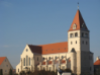
The church was replaced by the current Sacred Heart church in 1976.
Comings and Goings
A post office opened in St. Joseph in May 1893 and closed in November 1918, in favor of service from Dade City.
Two of the original Barthle brothers stayed in St. Joseph, with Andrew relocating to land west of Sacred Heart church. His brother, Bernard, died in 1900 and his youngest son, John B., inherited his land and maintanied the original family homesteard until his death.
Charles Barthle moved to San Antonio and opened the St. Charles Hotel in 1913. Ted and Anne Stephens bought the place in 1995 and restored it as a bed and breakfast, the St. Charles Inn.
Other descendents of pioneer families are still in the area, and many still work their forefathers' land. According to a San Antonio newspaper column published between 1896 and 1900, St. Joseph's main industry was growing strawberries, citrus and begetables, along with raising hogs and chickens.
Not surprisingly, then, the concerns of early growers were much the same as today: whether it would rain enough or too much, and whether it would freeze in the winter.
Farmers also were concerned with building roads to get their crops to town. And in 1898, they fretted about decreasing prices. Strawberries selling for 35 to 40 sents a quart dropped to 20 and 25 cernts. Farmers had to make 18 cents a quart to break even.
Life Was Simpler Back Then
Gertrude Gude, granddaughter of Bernard Barthle, then 91, said in a 1983 interview that "visiting" was the primary entertainment in St. Joseph when she was young.
"I really miss that. It seems people today are working all the time. And we had a lot of fun playing with broken dishes and sticks and strings than kids do today with all those expensive toys." said Gude, who lived most of her life on 40 acres belonging to her father, Joe Nathe.
The Nathe family raised all its food and sold the excess to obtain other needed items. "We'd drive a horse to Dade City and always take something you grew in there to trade for whatever you needed." Gude said.
"It'd take several hours -- most of the day -- to go to town because we had to go on sand roads through the woods."
Gude's other grandfather came from Minnesota to settle in St. Joseph in 1887. Casper Joseph "J.C." Nathe worked several jobs, including at a nursery near Jessamine. There, he became acquainted with the kumquat, considered an ornamental plant back then.
Nathe set out an acre of kumquat trees in 1912, a year after buying 340 acres of mostly uncleared land. Nather also planted 50 acres of citrus, plus tried growing bananas, avocados, guavas, pineappples and vegetables for his family and neighbors to share.
Within a few years Nathe's kumquat trees bore enough fruit for preserves. Before long, orders started coming in and he set out more acres of tress. By 1926, Florda Grower magazine crowned Nathe "the world's kumquat king."
Other growers followed, and soon Pasco County became the worlds leader in producing and shipping the fruit.
So it remains today. Annual production of kumquats in St. Joseph is 250 acres of 10,000 bushels or 500,000 pounds.
The Greater Dade City Chamber of Commerce took that fact to build its successful Kumquat Festival five years ago. Although the kumquat remains the focus, many other activities are scheduled for the one-day event downtown.
Excerpt from "Cowboys, Kids & Critters" by Jeanette Barthle
The history of the Barthle clan in the area is somewhat curious and dates back to Andrew Barthles three marriages. He had a son by each of his three wives. From those three half-brothers the present Barthle families are descended, "filing the woods," so to speak, with Barthles.
Trying to untangle the relationships between all of the families can be a frustrating procedure. One has to take into account all of the grandparents, aunts, uncles, nieces, nephews, and cousins that are once, twice, or three-times removed, keeping in mind that many are "half-cousins."
The fact that there were several other large families in the area and that they all intermarried really adds to the complications of determining whose relations are whose!
A CENTURY OF SERVICE // SACRED HEART CHURCH IS THE FOCUS OF AN ENDURING COMMUNITY IN PASCO
St. Petersburg Times; St. Petersburg, Fla.; Oct 1, 1988; Jeanne Pugh;
ST. JOSEPH - An all-day celebration beginning at 10 a.m. today marks the 100th anniversary of Sacred Heart Roman Catholic Church, one of the Tampa Bay area's pioneer religious institutions and a solid reminder that not all of Florida's roots have been planted in shifting sand.
Many of the participants will be in turn-of-the-century attire, recalling the early days of Sacred Heart Parish, which was founded by German immigrants for whom coming to Florida meant a lot of hard work and primitive living conditions.
Church members estimate that half the population of the community, in fact, can trace its lineage to those original settlers. They are survivors who have weathered economic and climatic storms. And, curiously, they have maintained a sense of community even though their town - ``Saint Joe,`` as they call it - has never been legally incorporated, has no elected officials and has no officially defined boundaries.
Frank and Rosemary Gude, descendants of two of the parish's founding families, recently reminisced about the community's history, drawing on personal experience and family lore.
Mrs. Gude said her grandfather, Charles Barthle, was one of the three Barthle brothers who arrived in the area in 1883 as homesteaders. The brothers had emigrated to Minnesota a couple of years earlier from the Black Forest area of Germany, intending to find work as carpenters or on the railroad. But an economic recession had made jobs scarce for immigrants in the North.
Once exposed to the cold Minnesota winters, Mrs. Gude said, the city-bred brothers and their young families were easy prey for the propaganda about Florida being spread throughout the Midwest by Judge Edmund Dunne. He had been commissioned by the Plant Investment Co. to find homesteaders for the company's land in what is now eastern Pasco County.
In addition to plugging Florida's healthful climate, fertile land and year-round growing season, Dunne was promoting the development of an ``International Catholic City`` made up of clusters of ethnic neighborhoods - German Catholics in one sector, Irish Catholics in another and so on - with Saint Leo Abbey, the Benedictine monastery, as the hub.
The ``city,`` like a lot of other schemes hatched by Florida developers, never materialized. But the German community did. Soon the Barthles were joined by more German Catholic families - the Nathes, the Blommels, the Buttweilers, the Gerners and the Zierdans - who formed the nucleus of the community that came to be known as St. Joseph.
Many of the newcomers found it difficult to adapt to an agricultural life, Mrs. Gude said. Among them was her grandfather, Charles Barthle, who became so discouraged after a freeze destroyed his fledgling citrus grove that he gave up his homestead, moved into the nearby village of San Antonio and built the St. Charles Hotel. The hotel, which was run by members of the Barthle family until the mid-1930s, is now the St. Charles Restaurant and Ice Cream Parlor.
Other settlers, however, became successful citrus and strawberry growers. By 1888, Saint Joe had grown large enough to establish its own parish.
Frank Gude said his grandparents were among the second wave of German immigrants who arrived in 1895, not long after the parish had completed construction of its second and larger sanctuary. By that time, the original church building was well-established as the community's school.
The community was especially attractive to German immigrants because the church and the school conducted their business in German, Gude said. German-speaking Benedictine monks from Saint Leo Abbey served as pastors of the congregation, and German-speaking nuns from Saint Leo's sister community, Holy Name Priory, taught at the school.
The school and church had to switch to the English language in 1918 when the parish was ordered to do so by Bishop Joseph Curley, head of the Diocese of St. Augustine, then Florida's only Catholic diocese. Shortly afterward, the school was taken over by the public school system, and the Benedictine sisters were replaced by lay teachers.


Events
| Birth | November 16, 1802 | Oberbettringen, Ostalbkreis, Baden-Württemberg, Germany | |||
| Marriage | November 9, 1829 | Waldstetten, Jagstkreis, Wuerttemberg - Anna Maier | |||
| Marriage | January 24, 1842 | Waldstetten Jagstkreis, Wuerttemberg, Germany - Maria Josefa Menrad | |||
| Marriage | March 6, 1848 | Waldstetten, Jagstkreis, Wuerttemberg - Maria Anna Menrad | |||
| Marriage | October 8, 1849 | Waldstetten, Jagstkreis, Wuerttemberg - Maria Barbara Blessing | |||
| Immigration | February, 1861 | Waldstetten Jagstkreis, Wuerttemberg, Germany | |||
| Census | 1875 | Millwood, Stearns, Minnesota, USA | |||
| Census | 1880 | Millwood, Stearns, Minnesota, USA | |||
| Death | February 6, 1891 | St. Joseph, FL-Headstone born 1801 | |||
| Burial | Sacred Heart Cemetery |
Families
| Spouse | Maria Josefa Menrad (1807 - ) |
| Child | Andreas Barthle (1842 - 1842) |
| Child | Maria Anna Barthle (1843 - 1843) |
| Child | Hieronimus Barthle (1844 - 1844) |
| Child | Maria Bartle-Menrad (1845 - ) |
| Child | Son Barthle (1846 - 1846) |
| Spouse | Anna Maier (1805 - ) |
| Child | Bernhard Aloysius Barthle-Bernard Andrew Barthle (1830 - 1900) |
| Child | Maria Anna Barthle (1831 - 1837) |
| Child | Josef Albert Barthle (1835 - 1835) |
| Child | Josepha Kunigunda Barthle (1837 - 1837) |
| Child | Maria Barthle (1840 - 1840) |
| Spouse | Maria Anna Menrad (1811 - ) |
| Child | Andrew "Andreas" Barthle Jr (1848 - 1923) |
| Spouse | Maria Barbara Blessing (1815 - 1883) |
| Child | Charles B. "Karl" Barthle (1852 - 1936) |
| Child | Frances "Franziska" Barthle (1855 - 1908) |
| Father | Josephus Barthle (1769 - ) |
| Mother | Katharina Trinkle (1776 - ) |
| Sibling | Franciscam Barthle (1801 - ) |
| Sibling | Franziska Barthle (1805 - ) |
| Sibling | Johannes Baptista Barthle (1808 - 1827) |
| Sibling | Son Barte (1811 - 1811) |
| Sibling | Simon Barthle (1812 - 1812) |