Individual Details
Sir John Scott
(1585 - Jul 1670)
Sir John Scot, Lord Scotstarvit, was a Scottish laird, advocate, judge, politician and author. He was Director of Chancery and a Lord of Session. His surname is often spelt as Scott, and Scotstarvit is also spelt as Scotstarvet or Scotstarver.
Life
He was the only son of Robert Scot the younger of Knights-Spottie in Perthshire, representative in the male line of the Scots of Buccleuch. Robert Scot succeeded to the office of director of chancery on the resignation of his father, Robert Scot the elder of Knights-Spottie, but, falling into bad health, resigned the office in 1582 in favour of his father, its former holder.
Robert Scot the elder in 1592 again resigned the office to a kinsman, William Scot of Ardross, on condition that his grandson, John Scott (the subject of this article) should succeed to it on attaining majority, which he did in 1606. The Scottish chancery framed and issued crown charters, brieves, and other crown writs. The possession, loss, and efforts to regain this office played a large part in the career of Sir John.
He was educated at St. Leonard's College, St. Andrews, which he appears to have entered in 1600: he describes himself in the register of 1603 as in his third year. After leaving St. Andrews he went abroad to study, and on his return was called to the bar in 1606. In 1611 he acquired Tarvet and other lands in Fife, to which he gave the name of Scotstarvet, and six years later he was knighted and made a privy councillor by James VI, in whose honour he published a Latin poem, Hodœporicon in serenissimi et invictissimi Principis Jacobi Sexti ex Scotiâ suâ discessum.
In 1619 Scot had a license to go for a year to Flanders and elsewhere. He did not practise much, if at all, at the bar, but recommended himself to Charles I by a suggestion for increasing the revenue by altering the law of feudal tenure. He became in 1629 an extraordinary, and in 1632 an ordinary, lord of session under the title of Scotstarvet.
He was one of many Scottish lawyers and lairds who accepted the covenant, which he subscribed at his parish kirk of Ceres, Fife on 30 April 1638, and in the following November he declined to sign the king's confession. In 1640 he served on the committee of the estates for the defence of the country. In 1641 he was, with consent of the estates, reappointed judge by a new commission. During the war between England and Scotland he served on the war committee in 1648 and 1649. He bought the Mill of Kinghorn and Inchkeith Island for 20,000 merks in 1649.
Under the Commonwealth he lost the office both of judge and director of chancery. He made many appeals to be restored to the latter as an administrative, and not a judicial, office; but, although he obtained an opinion in his favour by the commissioners of the great seal, Oliver Cromwell gave it in 1652 to Jeffrey the quaker, who held it till the Restoration. Scott, through George Monck, again appealed to Cromwell for the reversion of the office if Jeffrey died. Cromwell fined him £1,500 in 1654 for his part in the war.
But his later correspondence with Cromwell did not improve his character with the royalists, and on the Restoration he was fined £500, and was not restored to the office of judge or that of director of chancery, which was conferred on Sir William Ker, who, he indignantly said, ‘danced him out of it, being a dextrous dancer.’ Sir James Balfour described Scott's public character in a few words: ‘He was a busy man in troubled times.’ But in spite of his misfortunes, Scot did not cease to be busy when peace came. He returned to Scotstarvet, where he engaged in literary work and correspondence. There he died in 1670.
Works and legacy
Scott is characterized by James Grant in Old and New Scotland as "eccentric and sarcastic". He consoled himself for his disappointment in losing office by composing "The Staggering State of Scottish Statesmen", not published until a hundred years after his death.
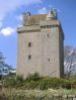
Scotstarvit Tower, which Sir John rebuilt, still stands, and the inscription, with his initials and those of his first wife, Anne Drummond, as the builders, and its date (1627) are carved on a stone over the door. The tower became a kind of college, where he attracted round him the learned Scotsmen of the time, and corresponded with the scholars of Holland, Caspar Barlæus, Isaac Gruterus, and others. In it his brother-in-law William Drummond composed his History of the Jameses and the macaronic comic poem Polemo-Middinia, which had its occasion in a dispute of long standing as to a right of way between the tenants of Scotstarvet and of Barns, the estate of Sir Alexander Cunningham, whose sister was Drummond's betrothed.
In 1620 he endowed the professorship of humanity or Latin in his old college, St. Leonard's, at the university of St. Andrews, in spite of the opposition of the regents of St. Salvator. At the same time he organised a substantial collective gift of classical texts to the library of St. Leonard's for the use of the Humanity regent. Fellow donors included Scott's brother-in-law, Drummond, and other distinguished men of the time.
Scott's intimacy with Joan Blaeu of Amsterdam led to the inclusion of a Scottish volume in the series of Delitiæ Poetarum then being issued by that enterprising publisher. The Scottish volume, edited by Arthur Johnston, and printed at the sole cost of Scott in two closely printed duodecimo volumes, has preserved the last fruits of Scottish latinity. A more important work was the publication of detailed maps of Scotland in the great atlas of Blaeu. Scot interested himself in the survey of Scotland begun in 1608 by Timothy Pont. Pont's drawings, after his death about 1614, were purchased by the crown. Scott caused them to be revised by Sir Robert Gordon of Straloch and his son, James Gordon, parson of Rothiemay, and then went in 1645 to Amsterdam to superintend their publication, dictating from memory the description of several districts.
The work was not issued till 1654, when it appeared as ‘Geographiæ Blaeuaniæ volumen quintum,’ with dedicatory epistles to Scot both by Blaeu and Gordon of Straloch. Other examples of Scott's public spirit were the establishment of the St. Andrews professorship of Latin and his endowment of a charity for apprenticing poor boys from Glasgow at the estate of Peskie near St. Andrews.
Family
Scot was three times married: first, to Anne, sister of William Drummond of Hawthornden, the poet, by whom he had two sons and seven daughters; secondly, to Margaret, daughter of Sir James Melville of Hallhill; and thirdly, to Margaret Monpenny of Pitmilly, widow of Rigg of Aitherny, by each of whom he had one son. The son by his second wife, George Scott (died 1685), is known as a writer on America.
Sir John's male descendants became extinct in the person of Major-general John Scot, M.P. for Fife, his great-great-grandson, who, at his death on 24 January 1776, was reputed the richest commoner in Scotland. The general's fortune passed chiefly to his eldest daughter, who married the Duke of Portland, but the estate of Scotstarvet was sold to Wemyss of Wemyss Hall.
Notes
http://www.scotsconnection.com/clan_crests/Scott.htm
http://www.oldandnewedinburgh.co.uk/volume6/page109.htm
The Staggering State of the Scots Statesmen, for one hundred years, viz. from 1550 to 1650. By Sir John Scot, of Scotstarvet, Director of the Chancery [and edited by Walter Goodal]. Edinburgh : W. Ruddiman, 1754, 12mo.
Republished as The Staggering State of Scottish Statesmen : from 1550 to 1650. By Sir John Scot, of Scotstarvet, with a Memoir of the Author and Historical Illustrations by the Rev. Charles Rogers, Historiographer to the Historical Society. Edinburgh : William Paterson, 1872 (printed in a limited edition of 100 copies). See also Transactions of the Royal Historical Society, 1, pp 389-414.
R V Pringle: "An early humanity class library: the gift of Sir John Scot and friends to St Leonard's College (1620)"
Attribution
This article incorporates text from a publication now in the public domain: "Scott, John (1585-1670)". Dictionary of National Biography. London: Smith, Elder & Co. 1885–1900.
Life
He was the only son of Robert Scot the younger of Knights-Spottie in Perthshire, representative in the male line of the Scots of Buccleuch. Robert Scot succeeded to the office of director of chancery on the resignation of his father, Robert Scot the elder of Knights-Spottie, but, falling into bad health, resigned the office in 1582 in favour of his father, its former holder.
Robert Scot the elder in 1592 again resigned the office to a kinsman, William Scot of Ardross, on condition that his grandson, John Scott (the subject of this article) should succeed to it on attaining majority, which he did in 1606. The Scottish chancery framed and issued crown charters, brieves, and other crown writs. The possession, loss, and efforts to regain this office played a large part in the career of Sir John.
He was educated at St. Leonard's College, St. Andrews, which he appears to have entered in 1600: he describes himself in the register of 1603 as in his third year. After leaving St. Andrews he went abroad to study, and on his return was called to the bar in 1606. In 1611 he acquired Tarvet and other lands in Fife, to which he gave the name of Scotstarvet, and six years later he was knighted and made a privy councillor by James VI, in whose honour he published a Latin poem, Hodœporicon in serenissimi et invictissimi Principis Jacobi Sexti ex Scotiâ suâ discessum.
In 1619 Scot had a license to go for a year to Flanders and elsewhere. He did not practise much, if at all, at the bar, but recommended himself to Charles I by a suggestion for increasing the revenue by altering the law of feudal tenure. He became in 1629 an extraordinary, and in 1632 an ordinary, lord of session under the title of Scotstarvet.
He was one of many Scottish lawyers and lairds who accepted the covenant, which he subscribed at his parish kirk of Ceres, Fife on 30 April 1638, and in the following November he declined to sign the king's confession. In 1640 he served on the committee of the estates for the defence of the country. In 1641 he was, with consent of the estates, reappointed judge by a new commission. During the war between England and Scotland he served on the war committee in 1648 and 1649. He bought the Mill of Kinghorn and Inchkeith Island for 20,000 merks in 1649.
Under the Commonwealth he lost the office both of judge and director of chancery. He made many appeals to be restored to the latter as an administrative, and not a judicial, office; but, although he obtained an opinion in his favour by the commissioners of the great seal, Oliver Cromwell gave it in 1652 to Jeffrey the quaker, who held it till the Restoration. Scott, through George Monck, again appealed to Cromwell for the reversion of the office if Jeffrey died. Cromwell fined him £1,500 in 1654 for his part in the war.
But his later correspondence with Cromwell did not improve his character with the royalists, and on the Restoration he was fined £500, and was not restored to the office of judge or that of director of chancery, which was conferred on Sir William Ker, who, he indignantly said, ‘danced him out of it, being a dextrous dancer.’ Sir James Balfour described Scott's public character in a few words: ‘He was a busy man in troubled times.’ But in spite of his misfortunes, Scot did not cease to be busy when peace came. He returned to Scotstarvet, where he engaged in literary work and correspondence. There he died in 1670.
Works and legacy
Scott is characterized by James Grant in Old and New Scotland as "eccentric and sarcastic". He consoled himself for his disappointment in losing office by composing "The Staggering State of Scottish Statesmen", not published until a hundred years after his death.
Scotstarvit Tower, which Sir John rebuilt, still stands, and the inscription, with his initials and those of his first wife, Anne Drummond, as the builders, and its date (1627) are carved on a stone over the door. The tower became a kind of college, where he attracted round him the learned Scotsmen of the time, and corresponded with the scholars of Holland, Caspar Barlæus, Isaac Gruterus, and others. In it his brother-in-law William Drummond composed his History of the Jameses and the macaronic comic poem Polemo-Middinia, which had its occasion in a dispute of long standing as to a right of way between the tenants of Scotstarvet and of Barns, the estate of Sir Alexander Cunningham, whose sister was Drummond's betrothed.
In 1620 he endowed the professorship of humanity or Latin in his old college, St. Leonard's, at the university of St. Andrews, in spite of the opposition of the regents of St. Salvator. At the same time he organised a substantial collective gift of classical texts to the library of St. Leonard's for the use of the Humanity regent. Fellow donors included Scott's brother-in-law, Drummond, and other distinguished men of the time.
Scott's intimacy with Joan Blaeu of Amsterdam led to the inclusion of a Scottish volume in the series of Delitiæ Poetarum then being issued by that enterprising publisher. The Scottish volume, edited by Arthur Johnston, and printed at the sole cost of Scott in two closely printed duodecimo volumes, has preserved the last fruits of Scottish latinity. A more important work was the publication of detailed maps of Scotland in the great atlas of Blaeu. Scot interested himself in the survey of Scotland begun in 1608 by Timothy Pont. Pont's drawings, after his death about 1614, were purchased by the crown. Scott caused them to be revised by Sir Robert Gordon of Straloch and his son, James Gordon, parson of Rothiemay, and then went in 1645 to Amsterdam to superintend their publication, dictating from memory the description of several districts.
The work was not issued till 1654, when it appeared as ‘Geographiæ Blaeuaniæ volumen quintum,’ with dedicatory epistles to Scot both by Blaeu and Gordon of Straloch. Other examples of Scott's public spirit were the establishment of the St. Andrews professorship of Latin and his endowment of a charity for apprenticing poor boys from Glasgow at the estate of Peskie near St. Andrews.
Family
Scot was three times married: first, to Anne, sister of William Drummond of Hawthornden, the poet, by whom he had two sons and seven daughters; secondly, to Margaret, daughter of Sir James Melville of Hallhill; and thirdly, to Margaret Monpenny of Pitmilly, widow of Rigg of Aitherny, by each of whom he had one son. The son by his second wife, George Scott (died 1685), is known as a writer on America.
Sir John's male descendants became extinct in the person of Major-general John Scot, M.P. for Fife, his great-great-grandson, who, at his death on 24 January 1776, was reputed the richest commoner in Scotland. The general's fortune passed chiefly to his eldest daughter, who married the Duke of Portland, but the estate of Scotstarvet was sold to Wemyss of Wemyss Hall.
Notes
http://www.scotsconnection.com/clan_crests/Scott.htm
http://www.oldandnewedinburgh.co.uk/volume6/page109.htm
The Staggering State of the Scots Statesmen, for one hundred years, viz. from 1550 to 1650. By Sir John Scot, of Scotstarvet, Director of the Chancery [and edited by Walter Goodal]. Edinburgh : W. Ruddiman, 1754, 12mo.
Republished as The Staggering State of Scottish Statesmen : from 1550 to 1650. By Sir John Scot, of Scotstarvet, with a Memoir of the Author and Historical Illustrations by the Rev. Charles Rogers, Historiographer to the Historical Society. Edinburgh : William Paterson, 1872 (printed in a limited edition of 100 copies). See also Transactions of the Royal Historical Society, 1, pp 389-414.
R V Pringle: "An early humanity class library: the gift of Sir John Scot and friends to St Leonard's College (1620)"
Attribution
This article incorporates text from a publication now in the public domain: "Scott, John (1585-1670)". Dictionary of National Biography. London: Smith, Elder & Co. 1885–1900.
Events
| Birth | 1585 | Scotstarvet, Scotland | |||
| Death | Jul 1670 | Scotland | |||
| Marriage | Anna Drummond | ||||
| Description |  | ||||
| Description | |
Families
| Spouse | Anna Drummond (1589 - 1637) |
| Child | Jean Scott (1606 - 1635) |
| Father | Robert Scott Jr (1569 - 1588) |
| Mother | Margaret Aitcheson ( - ) |
Notes
Description
Sir John Scot of Scotstarvit by Jeffrey C. StoneSir John Scot of Scotstarvit in Fife (1585-1670), 'statesman, scholar and patriot', was born into the nobility, a descendant of the House of Buccleuch, and held high office as Directory of Chancery, Lord of Session, and Privy Councillor. His eminence lends credence, if nothing else does, to the improbable assertion of Bishop Nicolson in 1702, that Timothy Pont surveyed Scotland with Scot's patronage.
The dust jacket of T.G. Snoddy's biography of Scot, published in 1968, suggests that Scot saved Pont's maps from oblivion, also with hindsight an unlikely interpretation of events. Nevertheless, Scot was extremely influential in the eventual publication of Pont's maps by Blaeu in 1654. He also contributed directly to the accompanying text which Blaeu would have considered an essential part of his atlas, although today we are often inclined to set the text aside, in the absence of an English- or Scots-language edition, and concern ourselves solely with the engraved maps.
Remarkable correspondence between the Blaeus and Scot, discovered in the National Library of Scotland in 1967, suggests that Scot only became aware of the Pont manuscripts between 1628 and 1631, when they had already been acquired by his fellow Fifer, Sir James Balfour of Denmilne. As a result of Scot's longstanding poetic association with the house of Blaeu, Pont's maps were passed to Amsterdam for engraving, although whether Scot was an intermediary, or whether Balfour passed them directly to Blaeu, is not evident from the correspondence. However, in the introductory matter to the atlas, Blaeu states that it was Scot who gathered up Pont's papers and sent them to him.
Ironically, that led eventually to the loss of many of the best of Pont's original drafts, since not all of those maps which were copied in the first and main phase of engraving were returned to Scotland. However, Scot's action ensured that much of Pont's detailed work on the ground was permanently on record, in printed form.
Scot deserves great credit for advancing the whole atlas project, by the way in which he involved Parliament, the General Assembly and King Charles I. It was on the prompting of Scot that the King wrote to Robert Gordon of Straloch, drawing him and his son into the process of filling the gaps in Blaeu's coverage of Scotland by preparing some new drafts from some of Pont's rougher work. It was Scot who sought to use the powers of the General Assembly to elicit descriptions of parishes across Scotland, which were intended to provide the raw material of Blaeu's accompanying texts. He was, of course, not entirely successful in that respect.
Above all, it was Scot who travelled to Amsterdam, with the formal approval of Parliament, to complete the drafting of text for the atlas. In his introductory address to the reader, Blaeu enthuses over Sir John's diligence and abilities, saying that he described the shapes of the regions, situation, boundaries, lords - both former and those of modern times - the prosperity of the soil, towns, rivers and all the many other features of this kind. Blaeu could not have praised Sir John more highly, it seems, describing him as a complete Scotland in himself.
Despite the significance of Scot's final and direct contribution to the publication, his was not the only input to the narrative in the atlas. The text has understandably received relatively little attention, compared to the maps in the atlas. It is probably an amalgam of the writings of Pont himself, Robert Gordon, James Gordon, some Presbyteries and earlier writers. Much work remains to be done, to establish the extent of Scot's contribution to the narrative, but his involvement in the project spanned some twenty years. In Blaeu's stated estimation, he should be engraved in the annals of the Scots!
Description
He was the celebrated Sir John Scott of Scotstarvet, and, on coming of age, he obtained the office of director of the chancery. (Douglas’ Baronage, p. 222.) Among other charters he had one of the lands and barony of Tarvet, Fifeshire, dated 28th November 1611. These lands he called Scotstarvet. He was knighted by King James VI., in 1617, and appointed of his privy council. Sir James Balfour styles him “a busy man in foul weather.” In Brunton and Haig’s Senators of the College of Justice, (p. 280), there is a somewhat elaborate life of him. We learn from it that he was admitted an extraordinary lord of session 14th January 1629, when he took the judicial title of Lord Scotstarvet. He was displaced in November 1630, and appointed an ordinary lord 28th July 1632.He was one of the four judges of the court who, in 1639, refused to take the king’s covenant when tendered by the royal commissioner, in respect that he did not conceive the innovations which had been introduced into the church since 1580, could subsist with the covenants then subscribed, of which it was a copy, and that it belonged to the General Assembly to clear doubts of this nature. (Balfour’s Annals, vol. ii. p. 147.) IN 1640, he was appointed one of the committee of estates established for the defence of the country. In November 1641, he was reappointed by the king, with consent of the estates, a judge ad vitam aut culpam.
On 1st February 1645, he was named one of the commissioners of the exchequer, and in 1648 and 1649, a member of the committee of war. During the commonwealth he lived retired, and in 1654 he was fined by Cromwell £1,500 sterling. At the Restoration, notwithstanding his well-known loyalty, his office of director of the chancery was taken from him and bestowed on another, and by Charles II. he was fined £6,000 Scots. He died in 1570, in his 84th year.
According to Nisbet (Heraldry, vol. ii. p. 293), he was “a bountiful patron of men of learning, who came to him from all quarters, so that his house became a kind of college.” Among others, he encouraged Timothy Pont, in his survey of Scotland, and prevailed upon Sir Robert Gordon of Straloch to prepare the maps which he left, for publication. They compose the ‘Theatrum Scotiae,’ published by John Bleau in the sixth volume of his celebrated Atlas, which appeared in 1662, dedicated to Sir John Scott of Scotstarvet. Being anxious that the maps of the different counties should be accompanied by correct topographical descriptions, Sir John petitioned the General Assembly that these might be furnished by some of the ministers of every parish, in the way that a century and a half later was done for the New Statistical Account of Scotland; but although his request was acceded to, very few complied with the order. In consequence, most of the descriptions were supplied by himself and his friends.
So anxious was he as to the publication of this great work that he made a second visit to Holland for the purpose of superintending it, and, according to Bleau, spent whole days in his house in Amsterdam, writing the description of the counties from memory. (Senators of College of Justice, p. 282.) In the old tower of Scotstarvet, parish of Ceres, he wrote his curious work alliteratively entitled ‘The Staggering State of Scots Statesmen, by Sir John Scott of Scotstarvet,’ published by Ruddiman in 1754.
He took a great interest in the work entitled ‘Dalitiae Poetarum Scotorum,’ edited by Arthur Johnston, and to superintend the printing of it, we are told, that he took a voyage to Holland, and disbursed “a hundred double pieces.” Some of his pieces of another kind appear among the contents, but, as has been remarked, they are not quite deserving of the high compliment paid to him on their account, that he shines among the other poets whose works are contained there as a moon among stars.
Sir John Scott of Scotstarvet, among other benefits conferred on learning, founded a professorship for teaching the Latin language in St. Leonard’s college, St. Andrews, and gave a mortification to the smiths of Glasgow, for which his descendants had the presenting of apprentices. (Sibbald’s History of Fife, ed. 1803, p. 344.) He was three times married; first, to Anne, daughter of Sir John Drummond of Hawthornden, by whom he had two sons and seven daughters; secondly, to Margaret, daughter of James Melville of Hallhill, by whom he had one son, George Scott of Pitlochie; and, thirdly, to Margaret, daughter of Monypenny of Pitmilly, relict of Rigg of Aitherney, by whom he had a son, Walter Scott of Edenshead.